
• Skip to main content
  • Skip to secondary menu
  • Skip to primary sidebar
  • Skip to footer
Irish America

Irish America

Irish America

  • HOME
  • WHO WE ARE
    • ABOUT US
    • IRISH AMERICA TEAM
  • IN THIS ISSUE
  • HALL OF FAME
  • THE LISTS
    • BUSINESS 100
    • HALL OF FAME
    • HEALTH AND LIFE SCIENCES 50
    • Wall Street 50 – 2026 Gala
  • LIBRARY
  • TRAVEL
  • EVENTS

Issues

A Strike Against The Empire

By Jason Kelly, Contributor
February / March 2016

February 11, 2016 by Leave a Comment

Notre Dame’s Keough-Naughton Institute has produced a documentary on the Easter Rising that promises to stir a global debate on the historic event that led to Ireland’s independence. Historian Thomas Bartlett remembers how Ireland commemorated the Easter Rising’s 50th anniversary, in a full-throated, pro-rebel fashion in 1966: “Not so much commemorated, as celebrated,” he … [Read more...] about A Strike Against The Empire

Profiles in Courage: The Executed Leaders

By Irish America Staff
February / March 2016

February 11, 2016 by 1 Comment

The 16 men who were executed in the aftermath of the Easter Rising included the seven leaders who sealed their fate by signing the Proclamation (Forógra na Poblachta). It was read by Pádraig Pearse outside Dublin’s General Post Office, on April 24, 1916. The names of the seven as they appear on the Proclamation are: Thomas J. Clarke (who was invited to be the first signatory … [Read more...] about Profiles in Courage: The Executed Leaders

Printing the Proclamation

By Adam Farley, Deputy Editor
February / March 2016

February 11, 2016 by 2 Comments

The 1916 Proclamation of the Irish Republic has been called the most important document in Irish history, establishing the idea of equal rights across gender, fair labor practices, and conferring the right of self-governance from the provisional government to the people. It was based in part on a similar proclamation of independence issued by Robert Emmet during the 1803 … [Read more...] about Printing the Proclamation

Sir Roger Casement:
Irish Nationalist & Humanitarian

By Rosemary Rogers, Contributor
February 11, 2016 by 1 Comment

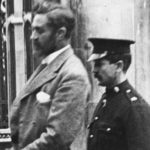
Sir Roger Casement under arrest. He was sentenced to be hanged on June 29, 1916. (Photo. Getty images).

Hanged by the British in 1916, he was deemed first among traitors to the  Empire for his role in the Easter Rising of 1916.  Today he is honored as the “Father of Human Rights Activism.” I saw that Roger CasementDid what he had to do.He died upon the gallowsBut that is nothing … [Read more...] about Sir Roger Casement:
Irish Nationalist & Humanitarian

Roger Casement: The Last Martyr

By Rosemary Rogers, Contributor

February 11, 2016 by 2 Comments

Sir Roger Casement under arrest. He was sentenced to be hanged on June 29, 1916. (Photo. Getty images).

Hanged by the British in 1916 for working with Germany and Irish nationalists in planning the Easter Rising of 1916, Sir Roger Casement is remembered as the “father of twentieth-century human rights investigations.” Standing in the gallows of Britain’s Pentonville Prison, Casement was asked by the governor if he had any final words. He did, but only one: “Ireland.” The … [Read more...] about Roger Casement: The Last Martyr

« Previous Page
Next Page »

Primary Sidebar

Featured Video

Featured Podcast

News from the Irish Post

  • Dónal Lunny: the man who changed the sound of Ireland

    DÓNAL LUNNY, a colossus of Irish music, has died at the age of 79. One of the most influential fi...

  • Brian O'Driscoll to receive Irish Post award

    Brian O’Driscoll will receive the Outstanding Contribution to Sport Award at November’s Irish Pos...

  • GAA superfan set for London launch of new book

    ROSCOMMON GAA superfan Paddy Joe Burke will launch his autobiography at the Roscommon Association...

  • Irish Rambling House brings music and laughter back to Britain

    THE IRISH Rambling House Show returns to Britain at the end of October, bringing a mix of traditi...

October 24, 1945

The United Nations was born in Washington, D.C. on this day in 1945. During a short ceremony, representatives from a total of 29 nations ratified the UN charter which declared that nations work together to uphold human rights and work together to overcome social, economic, humanitarian and political challenges. Formed in the wake of World War II, Ireland was at first denied access to the UN on the grounds that the country took a neutral stance during the war and did not aid the Allied forces. Ireland was accepted into the UN ten years later, in 1955. Although Ireland did not join NATO, they became an active nation, contributing Irish Defence Forces to UN peace-keeping missions in Congo, Cyprus, Lebanon and Bosnia and Herzegovina.

Footer

Follow Us

  • Facebook
  • Instagram
  • LinkedIn
  • Twitter
  • YouTube

Subscribe

  • Subscribe
  • Give a Gift
  • Newsletter

Additional

  • Advertise
  • Contact
  • Terms of Use & Privacy Policy

Copyright © 2026 · IrishAmerica Child Theme on Genesis Framework · WordPress · Log in