
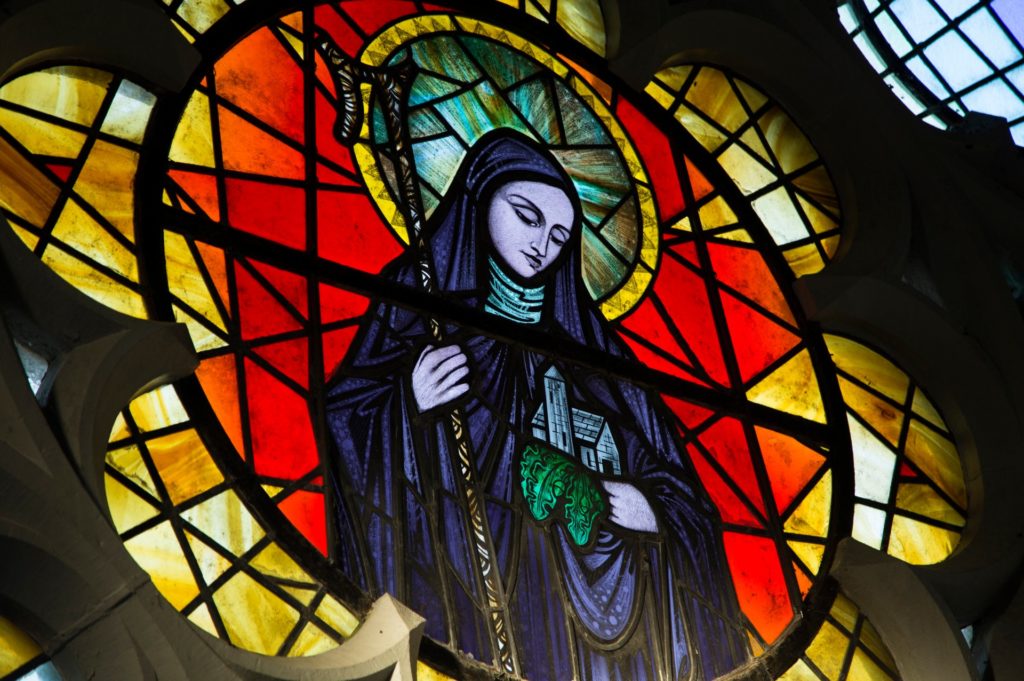
For over a thousand years, February 1 has been celebrated as St. Brigid’s Day. Legend holds it was then that the saint placed her foot in a spring outside the village of Liscannor by the Cliffs of Moher in County Clare. Waters warmed; weather improved. Cows filled with milk; butter production expanded. To this day, pilgrims gather at Liscannor’s well on Brigid’s feast to beseech the saint’s blessing.
But February 1 was a celebrated day long before the pious woman founded her abbey at Kildare. The historical Brigid lived from about 453 A.D. to 523. Christianity was still new to Ireland then, and like many other women of the time, Brigid was named in honor of Brid, the most revered Celtic goddess.
According to myth, Brid was born full-grown at sunrise in a house ablaze with light. A fiery column reached from her flame-red curls into the heavens. Besides the cottage flowed a stream whose waters had the power to cure. On its banks grew healing plants. In the pasture a red-eared cow whose sweet milk never ran dry.
Brid, the goddess of fire, was a patroness of hearth and home, smiths and forges, healers and herbs, poets and language. Blessed was the place where a fire burned in her honor.
For centuries before Christianity arrived, Druid priests lit fires in Brid’s name on the Celtic feast of Imbolc (February 1), beseeching the goddess for an early spring. Druids revered the oak, because, of all trees in the forest, it alone could survive a lightning strike. Priestesses tended a perpetual flame dedicated to Brid in an oak grove on a hill in Leinster (now known as Kildare or “Place of the Oak”). On that very hill Saint Brigid later built her abbey.
The saint’s life is shrouded in mystery and legend, but by all accounts, she was sired by a Celtic chieftain to a slavegirl and foster raised by a Druid priest. She was beautiful, gifted, and so strong-willed that when the Druid attempted to marry her off, she refused, choosing instead baptism by Saint Patrick and a life dedicated to charity.
Saint Brigid was a warm-hearted, hospitable, and one of history’s liberated women. She traveled widely, entertained with charm and grace, and, like modern successful women, was an excellent business manager who could outwit even the cagiest chieftain. She was also quite accomplished in the miracle department.
A favorite Kildare story concerns the founding of her abbey. It seems Brigid had acquired such a reputation for good works that the local king was obligated to reward her. To prove his magnanimity, he offered Brigid as much land as her mantle could cover. With a knowing smile, the good woman spread her cloak on the ground. Much to the chieftain’s dismay, the garment grew until it covered the entire hill!
The abbey became a way station for other weary travelers, and its abbess known for being as caring of starving dogs as hungry beggars, miraculously able to feed multitudes with very little. Like her mentor, Patrick, she was fond of ale and is reputed to have been the best brewer in the land. She also kept the best dairy where her cows gave more and better milk than any other herd.
The monastery has been added to many times during the intervening fifteen hundred years. In the 11th century a Norman round tower was built. Made of unmortared stone, the 108-foot tower is the tallest of its kind in Ireland and still stands in silent vigil over the plain of Curragh. To one side of a graveyard filled with Celtic crosses lie the ruins of the Druid fire temple.
Six hundred years ago, a cathedral was built over the crumbling monastery, but during the 16th century, its walls were blown out by invading English artillery fire. For two hundred years, Saint Brigid’s lay crumbling and neglected.
Between 1860 and 1895, a massive restoration project expanded the ancient structure. At that time, stained glass windows were installed. Remarkably, each portrayal of Brigid bears Druid symbols: oak trees and the goddess Brid’s sacred fire.
Today, the customs of Saint Brigid’s feast interweave with the rituals from pre-Christian times. A “Brigid’s Cross” made from new straw is hung above the door, the old one is burned in the hearth. Once, the cross symbolized hope for a successful harvest. Today, it invokes the saint’s blessing.
Whether the evening meal be fish, beef, or fowl, it is always accompanied with Boxty Cakes, plenty of fresh butter and tall glasses of creamy buttermilk.
In very traditional Irish homes, two devout practices are still observed. A strip of cloth called “brat Bhride” (Brigid’s mantle) is hung outside the door. A loaf of oat bread baked in the shape of a cross and a sheaf of straw are left on the windowsill. For on that one night, Brigid travels through the land with her red-eared cow, bestowing blessings on those who remember the old ways. Sláinte!
Boxty Cakes
- 1/2 pound hot cooked potatoes
- 1/2 pound grated raw potatoes
- 2 cups flour
- 1 teaspoon baking soda
- 1- 1 1/2 cups buttermilk
- Salt and pepper
- Butter for frying
Drain, peel, and mash hot potatoes. Stir in grated raw potatoes, flour, and baking soda. Add salt and pepper to taste. Mix well with enough buttermilk to make a stiff batter. Shape into 3″ patties about 1/4″ thick and fry on a grased griddle until crispy and golden on both sides. Makes 12 cakes.
Apple Flan with Bailey’s Cream Liqueur
- 1cup plain flour, pinch salt
- 5 tablespoons butter
- 2 egg yolks or one whole egg, beaten
- 3 ounces sugar
- 2 teaspoons cinnamon
- 3-4 firm apples, peeled
- generous amount of Bailey’s Irish Cream Liqueur
- 1-2 tablespoons brown sugar
Preheat oven to 400 degrees. Combine flour, salt, butter, egg yolks, cinnamon and sugar to make pastry crust. Roll out and line an X flan or spring form pan. Slice apples and arrange, overlapping, on pastry. Pour in Bailey’s Cream generously. Sprinkle with brown sugar. Cook in preheated oven for 25-30 minutes. Sugar will caramelise on the apples. Serve warm with whipped cream. Serves 5-6 people.
Recipe from Ireland Grand Places, Glorious Food Cookbook by Margaret M. Johnson.
Editor’s Note: This article was originally published in the May/June 1995 issue of Irish America. ♦
Oaten Bread
- 1cup flour
- 1 tablespoon sugar
- 3/5 teaspoon baking powder
- 1/4 teaspoon baking soda
- 1/4 teaspoon salt
- 3 tablespoons butter, cut into small pieces
- 3/4 cup uncooked oatmeal flakes
- 1 egg
- 1/2 cup buttermilk
Preheat oven to 425°F. Lightly grease a baking sheet. Combine flour, sugar, baking powder, baking soda, and salt in a large bowl. Mix thoroughly. Add butter bits and cut in with a knife until the mixture is crumbly. Add oats and toss to combine.
In a separate bowl, beat egg with buttermilk. Make a well in the dry ingredients, pour in egg mixture and mix with a fork until the crumbs hold together. Gather the dough into a ball and transfer to a floured surface. Knead 20-25 times, sifting on flour if necessary to prevent sticking. Pat dough into an 8-inch round and transfer to the baking sheet. Score a deep cross into the top with a floured knife, but do not cut all the way through. Bake approximately 15-20 minutes or until golden brown. Serve with butter, jam, and tall glasses of buttermilk. Makes one bread.
Editor’s Note: This article was originally published in the January/February 1994 issue of Irish America. ♦
Leave a Reply