To do successful family history research you must know where to look. Knowing the sources and what they can tell you is vital to success. This column in the coming issues will describe the major sources of information and provide advice on how to access them.
Irish church records are probably the best place to start, are among the earliest, and are undoubtedly the most comprehensive sources of personal information available to family researchers. They are often the only evidence of the existence of a large proportion of the population of late 18th and early 19th-century Ireland. A huge proportion of small farmers, laborers, servants and many others left no record of their existence except that of their church.
If you know where in Ireland your ancestors lived, church records are an obvious first source.
If you do not know where your ancestors came from, we will describe in future issues some of the ways in which you can find out.
Records of baptism, marriage and burial exist for many Irish religious groups, but those of most interest are those of the Catholic, Church of Ireland and Presbyterian churches. These together made up 99 percent of the population of the mid-19th century.
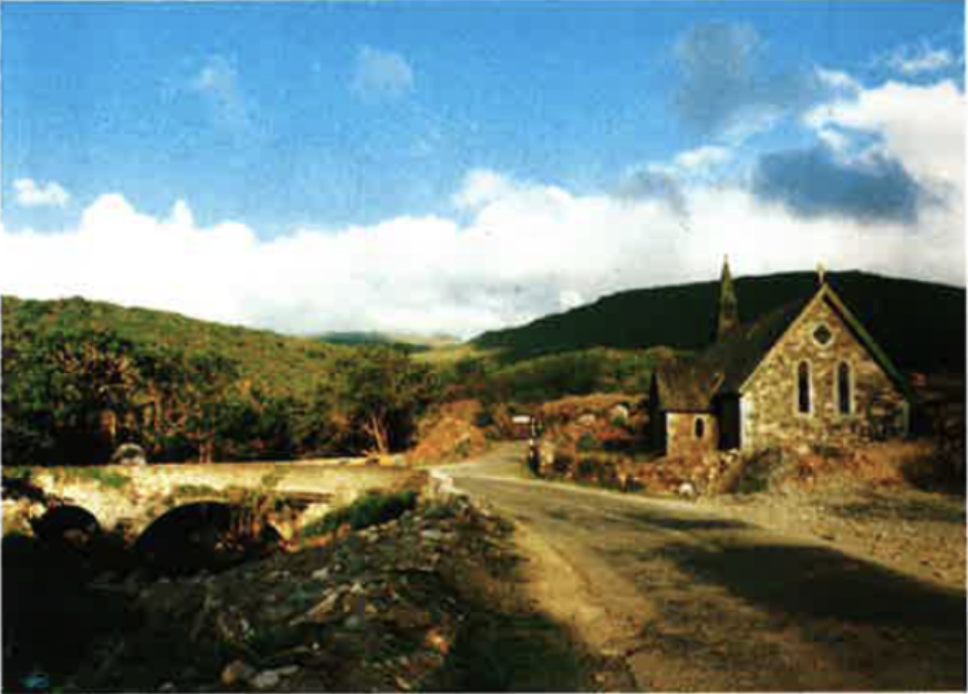
The Catholic church was the largest, containing about 78 percent of the population. Unfortunately, Catholic records are sparse until the early 1800’s. They are written in either English or Latin, and are detailed or brief, well-written or illegible according to the whim of the priests compiling them. They are accessible as original records, microfilm copies, and (for some counties and years) indices of the records.The original registers are almost all held in their original parishes. They can be examined there by permission of the priest.
However, since they are microfilmed and, in many cases, indexed, some priests prefer that researchers consult these sources rather than seek access to the originals. For this reason, written requests to a parish priest for a search of their records will often remain unanswered.
Microfilm copies of almost all Catholic records are available in the National Library of Ireland in Dublin. Although some bishops have placed restrictions on access to these microfilms, in most cases permission may be obtained by writing to the bishop. Those planning to visit Ireland for research should make these arrangements in advance. Addresses of the relevant bishops can be obtained from the National Library, Kildare Street, Dublin 2. The library can also supply a list of researchers who will search these records for you. The Genealogical Library of the Church of Jesus Christ of Latter-Day Saints (the LDS Library), based in Salt Lake City, Utah, also has copies of many of these microfilms. This collection is available for research at all LDS Libraries.
Catholic Parish Records are also being indexed as part of the Irish Genealogical Project, which offers a genealogical research service for completed indexes. Some counties, e.g. Armagh, Sligo and Clare, have completed this indexing, while others have not even begun. For further information contact the Irish Genealogical Project, 1 Clarinda Park North, Dun Laoghaire, Co. Dublin.
Although records of the Church of Ireland were compiled for virtually every parish, approximately a third of these registers were destroyed in the Public Record Office fire of 1921. Today many of the surviving records are still in local custody. However, many are also in the Representative Church Body Library, Braemor Park, Rathgar, Dublin 14; in the National Archives, Bishop Street, Dublin 2, and (for the Northern counties) in the Public Record Office of Northern Ireland.
The Presbyterian Church was strongest in the Northern counties and thus the major sources of their records are the Public Record Office of Northern Ireland, and the Presbyterian Historical Society, Fisherwick Place, Belfast BT9 6NY. The earliest record dates back to 1674, but this is an anomaly and most do not begin until the 1800’s.
Apart from the above, records of the Huguenot, Baptist, Jewish, Quaker and Methodist churches are also available. A comprehensive account of the records of all of these churches, and their value in family research, is provided in Irish Church Records which is available from Flyleaf Press, 4 Spencer Villas, Glenageary, Co. Dublin, Ireland at $46, inc. airmail.
In conclusion, the records of the Irish churches are a major resource. However, like the families whose lives they record, they have been subjected to the forces of Irish history. Consequently they are not as plentiful as researchers might hope, nor are the surviving records as detailed as might be desirable. Nevertheless, they are used in virtually every family history research project, and anyone planning family research should know how to use them.
Editor’s Note: This article was originally published in the November/December 1994 issue of Irish America. ♦
Leave a Reply