
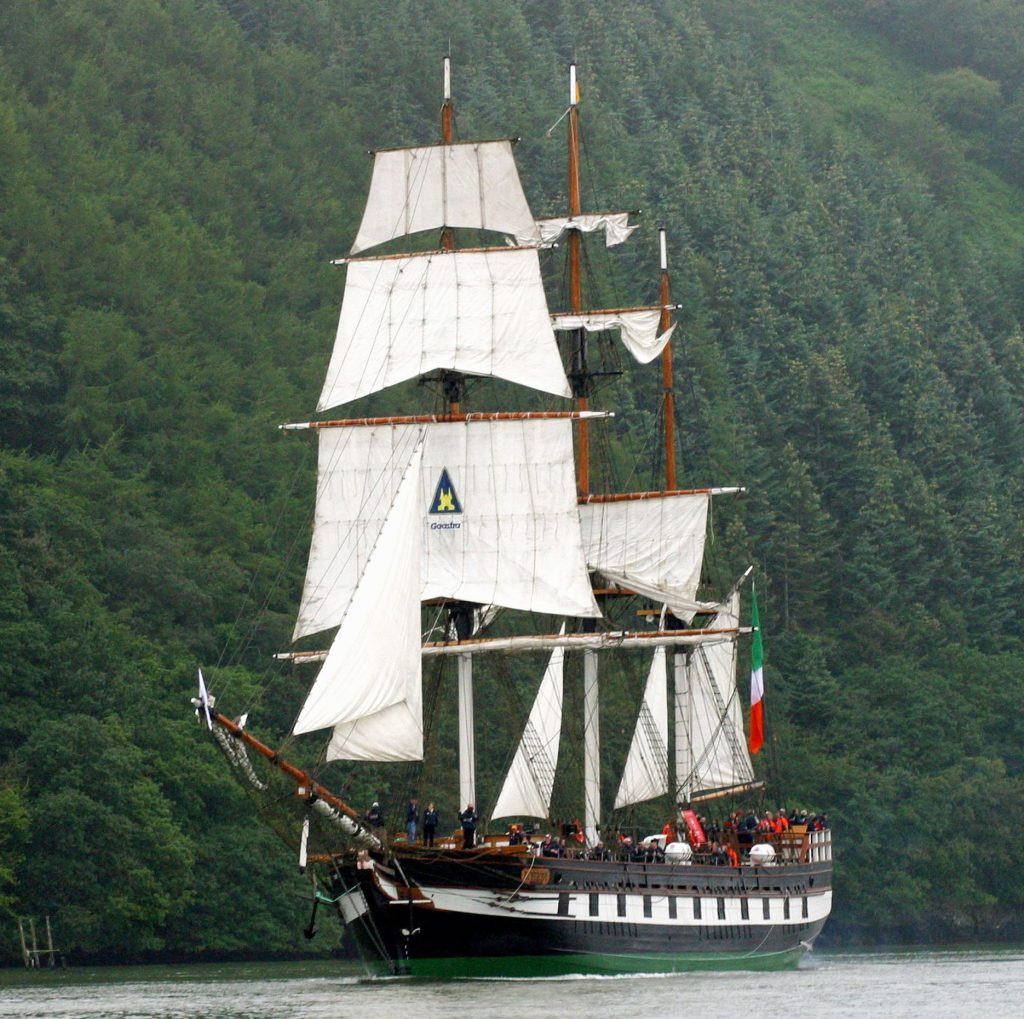
The story of how JFK’s roots helped to revive an Irish town, and how the Dunbrody Famine Ship and Irish Emigrant Experience became the home of the Irish America Hall of Fame.
In the late 1980s, New Ross was an unemployment blackspot. Its salvation came from a volunteer group of local business people who banded together to revive their struggling town. As the ancestral home of President John F. Kennedy, New Ross held a powerful legacy – one that the volunteer group hoped could be harnessed to spark economic renewal. Their efforts led to the creation of the John F. Kennedy Trust, established to commemorate the Kennedy story and to develop projects that would strengthen the town’s future.
The plan was simple and ambitious: build a tourist attraction that would celebrate the maritime heritage of the port and highlight the positive achievements of Irish emigrants, exemplified by JFK himself.
Sean Reidy was appointed project manager, and his proposal – a full-scale reconstruction of the type of ship JFK’s great-grandfather would have sailed on during the Famine – received immediate support from the Trust.
When he accepted the role, Chairman Paddy Quinn informed Reidy that he would first need to raise the funds to cover his own salary.
Undaunted, Reidy set out with confidence, convinced that a replica emigrant ship on the quayside would make a dramatic visual statement and attract tourism to New Ross. Paddy and others saw the potential. Funding followed from Fáilte Ireland and Wexford County Council.
Implementing the idea was another matter. But luck was on Reidy’s side. A marine artist named Gary Fallon came forward with information about a ship called the Dunbrody.
And David McBride, who had worked for the Graves Company, contributed boxes of the ship’s artifacts, including passenger lists, letters from the ship’s captain, and most importantly, the original bill of sale, which included the precise dimensions of the vessel. Thus, naval architect Colin Mudie was able to build a replica.
On February 11th, 2001, the Dunbrody – New Ross’s own modern-day ark – was launched.
The ship, an exact model of the sailing ship that had ferried many thousands from New Ross to North America, quickly became one of Ireland’s top visitor attractions. On board, actors portrayed emigrants fleeing the Famine, bringing history vividly to life. Over the past 25 years, nearly two million visitors have crossed its gangway.
And the ship became a catalyst – proof that “build it and they will come” was no longer a dream but a reality. With more than 60,000 visitors arriving annually, momentum surged. The Town Council commissioned a statue of JFK. Plans emerged for a new visitor center, the Irish Emigration History Centre, and a boardwalk to transform the waterfront. A new visitor center for the Kennedy Homestead in Dunganstown was also under consideration.
In 2007, a young politician named Seán Connick became the first – and still the only – New Ross native elected to Dáil Éireann. It was timely and fortuitous for New Ross. Every major project underway required government support, and Seán became an invaluable champion.
Sean Reidy became a frequent visitor to Connick’s office in Leinster House, where they lobbied together for funding and approvals. Even during Ireland’s EU bailout and the austerity years, money continued to flow to New Ross thanks to their efforts.
The JFK statue was unveiled in 2008 by Jean Kennedy Smith, with the Minister for Finance, Brian Lenihan, representing the Government. Brian and Seán Connick had become close friends.
Jean, Brian, and the two Seans, Reidy and Connick – along with Kennedy cousin Patrick Grennan – gathered at the Kennedy Homestead after the ceremony. Jean made the case directly to the Minister for Finance: the Homestead needed a new visitor center worthy of its national and historic significance. Brian promised to help. It is difficult to say no to a Kennedy.
Meanwhile, Fáilte Ireland committed funding for the new waterfront development linking the Dunbrody to the JFK statue. Seán Connick ensured every pledge stayed firmly on track.
In 2011, the Irish Emigration Visitor Centre opened beside the Dunbrody and, in partnership with Irish America magazine, became the home of the Irish America Hall of Fame. Minister for Tourism (and later Taoiseach) Leo Varadkar and Hall of Fame honoree Michael Flatley officiated. Fellow Hall of Fame recipient Donald Keough (former head of Coca-Cola), whose ancestor, Michael Keough, had made the journey to America on the original ship, made a significant donation.
“Our association with the Dunbrody has long been a source of pride,” publisher Niall O’Dowd confirmed. “To honor emigrants and their descendants on the very quayside from which JFK’s great-grandfather Patrick Kennedy departed for America feels profoundly fitting.”
The magazine’s editor and co-founder, Patricia Harty, added. “What a journey – from Famine emigrant to President of the United States in just three generations.”
As the 50th anniversary of President Kennedy’s visit approached in 2013, New Ross prepared to take center stage. Seán Connick had now stepped away from national politics and into the role of Chairman of the JFK Trust. Sean Reidy was appointed liaison to the Kennedy family for the celebrations. These commemorations also provided a vital deadline for completing both the new Kennedy Homestead/Dunganstown visitor center and the New Ross boardwalk, a fully accessible trail alongside the marina,
And everything came together.
Thirty-five members of the Kennedy family traveled to New Ross for JFK50. Caroline Kennedy officially opened the new visitor center at the Kennedy Homestead. And then came the major public event on the quayside.
An estimated 15,000 people attended as the new boardwalk – linking the Dunbrody with the JFK statue – was unveiled. The project, led by visionary Wexford County Council Director Eamonn Hore, included two special features: a bronze podium marking the place where JFK had spoken in 1963 and its crowning feature: the Emigrant Flame.
Lit from the eternal flame at President Kennedy’s grave in Arlington, the flame traveled under Irish Army and Naval Service escort to New Ross. The naval vessel LÉ Orla sailed upriver on the evening tide and docked beside the harbor office, where Jean Kennedy Smith disembarked carrying the flame. She passed it to Special Olympics athletes who took it to the Dunbrody. There, Taoiseach Enda Kenny, Caroline Kennedy, and Jean Kennedy Smith lit the eternal Emigrant Flame together, dedicated to the Irish diaspora worldwide.
“We are bringing John Kennedy home,” said Michael Flatley as he narrated the moment. Judy Collins, who sang at a 1963 B’nai B’rith broadcast honoring President Kennedy, gave a stunning performance of “Amazing Grace,” solidifying her connection to the Kennedy family and the era. The Irish Air Corps followed with a flyover that surprised and delighted the crowd.
“Looking back, if someone had told us in 1991 that New Ross would one day have a replica Famine ship, an emigration history center, the Irish America Hall of Fame, a transformed quayside, a statue of JFK, a new Kennedy Homestead visitor centre, and the Emigrant Flame, we would scarcely have believed it,” said Séan Connick.
“Paddy Quinn probably would have,” said Sean Reidy, relaying how the late Quinn was nothing but encouraging.
“Ever the optimist, he once rang me during the Dunbrody’s construction to announce he’d bought the Five Counties Hotel. ‘We’re going to need a great hotel for the thousands of people who are going to come to see the Dunbrody,’ he said. He was right. Rebranded as the Brandon House Hotel and Spa, expanded by forty rooms, and overlooking the town, the hotel has become another cornerstone of New Ross tourism.
Sean Reidy stepped down as CEO of the Dunbrody in 2014, passing the baton to Seán Connick. Under his leadership, the Dunbrody continues to flourish.
In 2023, the last relic of the industrial era – the old oil tanks beside the ship – were removed and replaced with a new public space, the Emigrant Park. Today, the New Ross waterfront is one of the most impressive public amenities in Ireland. And in 2023, Sean also received funding to revamp and upgrade the exhibition.
Plans are already underway for a €1.5 million expansion of The Dunbrody Visitor Centre, along with a redesign of the Irish America Hall of Fame, which many of the inductees and their families have visited over the years, including General Martin Dempsey, Duke University’s Director of Athletics, Kevin White, Northwell CEO Michael Dowling, and Cherish the Ladies front woman, Joanie Madden.
On February 11th, 2026, New Ross will celebrate the 25th anniversary of the Dunbrody’s launch.
The Dunbrody and the Irish America Hall of Fame stand as tributes to those who left Ireland in hope and hardship, and to the generations who built remarkable lives abroad. Their achievements – and those of exemplars like John F. Kennedy, Donald Keough, and Michael Flatley – continue to inspire young people today to believe that anything is possible. As President Kennedy once said:
“Some men see things as they are and say Why? I dream things that never were and say Why not?
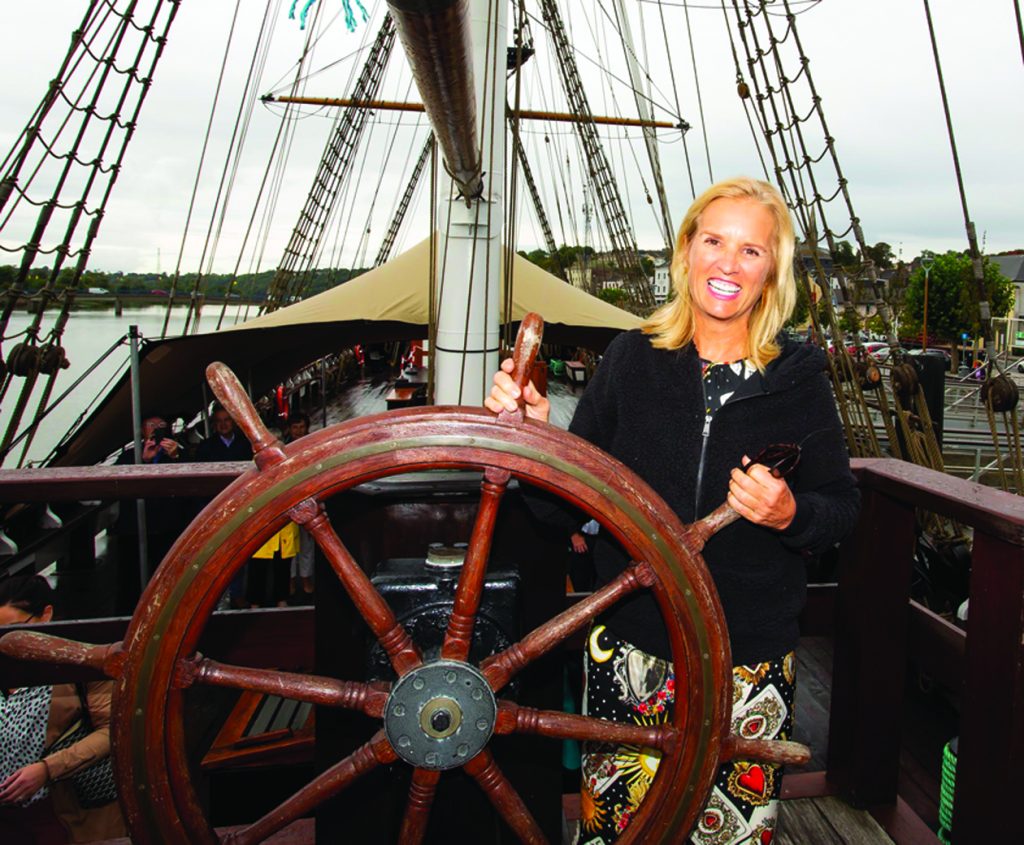
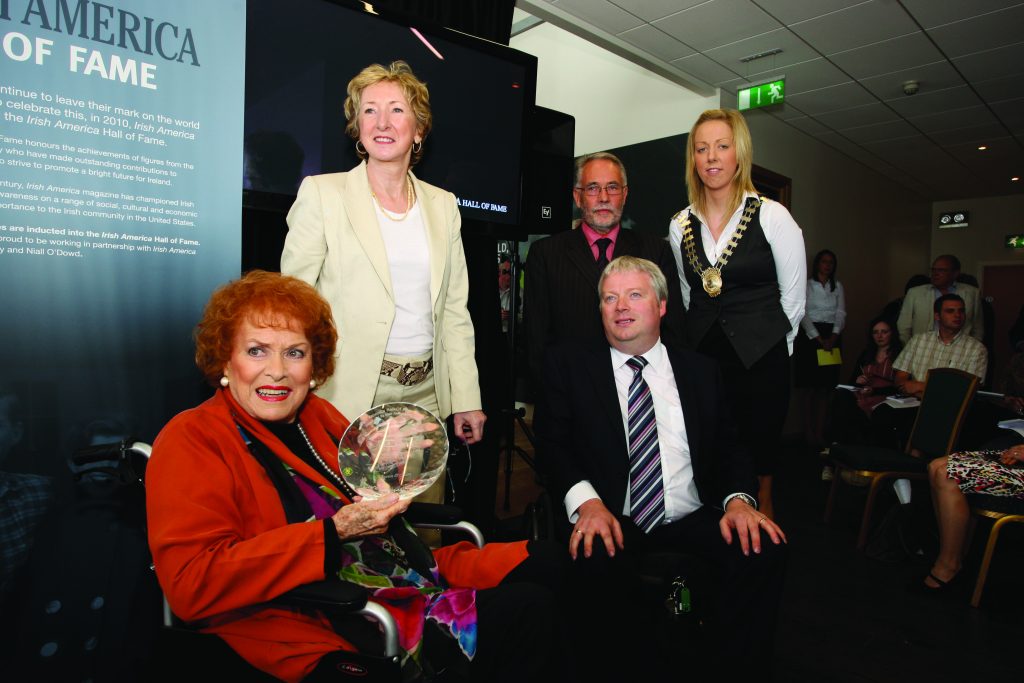
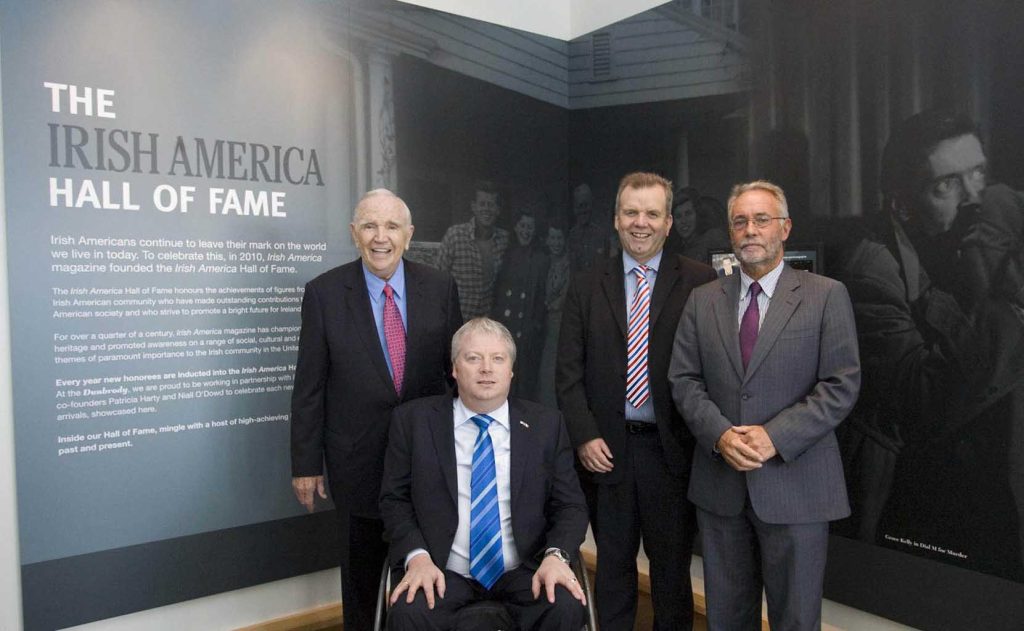


- Top Left: Kerry Kennedy celebrates the JFK50 on the Dunbrody. Top Center: Maureen O’Hara is inducted into the Irish America Hall of Fame by Patricia Harty. Top Right: Donald Keough, Séan Connick, Niall O’Dowd, and Sean Reidy at the Irish America Hall of Fame. Bottom Left: The Irish America Hall of Fame was officially opened on July 8, 2011 at the Dunbrody Famine Ship and Irish Emigrant Experience by Michael Flatley. Bottom Center: Hall of Famer, Kevin White, Duke’s athletic director. Bottom Right: Judy Collins sings at the JKF50 celebration.
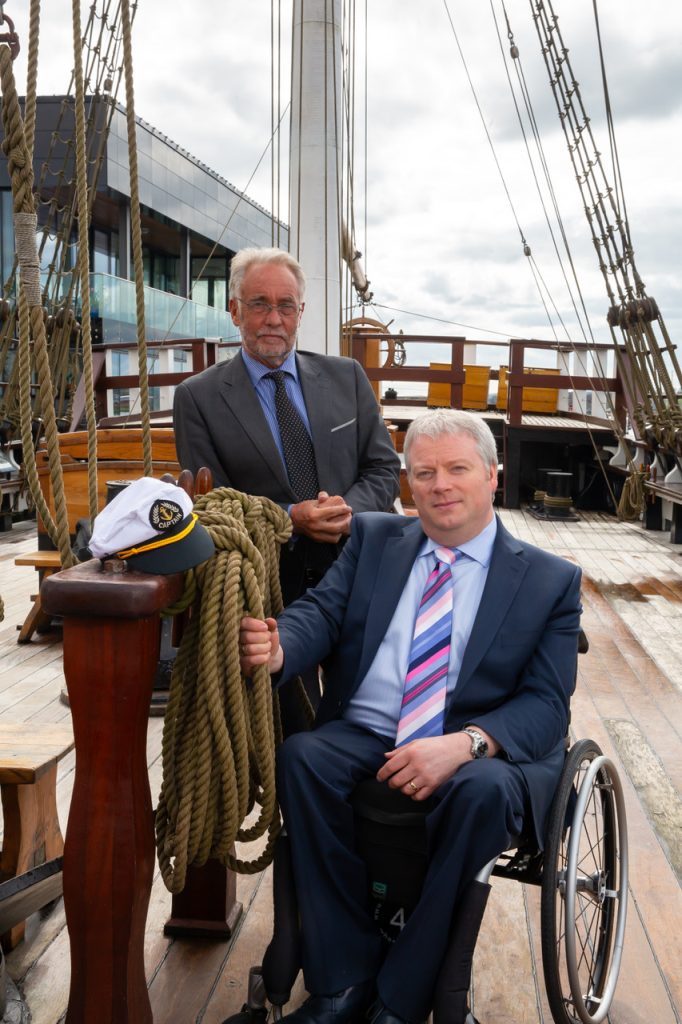


Left: Sean Reidy and Séan Connick on board the Dunbrody. Center: Actress Fionnula Flanagan and her husband Garret, with actors aboard the Dunbrody. Right: The Emigrant Flame memorializes JFK on the quay in New Ross.
A Voyage of Rediscovery
On a blustery July day, I descend the narrow ladder into the depths of the Dunbrody, an exact replica of a three-masted sailing ship that ferried thousands of Irish people across the Atlantic to New York and Quebec during the Famine years. I have often wondered what it would have been like to make that journey. Would I have had what it takes to survive the five-to-six-week passage? I know for sure that I wouldn’t have been much fun to travel with. I suffer acutely from motion sickness, so God help anyone who was sharing my berth.
I’m also a borderline claustrophobic. What strikes me as I stand at the bottom of the ladder surveying the lower deck, is how small the hold of the ship is. When you take away the crew’s quarters, the captain’s cabin, the cargo area, and the space for cabin passengers, you are left with the middle “steerage” section and it’s not that big.
Stacked bunks set up on both sides of this section measure six feet by six feet, which would be fine if it was for just one person. It wasn’t. An adult was allotted 18 inches of sleeping space, a child half of that. Whole families and their belongings were crowded into these bunks. There was no separation of men from women, single from married, and no privacy. A rudimentary toilet served the two first class cabins; the steerage passengers made do with a bucket. If the weather was good you were allowed on deck once a day for 30 minutes, if it was stormy, you were locked in below. Rations were meager; dry, hard bread was a staple. I would have had to be pretty desperate to get on such a ship. Most of the passengers on the Dunbrody were. They were escaping starvation and evictions – they had little choice but to leave.
The Dunbrody, was designed to carry 187 passengers, but we know from records that when she arrived at at Grosse Ile – an island in the middle of the St. Lawrence River that served as Canada’s primary quarantine station – in July 1847, she had 317 passengers on board. Four had already died – two older people, a young girl, and an infant. Three people were detained in quarantine. We don’t know if they recovered or are buried with the other 4,000-5,000 Irish who lie in mass graves on the island. The rest of the passengers continued on their way.
What the journey was like for these passengers, the scene on the quayside before they left, and their experiences on landing in the New World, are all stories explored in the “Dunbrody Famine Ship and Irish Immigrant Experience” that has been built up around the vessel. The archive of Graves & Sons, the shipping firm that built the original ship, is at the heart of the exhibition. Every passenger you hear or read about is based on a real person who made the journey. Actors in period costume bring you their stories, and audio and visuals help enhance the experience. Photographs from the 1800s – of logging camps in Canada and tenements of New York (the three ports of call for the Dunbrody were Quebec, New York, and Savannah) help us understand what life was like for the new immigrant.
The Irish America Hall of Fame, which was established by Irish America magazine in 2010, occupies its own section and honors those immigrants and their descendants who made significant contributions to America. On July 8, 2011, Michael Flatley, himself a member of the Hall of Fame, was guest of honor at the opening ceremony.
“To be here is a very humbling experience,” he said, addressing the 400 or so gathered. “Standing in this magnificent structure, I’m reminded of all the tears that were shed right on this very spot. How many mothers cried right here?” he wondered. His own mother who emigrated from this area looked on.
“When people said goodbye here and landed in the New World, they weren’t always welcomed with open arms. It was a hostile new world and many were greeted with signs that read ‘No Irish need apply.’ They didn’t sit around crying, they didn’t go on the dole – they fought, they worked and many of them came back as heroes. And this is something this center allows us to celebrate and acknowledge. It’s very important that we recognize not only the difficult times but also celebrate our achievements as a race,” he said.
I spoke to Michael after he toured the ship with his wife, Niamh, and their son, Michael St. James. He was visibly moved. “This place is not just important now. It will be important a hundred years from now that this history is recorded,” he said.
– Patricia Harty
We went to the Dunbrody Famine Ship in 2023 and walked through the Irish America Hall of Fame. My husband stopped and called me back. On the wall was our nephew, Patrick Quinn, co-founder of the ALS Ice Bucket Challenge!
We’ve bragged about the Hall of Fame since then. Thank you Irish America magazine for including Patrick along with the rest of the notable Irish Americans.