
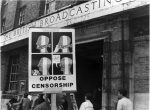
On October 19, 1988 the British Home Secretary, Douglas Hurd, imposed unprecedented peace time restrictions on broadcasting. The banning of direct interviews with eleven Irish organizations, including Sinn Féin, a legal political party with elected councillors and an MP at Westminster, was widely condemned. This article documents the effect of the restrictions on British TV … [Read more...] about The British Broadcast Ban, The Media and the Conflict in Northern Ireland
History Archives
Looking Back at the Hunger Strike
By Patrick Farrelly May 1991
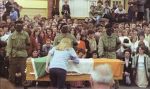
He has chosen death: Refusing to eat or drink, that he may bring Disgrace upon me; for there is a custom, An old and foolish custom, that it a man Be wronged, or think that he is wronged, and starve Upon another's threshold till he die, The Common People, for all time to come, Will raise a heavy cry against that threshold, Even though it be the King's. From The King's Threshold … [Read more...] about Looking Back at the Hunger Strike
Deadly Tales from County Tyrone
By Patrick Farrelly June 1992

In 1970, at the age of 22, Bernadette ‘Devlin' McAliskey was elected to represent the constituency of Mid-Ulster, which includes her home area of East Tyrone. Although she is no longer a Member of Parliament, and her international profile has receded, this radical Republican activist is still a kind of people's tribune in her own embattled nationalist community. Nowadays … [Read more...] about Deadly Tales from County Tyrone
Irish Homecoming Festival: A Time That Was
By Mary Pat Kelly June 1992

Writer Mary Pat Kelly and photographer Martin Sheerin visited the Ulster-American Folk Park at Camp Hill, County Tyrone, in the North of Ireland which houses the ancestral home of the Mellon family. "At the end of the day" can be an ominous phrase in Northern parlance, used by politicians and media commentators to sum up the difficulties of ending "the ancient quarrel" that … [Read more...] about Irish Homecoming Festival: A Time That Was
The Mighty Quinn
By Richard and Janis Londraville May 1992
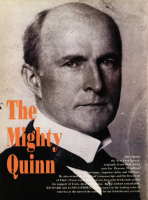
On reading the correspondence of central early twentieth-century literary figures such as W. B. Yeats, Lady Gregory, Ezra Pound, T. S. Eliot, and James Joyce, one finds the name of John Quinn appearing as a kind of oblique leitmotif, and his function seems to be as some sort of agent or patron or perhaps both. This shadowiness is at least in part his own creation, for Quinn … [Read more...] about The Mighty Quinn