
• Skip to main content
  • Skip to secondary menu
  • Skip to primary sidebar
  • Skip to footer
Irish America

Irish America

Irish America

  • HOME
  • WHO WE ARE
    • ABOUT US
    • OUR CONTRIBUTORS
  • IN THIS ISSUE
  • HALL OF FAME
  • THE LISTS
    • BUSINESS 100
    • HALL OF FAME
    • HEALTH AND LIFE SCIENCES 50
    • WALL STREET 50
  • LIBRARY
  • TRAVEL
  • EVENTS

October November 2001 Issue

Sláinte! The Irish Roots of Halloween

By Edythe Preet, Columnist
October / November 2001

October 1, 2001 by Leave a Comment

Ask anyone to name five favorite holidays, and it's a sure bet Halloween will be on the list. Then ask how the celebration came to be. More than likely you'll be told Halloween means All Hallows Eve the night of prayer preceding the Feast of All Saints. Yes, but there's more to it than that. The night we celebrate by dressing in outlandish costumes and traipsing about the … [Read more...] about Sláinte! The Irish Roots of Halloween

Roots: The Unimportance
of Being Mulligan
By Hugh A. Mulligan, Contributor
October / November 2001

October 1, 2001 by Leave a Comment

Irish literature and lore shows Mulligan little respect. The very opening sentence of James Joyce's acclaimed Ulysses introduces Buck Mulligan, a ribald braggart who, before many pages, is borrowing a quid to "get gloriously drunk so as to astonish the druidy druids," making an utter fool of himself in a "jester's dress of puce and yellow and a clown's cap" and identifying … [Read more...] about Roots: The Unimportance
of Being Mulligan

The Last Word: The
Far Side of Revenge
By Deaglán de Bréadún, Contributor
October / November 2001

October 1, 2001 by Leave a Comment

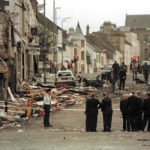
There was a terrible silence in Omagh in the days after the bombing. It seemed that not even birdsong could be heard in a town that was full of life and joy and laughter when the world turned upside down on 15 August 1998. To those who know nothing of Northern Ireland it may seem distasteful to engage in the arithmetic of tragedy, but the difference with Omagh was that the … [Read more...] about The Last Word: The
Far Side of Revenge

Photo Album: On the Town
Submitted by Kevin O'Brien
October / November 2001

October 1, 2001 by Leave a Comment

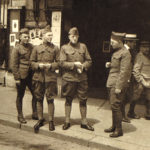
Cigarette in mouth and mates by his side, Corporal James L. O'Brien stands on a street in Paris in 1918. O'Brien and his friend, Pat Donovan (far left) joined "because we felt it was the right thing to do. Quite a few of our friends had been drafted." Assigned to recruitment duty in Washington D.C., O'Brien and Donovan would put up their friends who came down to enlist. "At … [Read more...] about Photo Album: On the Town

« Previous Page

Primary Sidebar

Featured Video

Featured Podcast

News from the Irish Post

  • Funeral details confirmed for architect and tv presenter Hugh Wallace

    TRIBUTES have been paid to the architect and television presenter Hugh Wallace who has died at th...

  • Man extradited to Lithuania for child human trafficking offences

    A MAN has been extradited from Northern Ireland to Lithuania over child human trafficking offence...

  • Anniversary appeal 25 years after murdered Sandra Collins disappeared from Mayo

    AN ANNIVERSARY appeal has been issued today for information on the murder of Mayo woman Sandra Co...

  • Witness appeal after driver dies following collision in Cork

    GARDAÍ have appealed for witnesses to come forward after a driver died in a collision in Cork cit...

December 5, 1921

Following the conclusion of negotiations between Irish government representatives and British government representatives, the British give the Irish a deadline to either accept of reject the Anglo-Irish Treaty. The treaty established the self-governing Irish Free State but still made Ireland a dominion under the British Crown. The treaty also gave the six counties of Northern Ireland, which had been acknowledged in the 1920 Government of Ireland Act, the option to opt out of the Irish Free State and remain part of England, which they opted for. The Anglo-Irish treaty split many and on this day in 1921 Prime Minister David LLoyd-George said that rejection by the Irish would result in “immediate and terrible war.”

Footer

Follow Us

  • Facebook
  • Instagram
  • LinkedIn
  • Twitter
  • YouTube

Subscribe

  • Subscribe
  • Give a Gift
  • Newsletter

Additional

  • Advertise
  • Contact
  • Terms of Use & Privacy Policy

Copyright © 2025 · IrishAmerica Child Theme on Genesis Framework · WordPress · Log in