• Skip to main content
  • Skip to secondary menu
  • Skip to primary sidebar
  • Skip to footer
Irish America

Irish America

Irish America

  • HOME
  • WHO WE ARE
    • ABOUT US
    • IRISH AMERICA TEAM
  • IN THIS ISSUE
  • HALL OF FAME
  • THE LISTS
    • BUSINESS 100
    • HALL OF FAME
    • HEALTH AND LIFE SCIENCES 50
    • WALL STREET 50
  • LIBRARY
  • TRAVEL
  • EVENTS

Issues

Sláinte! The Feast of Bealtaine

By Edythe Preet

May/June 1994

May 31, 1994 by 1 Comment

The Celtic feast of Bealtaine (Bright Fire) began on the first day of May with the lighting of the May Fires. The clan gathered to celebrate the end of the dark months and the return of the light. The fires symbolized the earth's life-giving forces-fertility and rebirth after the dormant winter months. Dancers enacted the sun's movement through the skies and the Maypole and … [Read more...] about Sláinte! The Feast of Bealtaine

Captain Paddy and Son

By Pat Crowe

May/June 1994

May 31, 1994 by Leave a Comment

Captain Paddy turned his boat around and pointed it toward the open waters of the North Atlantic. He has fished these waters along the rocky cliffs of County Donegal for so long that he no longer observes their rugged beauty. Sometimes he ventures far out to fish for salmon, today he would look for crabs and lobster and see to his numerous traps. The mighty gales and the strong … [Read more...] about Captain Paddy and Son

May June 1994

… [Read more...] about May June 1994

In the Name of the Father

By Jane Campbell

March/April 1994

March 18, 1994 by Leave a Comment

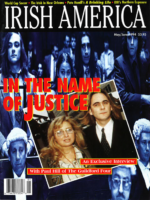
Pete Postlethwaite astonished critics and cinemagoers alike with his performance in In the Name of the Father. It came as no surprise when the previously little-known actor won a coveted Academy Award nomination for his portrayal of Guiseppe Conlon. Jane Campbell caught up with Postlethwaite in London, where they talked about the movie and the challenges of playing Guiseppe -- … [Read more...] about In the Name of the Father

Irish Roots: Quinn, Quinlan and Quigley

By James G. Ryan

March/April 1994

March 17, 1994 by Leave a Comment

Although the Irish language, or Gaelic, does not have a letter "Q," the distinctive sound of the accented "C" in some Gaelic names has caused them to be anglicized phonetically with this sound. Examples include Quinn, Quinlan, and Quigley, none of which are connected other than by their initial letter. Quinn is perhaps the most common of these names. It is derived from the … [Read more...] about Irish Roots: Quinn, Quinlan and Quigley

« Previous Page
Next Page »

Primary Sidebar

Featured Video

Featured Podcast

News from the Irish Post

  • Co. Mayo principal appeals for information after 'shocking' vandalism of school convent and chapel

    THE PRINCIPAL of a secondary school in Co. Mayo has appealed for information after the school's c...

  • Police officers meet baby they helped deliver in back of car in Co. Antrim

    TWO police officers have met a baby they helped deliver in the back of a car in Co. Antrim last m...

  • Police appeal for information on man missing after travelling from England to Belfast

    POLICE are appealing for information on the whereabouts of a man who has been missing since trave...

  • Sinn Féin MLA condemns reports of sectarian gestures from loyalist bandsmen at scene of massacre

    A SINN FÉIN MLA has condemned reports that loyalist band members made sectarian gestures at the s...

November 8, 1847

Bram Stoker, the famous author of “Dracula,” was born in Dublin on this day in 1847. Born Abraham Stoker, he was the third of seven children. He had a very sickly childhood and spent most of it bed-ridden, which allowed for his imagination to run wild. He recovered and attended Trinity College Dublin where he studied mathematics. Following Trinity, he found an interest in theater and became a critic. After reviewing Henry Irving’s production of “Hamlet,” the two became close friends and Stoker then went on to become business manager for Irving and the Lyceum Theater. While manager, Stoker began writing fiction. He published his novel “The Snake’s Pass” in 1890 and “Dracula” followed in 1897; it is considered the first definitive vampire novel.

Footer

Follow Us

  • Facebook
  • Instagram
  • LinkedIn
  • Twitter
  • YouTube

Subscribe

  • Subscribe
  • Give a Gift
  • Newsletter

Additional

  • Advertise
  • Contact
  • Terms of Use & Privacy Policy

Copyright © 2026 · IrishAmerica Child Theme on Genesis Framework · WordPress · Log in