
The March-April issue of Civil War magazine is devoted to examining the role of the Irish in the War Between the States. This fact comes on the heels of the widely acclaimed Public Broadcasting System’s eleven-hour series “The Civil War,” which virtually ignored the Irish contributions to both sides in America’s most famous conflict.
PBS mentioned the Irish for about fifteen seconds as being slaughtered at Fredericksburg: then came back with about two minutes on the New York City Draft Riots and the shameful role played by the Irish in that episode. It seemed incredible that a group which was so prominent in America in the 1860s should be so forgotten.
As if to make up for the PBS slight, Civil War magazine decided that the Irish were worth an entire issue.
Bill Miller, the managing editor of the widely distributed publication, explained that immigrants were often overlooked in discussing the Civil War. He pointed out: “We are a nation of immigrants, Irish, German, Italian, and you can’t understand the war without understanding the makeup of the population, especially in such critical states as New York and Massachusetts. The Irish are an appealing group. The Irish Brigade, for one, was a very famed unit in the Union Army. “Mr. Miller also admitted to having a grandfather born in County Mayo! However, he remarked further that his magazine believed that there would be a great interest in an issue describing the “Fighting Irish.” The magazine contains articles dealing with several subject areas. There is one article which describes a Union hero of the Battle of Gettysburg – Colonel Patrick Henry O’Rorke.
Born in County Cavan, O’Rorke graduated tops in his 1861 class at the United States Military Academy. At first in the U.S. Army Engineers, he eventually commanded the 140th New York Infantry, the “Rochester Race Horses,” and was cut down, even as his regiment saved Little Round Top.
Another article deals entirely with the activities of Irish soldiers on both sides during the Battle of Gettysburg. There were a number of Confederates of Irish birth or descent in the terrible battle. Indeed, one of the heroes of the South during the war was a Corkman, General Patrick Ronayne Cleburne. He was the highest-ranking foreign-born officer in the Confederate Army.
Early in the war, he had had the audacity to suggest to the Richmond authorities that they ought ask for slave volunteers to fight for the Confederacy. After the war, these men would be freed.
By the time the Southern Congress took this proposal seriously, Cleburne was dead and the war was just about over. Cleburne was killed in the Battle of Franklin, Tennessee.
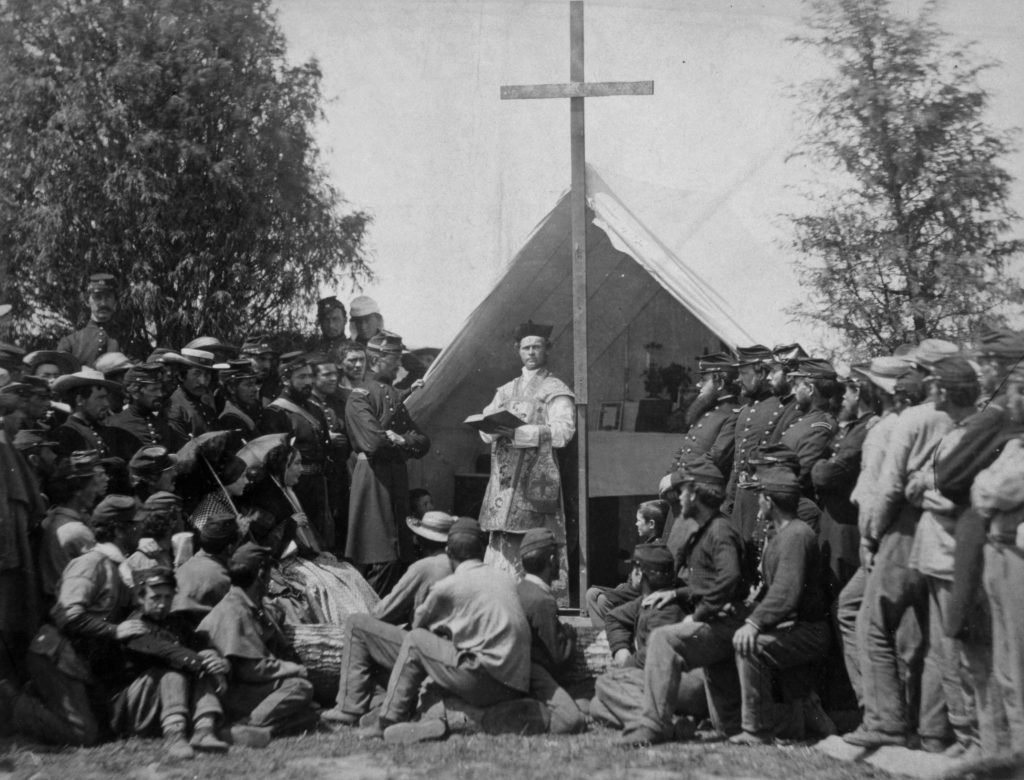
On a different note, there is also an article detailing the activities of Irish Catholic chaplains and their influence upon the Catholics in the two armies. Fr. Corby, who later became president of Notre Dame University, is one of the clergymen examined in this special edition of the magazine.
In the most dramatic moment of the Battle of Gettysburg, the brigade’s chaplain stopped the brigade. Amidst the most fiendish sounds and sights of hell, the priest raised his hand in absolution, as the men knelt before him, a sight never before seen on an American battlefield. The good padre’s statue still stands on the spot.
The “nonfighting Irish” have a place in this issue, too. There is an examination of the attitudes of the Mollie Maguires and anti-war activists. One of the short pieces in the edition is a poignant letter written by Captain James McKay Rorty, an original member of the 69th New York State Militia Regiment. He fought at First Bull Run, was captured and escaped, only to die defending his adopted land at Gettysburg.
His letter explains why he is fighting for the United States.
The magazine is available in early March through April. It is $3.95 on the newsstands. It may also be had by mail for the same cost plus postage. For persons interested in the Civil War, $39.00 per year makes one a member of the Civil War Society and includes a year’s subscription to the magazine.
The society conducts seminars, tours and special programs throughout the year in different parts of the country, mostly in Civil War-related areas. A newsletter and a calendar are distributed to members. Its conferences are well-attended by Civil War buffs and lay people alike and are conducted by the nation’s top Civil War authorities. A ” ’61-’65 Club” exists for members who have attended three of the seminars.
This group has grown large over the years and it refights “The War” at each conference.
Civil War magazine has gone a long way toward correcting the reluctance of the PBS people to recognize the contributions of soldiers from Ireland during the American Civil War. Mr. Miller and his colleagues are to be complimented for their willingness to sponsor such a project as this special issue. A Happy St. Patrick’s Day to all at the publication.
Editor’s Note: This article was originally published in the March 1991 issue of Irish America. ♦
Leave a Reply