

The Ghost of Muckross Haunts California
You don’t expect to find an Irish manor house, complete with 17 acres of formal gardens, tucked away only 25 miles from San Francisco.
The home, “Filoli,” an impressive Irish country-style estate, was designed by Willis Polk for William Bourn in 1916 near the town of Woodside, California. Bourn had strong ties with Ireland (he once owned Muckross Castle) and he chose this site for his rose brick home because it reminded him of the area around the Lakes of Killarney.
When you first see the house and gardens of “Filoli,” you may have a feeling of deja vu because the pilot for Dynasty was filmed there. The movies Heaven Can Wait and Starland were shot there as well.
The house has some sad memories. It was planned as a wedding gift for Bourn’s daughter. Unfortunately on one of her trips from Ireland to America she became ill on board ship and died.
“Filoli” is set on 700 acres of land with 17 acres of formal gardens. There are echoes of Ireland throughout. The “rooms” of the garden are separated by “walls” of yew trees. Bourn brought the yew seeds from Ireland and they have flourished in their adopted land, ignoring the difference in climate. There is a rose garden with 500 specimens, an herb garden, wild fern and azalea areas, a sunken garden with a lily pond, a Dutch garden with maze, and a spectacular Chartres garden, planted in glowing colors to resemble one of the stained glass windows at Chartres Cathedral. There is a wedding garden on a perfectly designed elevated spot from which the bridal couple can gaze down on the nearby lakes as they speak their vows.
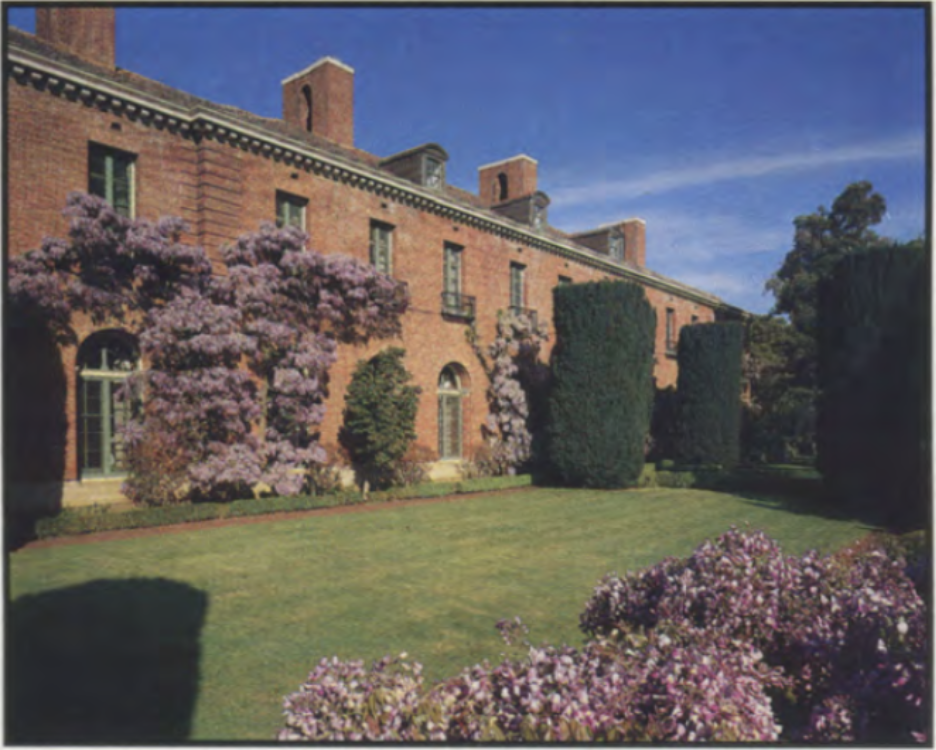
Although the home and garden are formal, they never have the gloomy prim air of some European estates. Something of the charm of the Irish pervades this area, giving a warm welcome, although the rolling hills in the background are tawny gold instead of emerald green.
Many of the rooms of the house are furnished. Of particular interest is the ballroom, decorated with murals of Ireland and chandeliers from Versailles. Some of the furnishings are from J. Paul Getty’s home in London.
Bourn had made a fortune in gold mining in California and the gold leaf used throughout “Filoli” came from ore taken from his mine. One of the focal points of the garden in the tea house, designed by Arthur Brown Jr. in Italian Renaissance style. He also designed a carriage house, which houses a collection of antique carriages and cars.
There is a shop where plants and various unusual articles can be purchased. Two of the favorites: a potpourri made of flowers from the garden, laced with pungent bits of orange rind, and a secret combination of herbs to be used on fish dishes.
After Bourn’s death, the house was sold to Mr. and Mrs. William Roth. In 1975 Mrs. Roth deeded the home and grounds to the National Trush for Historic Preservation, for the people of the world to enjoy.
The strange name “Filoli” is not of Indian derivation but a word coined by Bour composed of Fight, Love and Life. Mrs. Roth, a gentle soul, preferred the name to stand for Fidelity, Love and Life.
Gardeners are augmented by a large group of volunteers, who assist in the maintaining of the gardens and as knowledgeable docents and nature-walk leaders.
Volunteers also maintain the Sterling Library on the second floor of the mansion, a major repository of botanical books and landscape plans.
One of its jewels is a print set of Banks’ Florilegium, botanical sketches made during Captain Cook’s voyages. The copper plates of the sketches, lost since the voyage, were recently found in the basement of the British Museum.
The guided nature walks take visitors through the undeveloped portion of the estate. They visit the Indian digs and the San Andreas earthquake fault. Plant and animal life are discussed and the historical background of the 700-acre area is explained.
Next time you visit San Francisco, visit “Filoli.” You, too, may have the reaction reported by many visitors.
Wandering through the tall dark yews and gazing down on Crystal Springs Lakes, your mind plays tricks and you are strolling once again through the gardens of Muckross.
Editor’s Note: This article was originally published in the April 1991 issue of Irish America. ♦
Leave a Reply