
“Patrick Graham is a powerful and poetic artist. This man is real. He’s the artist to watch in the 1990’s.” So says Thomas Hoving, former director of the Metropolitan Museum, New York, now editor for Connoisseur.
Graham’s impact on Irish art is without precedent, and his work is increasingly arousing a dramatic response in the U.S. In 1986 he exhibited with four Irish expressionists in Boston, where critics singled out his art as extraordinary. At the Los Angeles Contemporary Art Fair in the same year, Graham’s art was distinguished by many as outstanding. Recently, Irish painter Patrick Graham, from Mullingar, now living in Dublin, came to Los Angeles again for an exhibition of his paintings and drawings at the Jack Rutberg Fine Art Gallery.
This is the third time that Jack Rutberg has mounted exhibitions of Graham’s paintings and drawings, and his powerful, poetic, emotionally wrenching images are a breathtaking experience.
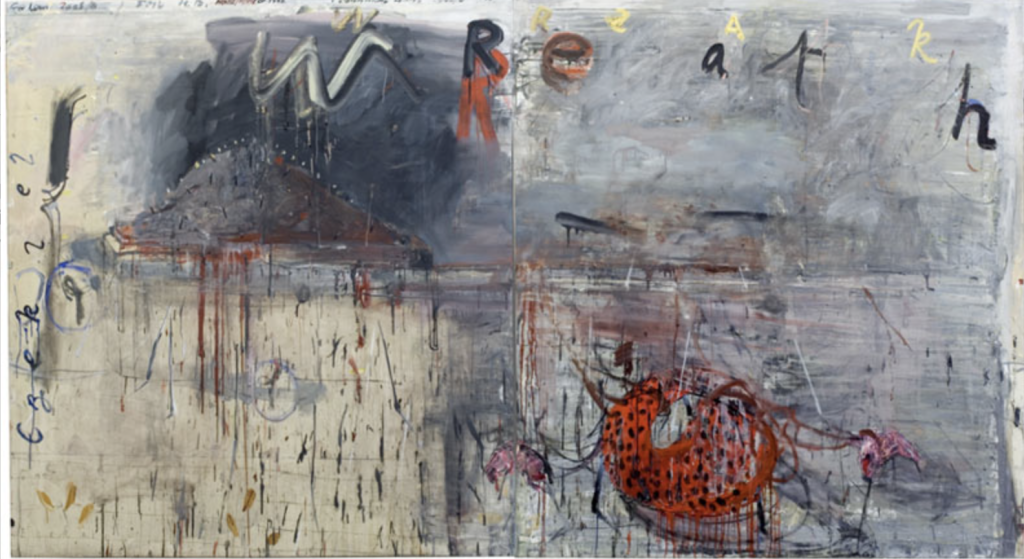
Graham knows a lot about art. He is not a purist. He uses oil and gouache and words to communicate with the viewer.
Words do not articulate the work literally, but are points of departure, incantations rather than messages. In the process they are obscured by layers of paint, collage, or other text in a stream of consciousness act of creation.
This is a man who has lived excessively—on the edge – and he defines his work with that. He is obsessed by sex and self-destruction. Most of his works are colorful, yet with a predominance of gray.
In his thick, lush brushstrokes an overwhelming sensuousness sings out.
As a young man Graham was rewarded for his artistic gifts. At seventeen, he won a major scholarship to the National College of Art in Dublin and in the following years he was awarded other scholarships and numerous prizes. At college he had an incredulous following, and two years later he was seen as a difficult genius with a profound tendency to lurch from one extreme to another in both life and art.
“I had always known that the few made art and the rest made picture,” he said. “I could not make a choice as to which road to travel. I never did make that choice. The road opened, not allowing me to choose either way.”
Graham’s discovery of the work of the German expressionist painter Emil Nolde knocked him flat. “In one appalling moment of clarity, my skill in head and hand was subverted by a reality of heart and flesh that burned me through. He was the stranger I wanted to walk with. When I allowed the truth to come from secret places he would be there.”
Graham stopped painting, hit the bottle, and became a tragedy of unfulfilled potential. When he started to draw again, he drew a small, clenched man, and from this,
“Truth came shuffling, grunting and bleeding into view,” he said.
I asked him whether his painings express truth.
“Truth is impossible to define. Perhaps truth is a series of events that will one day lead to some ultimate truth in which you have faith, but of which you have no intellectual understanding,” Graham said.
“I walk down the road and there are images flowing all the time. I can’t help it and I can’t avoid it. When I begin to work with an image, I make a drawing that is full of the complications of color that I want. That shows me what has to be thrown away. Out of destruction comes the final painting.”
Is despair, I wondered, crucial to his working strategy?
“Yes. It’s the ultimate step. It comes when you realize that the truth of the word is an illusion. It comes when there is a continuous loss, and through this loss arises a kind of resurrection. A loss of self-will, combined with an awesome sense of some sort of God experience.”
You seem to be searching for an alternative reality.
“In the search I find a tremendous source of continuity and revival.”
Your paintings are getting more abstract?
“They are more introspective and more weird,” he said with a deep laugh. “I’m sorry.”
Sorry for what?
“Who knows?” he said. He referred to his sense of loss. “In the struggle between despair and hope, art emerges. Failure is not an option – it’s given.”
Editor’s Note: This article was originally published in the July/August 1991 issue of Irish America. ♦
Leave a Reply