
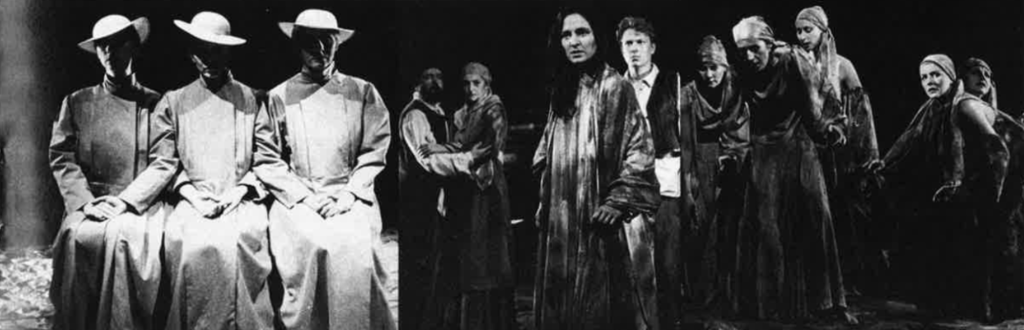
Report on the Second Annual W.B. Yeats International Theatre Festival at the Abbey Theatre, Dublin, August 2-25, 1990.
The Abbey Theatre’s second Yeats International Theatre Festival, “Masks of Transformation,” was named one of the artistic highlights of 1990 by the Sunday Tribune of Dublin, Ireland. The Festival featured three powerful Yeats plays, Cathleen ni Houlihan, The Dreaming of the Bones and Purgatory. In a stunning set that reminded one of the desert landscapes of the Persian Gulf, audiences again experienced the siren call of Cathleen ni Houlihan, as, in the name of nationalism, she continues to lure young men to their deaths, sowing at the same time seeds of implacable hatred and violence.
Dedicated to the memory of Samuel Beckett, the 1990 Yeats Festival explored the work of Yeats and Beckett as it embodies the act of intellectual, spiritual and political transformation. In addition to the Yeats plays, five short one-act plays by Beckett, Footfalls, Catastrophe, What Where, Come and Go and Nacht and Traume, were performed. The Festival also featured an exhibition of fourteen Northern and Southern Irish artists, two concerts, five lectures by internationally distinguished scholars, and a two-day symposium entitled “Tradition in Transformation” that explored the recent extraordinary changes in Central and Eastern Europe with regard to their impact upon Ireland.
The underlying theme of the 1990 Yeats Festival was that of intellectual freedom.
To Yeats, once that principle was established all other freedoms followed, leading ultimately to the highest one of all— spiritual transformation. What Yeats was most opposed to was a kind of iron curtain of the mind in which the blind forces of prejudice, ignorance and intolerance obstruct a free play of ideas on even the most sensitive of issues. The theme was a particularly appropriate one in a year in which many of the seemingly invincible iron curtains throughout Central and Eastern Europe tell, thanks to the voices of artists, intellectuals and ordinary people for whom freedom is an idea that cannot ultimately be suppressed.
Within an Irish context the idea of intellectual freedom carries a special significance. The production chosen to launch the first Yeats Festival in the summer of 1989 was “The Cuchulain Cycle,” five plays written over thirty-five years, which reflects Yeats’ views on the tumultuous changes which transformed Ireland during the first half of the twentieth century.
The bronze-age Celtic hero Cuchulain symbolized for Yeats the ideal of the indomitable heroism of the Irish people. As the “Cycle” unfolds, however, Yeats develops an increasingly ironic attitude toward the conventional idea of heroism as embodying personal fulfillment and freedom at all costs. What we discover is that this can lead to a way of life that, by excluding the views and values of others, embraces selfishness, insensitivity, and brutality. What we experience through “The Cuchulain Cycle” is the restless, violent energy of Cuchulain’s pathway — a pathway that ultimately is one of failure.
Cuchulain is, in effect, modern Ireland — an Ireland that has experienced political failure from the inability to deal with the blighting effects of conflicting ideologies that in their rigidity, breed hatred, spite, and ultimately self-destruction.
The 1990 Yeats Festival began where the previous year’s left off in exploring the lasting negative effect of violence as an agent for promoting political change, with particular reference to the situation in Northern Ireland. As with the 1989 production of “The Cuchulain Cycle,” last summer’s production evoked lively responses from both critics and audiences.
Perhaps the most penetrating review of the production was printed in the influential Sunday Tribune by the critic Mary O’Donnell. Ms. O’Donnell wrote: As expositions of Yeatsian philosophy and dramatic technique the production is near-perfect, very brilliant and loses nothing in dramatic value by also suggesting the pure relationships and atmospheres of poetry….The production is the kind of unselfconscious standard bearer fitting to a theatre of the Abbey’s history, and the work has not merely been restored so much as given a dramatic echo which ensures its carrying well into the future which Yeats himself accurately prophesied…. Masks of transformation are precisely that: In each play appearance is other than what it seems —more terrible, more poisoned, more spiritually deadened.
As complete works they draw fluidly on all the skills of performance, with patience, insight, and instinctive intelligence.
The result is in every way exceptional.
Other reviewers echoed the response of Ms. O’Donnell: Yeats in his profound symbolism and word magic is in his glory at the Peacock where the second International Yeats Festival pledged to the poet has begun with imaginative staging. It is a stunning evening of theatre.
— JOHN FINNEGAN, DUBLIN, EVENING HERALD.
As with his presentation of “The Cuchulainn Cycle” last year, Professor James Flannery has done Yeats proud with three superb productions that should continue the process of rehabilitating him as a major dramatist.
– COLM CRONIN, DUBLIN, EVENING PRESS.
Following last year’s exciting productions, the Yeats Festival has continued to break new ground. Yeatsian philosophy is injected with extraordinary dramatic juice.
Poetry, dance, movement, all are used with brilliance and innovation….All the plays are given an immediate and contemporary power by the almost absurd economy and power of the individual elements….
— KAREN MAMOME, THE LONDON STAGE.
The highlight, perhaps, of the entire festival, took place on Sunday afternoon, August 19, when some thirty Northern and Southern Irish writers read works that reflected upon their common experience. In many regards it was as if these artists were bearing witness to the daily tragedies that unfold in Northern Ireland. The aura of pained silence that pervaded the theater throughout the entire three-hour reading was a testimony to the impact of the event.
The exhibition of fourteen major Northern and Southern Irish artists was opened by Anne Yeats, the daughter of the poet. In her remarks Ms. Yeats emphasized the fact that art can embody ideas of significance, provided that we allow them to work upon us:
The world gets smaller every day. With television we can visit every nook and cranny, hear other points of view, see how others live. Everywhere there is a lot of talking, but not always a lot of listening.
People make prepared speeches and wait till the other fellow stops talking and then go on as if they had been interrupted.
The acceptance of the validity of another’s point of view is in short supply, but much to be valued when it does occur. I recommend this exhibition to you, and suggest that you look at it, remembering that it represents the views of fourteen men and women of the world around them.
Ask yourselves: “What are they trying to tell me?” and then listen to them.
In her remarks, Anne Yeats could have been expressing exactly the same sentiments voiced by her father over sixty years ago.
“It is perhaps the deepest political passion with this nation that North and South be united in one nation. If it ever comes that North and South unite, the North will not give up any liberty which she already possesses under her constitution. You will then have to grant to another people what you refuse to grant to those within your borders.”
—W. B. YEATS, DEBATE ON DIVORCE THE SENATE SPEECHES, (JUNE 11, 1925)
Editor’s Note: This article was originally published in the July/August 1991 issue of Irish America. ♦
Leave a Reply