
Why don’t Americans like soccer? Well, not exactly all Americans – just most of them. Ask your average baseball fan where the next World Cup is being held..
Most likely he’ll give you a big shrug.
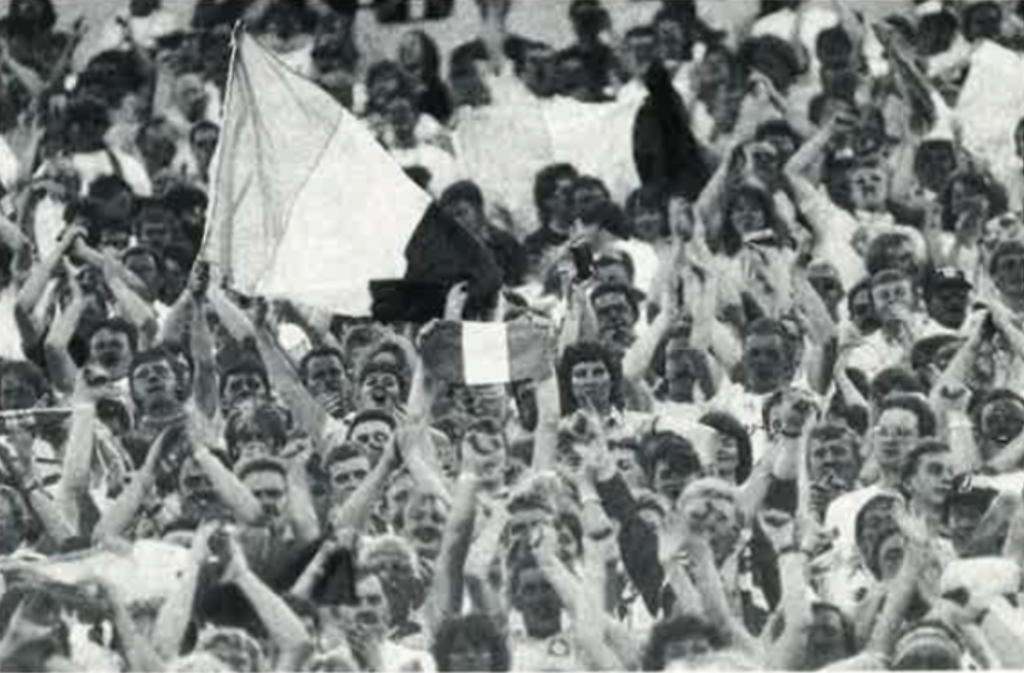
Explain to him that three-quarters of the globe goes into a frothy fever over the World Cup, that it draws a crowd of 2.6 million people and is broadcast to 170 countries and he’ll probably say, “Well, it hasn’t caught on with me yet!”
But if soccer hasn’t caught on here in the United States, it’s not for lack of trying.
Back in the 1960s, American sports promoters salivated with envy as stadiums in Europe and South America filled up with cash paying fans.
Hoping to get a piece of the money action, promoters launched the first professional U.S. Soccer League in 1966. And just to help the Yanks understand the game a little better, they imported a pleasing North Ireland ex-football champion named Danny Blanchflower to act as the TV color commentator for the games. Their thinking went like this: “Let’s have Danny teach the Americans about the beauty of the game. He’ll educate them to the finer points and the finesse of soccer. They’ll take to it like ducks to water.” Never were ducks so reluctant. Each Sunday, Blanchflower studiously went onto the playing field prior to the big televised game. With the help of blackboards and charts and slow-motion cameras, the science of passing the ball, the skill of a header shot and all the lovely intricacies of the game were shown. It was futile. Nobody was buying. The league folded in three years and lost millions.
But still, with such big dollars potentially at stake, the promoters didn’t give up easily. “What we need are big name stars to attract fans,” they said. “Let’s import international stars like Pele from Brazil and Franz Beckenbauer from West Germany. Have them play for the New York Cosmos in the media capital of the world. With the right hype and pizzazz. we can sit back and listen to those cash registers ring.” And they were right – for a while.
On certain Sundays the New York Cosmos drew as many as 77,000 fans to the Meadowlands. But even though by this time American youngsters were familiar enough with soccer through programs in their schools, there just weren’t enough Peles and Beckenbauers to go around. After a few years, this second professional soccer league collapsed just like the first.
Then someone hit on a new wrinkle: “Hey, we’re not against foreign sports! Look at Canadian hockey. Hockey is more popular every year. The reason? It’s fast! So let’s steal a page from the hockey book and bring soccer indoors on a playing field the size of a hockey rink. When American sports fans see and hear the soccer ball careening off the side boards with speed, action and plenty of noise, they’ll surely love it.” Another false hope dashed to pieces. It just wasn’t soccer anymore. And this soccer league faded away just like the others before it.
Trying to solve the puzzle of why the U.S. is practically the only place in the world where soccer is not king, I decided to visit Freddie, the punter-the most avid sports junky I know. I asked his opinion on why the sport hasn’t caught on.
“Scoring! Pure and simple. There’s not enough scoring in soccer.” Freddie said chomping his cigar. “Too much defense, not enough offense. Americans won’t stand for it. Soccer needs to open up more. It’s simple-give more penalties to the defense men and change the off-side rule. That’s the key—more shots on goal. When you start seeing scores like 6-5 or even 4-3 on a consistent basis—that’s when Americans will start turning to soccer. And get rid of tie games. American football had the good sense to get rid of tie games a long time ago. Tie games emphasize a defensive game which means a slower game.
“If promoters want soccer to catch on here they have to go long on offense and short on defense. Look at baseball. A few years ago, the overall batting averages of players started going down. So what did the league do? They lowered the pitcher’s mound to give the batter a better shot at hitting the ball because pitchers gain too much advantage with the higher mound.
Then in the American League they brought in the designated hitter which also made the batting percentages go up. They even made the ball livelier than it used to be so that it goes farther when it is hit.
“Our other major sports also made changes to heighten the offensive game. In basketball, the NBA added the three point line for the offense which increased scoring. And in football the NFL. toughened up the bump and run rule on the defensive backs, which allowed the pass receiver to break free more easily for more pass receptions. American sports is all about changing the rules to suit the fans’ desire for more excitement. More scores means more tension more possibility for cardiac arrest! That’s the way we like it. But soccer scems to be going in the opposite direction. In the last World Cup the scores were the lowest ever.”
“Hold on Freddie, have you ever watched soccer fans at their games? They’re transfixed. Even when a match ends at 0-0, they leave with no complaints. I doubt they want to see their game changed just to please American taste.”
“It’s their choice. Look, I remember being at the Meadowlands a few years ago and the Cosmos were behind 2-0 and there were 35 minutes left to go on the clock and I turned to my wife and said: “Let’s leave and beat the traffic. Nothing’s going to happen here. And if it does, the most either team will get is one more goal.’ So we left the stadium and, sure enough, when I checked the final score later it was the same, 2-0.
“Now that’s real different from American sports. Try leaving a National Basketball Association championship game when one team is ahead by three points and there’s only ten seconds left on the clock.
You can’t leave. Anything can happen.
“Or take an American football game. One team is ahead by seven points and there’s only two minutes left to play. The strategy that goes into those final minutes would make a field marshall like General Schwarzkopf stand up and be proud.”
“But Freddie, you certainly can’t say that about baseball. I’ve seen some slow baseball games that go nowhere. And, in fact, the games that get the most attention in baseball are the no-hitters. They make the front pages every time.”
“Yeah, we like no-hitters once in a while,” he said, ” especially when they come from guys over 40 like Nolan Ryan. But a steady diet of no-hitters would turn the fans off, believe me.”
“Wait a minute Freddie,” I said. “Isn’t there something else at play here? Something called American arrogance. We didn’t discover soccer and since it’s not ours, we don’t want to play it. Isn’t that what the resistance is really all about?”
“Maybe,” he said puffing his cigar slowly. “And maybe not. Tennis and hockey aren’t ours either. Nobody can argue with their success in the U.S. But let’s face it, when all is said and done, the real reason soccer hasn’t made it in the U.S. can be summed up in three words, ‘Television Advertising Dollars!’
“Soccer may be nice to watch on TV but it’s just not good for advertisers who want to sell beer and cars and hamburgers. The action goes on and on with no breaks for commercial spots. Without commercials, the networks can’t make any money. Nobody is going to promote a sport that doesn’t make money for them.
“Baseball, basketball and football all have one thing in common. They’re perfect for TV advertising. Baseball has innings that break the action. Basketball and football have quarters and time-outs. And in football we even force time-outs to allow for commercials. If soccer promoters want to penetrate the American market, they have to make TV advertising their first priority. But you know some-thing? My plate is just too full with sports as it is. I can’t fit in another sport.”
“Freddie, to hear you talk, we Americans don’t deserve to have the World Cup here in the United States in 1994,” I said.
“Well, the Los Angeles Olympics were a huge success. FIFA hopes for a bigpay day like that one for themselves. With enough hoopla, it may catch on this time. One thing’s for sure, hope springs eternal and they’ll never stop trying.”
“What are the chances for yet another professional soccer league?” I asked.
“What are the odds of the United States winning the World Cup?”
“500 to 1.”
“That’s about right,” he said walking away, puffing his cigar with head down into the Racing Form.
Editor’s Note: This article was originally published in the July/August 1991 issue of Irish America. ♦
Leave a Reply