
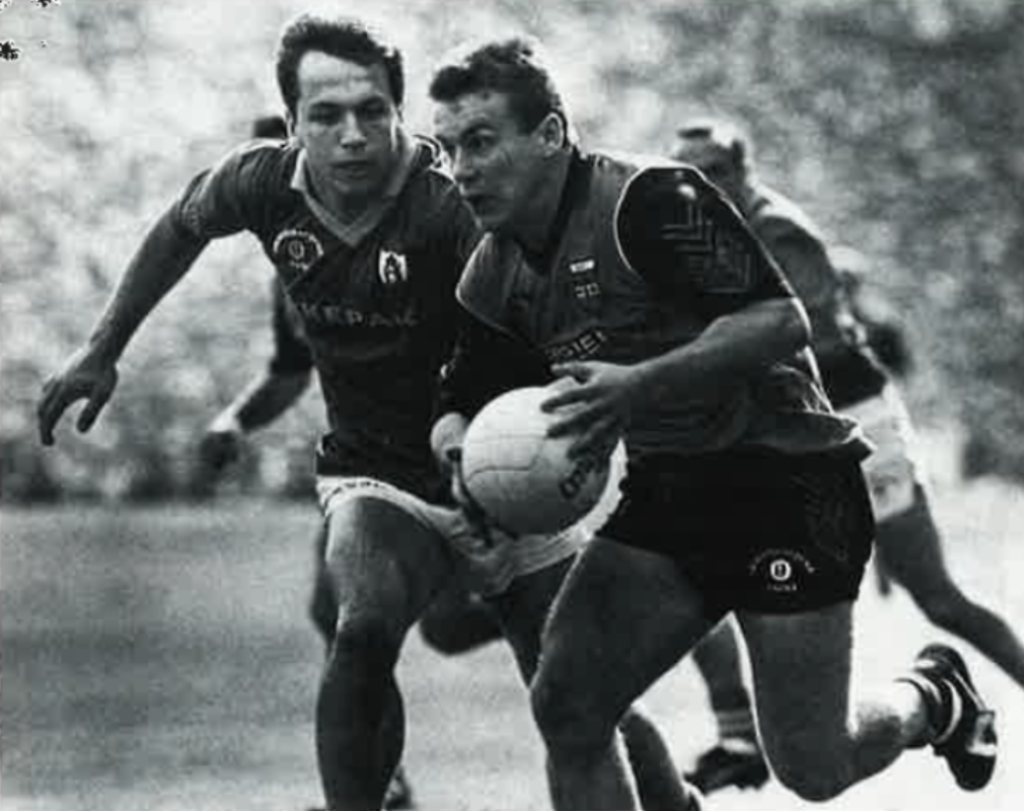
The last 23 years have been tough ones for the citizens in the North of Ireland, which makes it all the more significant that this year a team from across the border won the All- Ireland Gaelic football final, played in Croke Park in Dublin.
On a Sunday in late September, County Down defeated Meath in a thrilling victory. Not since 1968, when Down defeated Kerry, had a Northern team taken home the battered silver trophy known as the Sam Maguire Cup.
For this team to win was, as an Irish Times editorial said, “not just the mere winning of an All-Ireland title: it was a confirmation that they are officially part of Gaeldom.”
In Gaelic footballing terms Down is like no other county. They are the only team from north of the Irish border to win an All-Ireland. But that was stuff from another generation. There had been 23 years of defeat. But this year, in a summer set alight by a championship of heroic fightbacks, Down rediscovered their birthright and rekindled the romance that only Irishmen playing their national game before fanatical supporters can muster.
Down’s brash reemergence as a footballing force staggered “those in the know” who have, year in and year out, clapped politely when an Ulster team showed promise but quietly wrote them off for not having what it takes.
But to be fair Down’s leap from obscurity to glory has equally shocked their supporters.
The All-Ireland championship, played on a knock-out basis, began in June. Down were drawn against nearest neighbors and arch-rivals Armagh. Only 7,000 turned up to watch a dreary game played in the rain.
Down won by a slender margin only because they had slightly more go than their lack-luster opponents. If you had said to anyone over a pint that the champions had been on display that day they would have thought you mad, or drunk or both.
Yet five matches later, following a sporting metamorphosis and one of the most unseemly scavenging sessions for final tickets, Down fans blocked roads into Dublin’s city center. Only some of them made it inside the walls of Croke Park where they packed Hill 16, named after its construction from the rubble of Dublin following the Rising of 1916. There they orchestrated one of the most memorable and spectacular displays of football seen in a generation.
Just 18 months before, the depth of the slump that the team had sunk to was underlined by the resignation of manager Peter McManus. There was no scramble for his job. But eventually, Peter McGrath stepped forward. McGrath lives in Rostrevor, a picturesque and peaceful town that nestles at the foot of the Mourne Mountains and dabbles its toes in the waters of beautiful Carlingford Lough. Rostrevor is in football country.
A 38-year-old teacher, McGrath neither drinks nor smokes, has never married and lives with his mother, is unassuming and speaks in quiet understatements. His one passion is football. He knows and understands the romantic attachment to the game and knows how central the sport is to person’s self-belief and self-worth.
McGrath had managed junior county teams and had his own ideas for transforming the senior team from a collection of 15 men into a unit. Together with his newly appointed backroom boys, Barney Treanor and John Murphy (from the 1968 team), he insisted on dedication, commitment, self-denial and fitness. They appointed Paddy O’Rourke as team captain. A great footballer and a leader of men, O’Rourke became the corner stone to a new Down team that McGrath said could be brought to the summit within three years. Fortunately, it didn’t take that long.
The building of the Down team reads like something from a comic book. So many stories about the team’s genesis have been passed around that now it’s hard to see where truth blends with fiction. But true or not they are worth recounting.
The team needed a goalkeeper. A Newry taxi driver on hearing of the vacancy said: “I’ll find you a keeper,” and he drove off only to return with Neil Collins.
The team needed a sharper, younger attack. Peter Withnall had played soccer with Reading’s reserves in the English third division but had returned home disillusioned. He played Gaelic football “for something to do on Sundays.” Spotted playing at club level, he was invited to play in a red and black shirt against Meath in a challenge match. He has played ever since.
The likes of Barry Breen, Conor Deegan and John Kelly had graduated through that football factory of a school in Downpatrick – St. Patrick’s, and earned their places on the team. Then there was the family connection. Ross Carr is a nephew of Barney Carr who trained the great teams of 30 years ago. D.J. Kane is a brother of Mat Kane of the 1968 vintage and a cousin of the McCartans. James (Wee James) is the son of James McCartan senior, holder of two All-Ireland medals and nephew of Dan McCartan who has three. Another cousin of Clan McCartan was the legendary Sean O’Neill-a multiple medal winner to whom the tag “The Greatest” still applies.
From his days working with the underage teams in the early eighties, Peter McGrath knew who was available and what they could do. His new force, combining freshness and experience, wisdom and rawness gelled together behind the single determination to recapture a 1916 trophy of solid silver known as the Sam Maguire Cup.
The first hurdle against Armagh was stumbled over rather than cleared on a soft, damp day in Newry. The next game was against Derry. With three quarters of the game contested Down stood seven points clear but they lost both their way and their lead and only managed a tied game by converting a free kick in injury time. In the replay the mistake was not repeated and Down knew that they could play football.
After that came Donegal-hot favorites to win and deserving of the “best team in Ulster” title following their performance 12 months earlier. Down, free of the weight of expectancy and comfortable with the underdog role, took their new found cockiness up a gear. Before a crowd of 30,000 in Clones, County Monaghan they started with the speed and unpredictability of a fire cracker, rocketing home scores before a stunned Donegal and an entourage of support.
Donegal rallied but their points were met with counter attacks and the final 20 minutes were simply target practice. In the crowd on that glorious July afternoon sat Mickey O’Sullivan, manager of Kerry-Down’s next opponents. The next game would be in Dublin-Down were in the All-Ireland semi-finals.
Semi-finals are big time. Kerry are big time. They have made a habit of winning titles and their fans expect no less. “You couldn’t keep a Kerryman happy until the team has won six in a row,” said one.
But history can play on the mind and Kerry were facing the one team they had never beaten. Down triumphed by almost double scores and without playing to their potential for two-thirds of the game. They were in their first final for 23 years.
The GAA world, meanwhile, had spent the summer watching the enthralling encounters of Meath against Dublin (three replays) and against Wicklow (one re-play). They had played nine games to reach the final, nearly twice as many as Down. They had dazzled with their doggedness, they never gave up and had come back from the brink almost as a matter of course to record famous wins. Everyone talked about Meath.
Except in Down.
Children went back to school after the long summer break at the beginning of September.
Teachers organized Red and Black Days when kids dressed up in the county colors, they drew red and black pictures and sang red and black songs.
Shopkeepers changed their window displays. Fashion boutiques took down the autumn shades and replaced them with red and black outfits. Red and black bunting was ordered by the mile and was strung up between hundreds of lamp posts.
Flags, once unobtainable, arrived in shops as soon as manufacturers got their act together. The team shirts usually made in numbers to meet a team’s own need became an overnight fashion hit and the rag trade ran out of supplies.
Soon, streets and playgrounds-even pews in churches-were dotted with the distinctive red and black shirt.
The stories of yesteryear were resurrected. Hundreds turned up to watch the boys train-more than had paid to see them play earlier that same year. The county was on the move.
September 15 was a perfect day for football. There was a smell of history in the making that morning in Dublin, but then there always is on final day.
The evening before there had been an exodus from the north. Ticket holders (a minority) rubbed shoulders with the ticketless who were going anyway. Wives were offered in exchange for the elusive pieces of paper and their spouses were only half joking.
When the teams took to the field Croke Park shook with noise. The sons and daughters of men who had been there before raised voices and flags, and not a small number cried. It was that sort of day.
Meath opened a two point margin which was snuffed out within nine minutes. Down then stepped ahead into a lead which they never relinquished. In the second half Down were 11 points clear and almost out of sight. They were playing keen, lean and hungry football. But Meath had other ideas and reeled in the Down team until the original chasm of a margin was only two points. And then they ran out of time.
Meath were beaten.
The 65,000 crowd spilled out onto the pitch for the presentation party. The coveted Sam Maguire slipped down from the Hogan Stand and from the watchful eye of the great and good into a melee of red and back. Quiet and respectful, the Meathmen stayed in their places around the ground and clapped in appreciation of what had been a classic final.
It takes nearly two days to drive home 70 miles when you win an All-Ireland.
Punctuality, never an Irish speciality, gets kicked aside.
But people remember arrivals not delays. There were 30,000 fans waiting at the border to greet the team, which was five hours late, and escort them into Newry. Even the British soldiers at checkpoints were sporting the county colors. Policemen (banned from GAA membership due to a cocktail of unpleasant history and politics) attempting to impose some sort of public order got caught up in the swamp of people and joined in the celebrations. Ardent Irish nationalists patted officers on the back. Officialdom, in the persons of a Unionist councillor and an Anglican bishop, welcomed the team home and congratulated them. It was that sort of day.
Even yet, there is still a lingering sense of partying. Flags and bunting, tattered now after early autumn gales, flutter as a testimony to a hangover few want to forget in a hurry. The legends have been updated.
Editor’s Note: This article was originally published in the November 1991 issue of Irish America. ♦
Leave a Reply