
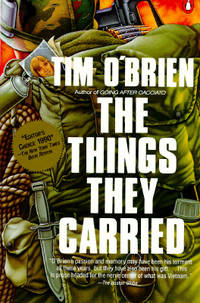
In 1968, Tim O’Brien, a Minnesota native and honors graduate in English, was looking forward to going to Harvard University on a full scholarship. As Student Body President at Macalester College, he opposed the Vietnam War, which was to him a case of certain bloodshed for uncertain reasons.” Military deferments for that purpose were rejected by draft boards so as induction day loomed he made a faint-hearted escape to Canada. He returned home because he couldn’t deal with the humiliation he and his parents would face if he became a draft dodger. He movingly describes his emotional hell during this period in “On the Rainy River” in The Things They Carried, his second book on Vietnam.
“People don’t go to war for reasons of patriotism or adventure; they go because they’re embarrassed not to go.” Landing in Vietnam, he says, was “like falling down a rabbit hole.” He was “totally dislocated,” he says and is still experiencing the aftershocks.
Because of the violence he either assented to or committed he says, “I don’t forgive myself; I hope I never do. I don’t look on my writing as a catharsis for what I did. I just live. I don’t think of myself as a suffering veteran. I was happy to be home, to be alive.” The 43-year-old O’Brien is addressing the cadets at the United States Military Academy at West Point. It is a calm June day, two days atter the Welcome Home Desert Storm parade in Manhattan.
The cadets wanted to know what that other war, Vietnam, was all about, what America itself was undergoing in that turbulent activist decade, which pleased O’Brien. “I don’t write for those who were there. I write for those who weren’t.” One of those who wasn’t there is his daughter Kathleen who he took with him to Vietnam a few years ago when she was ten years old. Predictably she saw only a chemically destroyed environment and couldn’t connect it to the human devastation O’Brien still saw vividly. Deliberately casting the stories in the fiction mode preserved his vision. “Fiction preserves a sense of things, the feel for a time and place,” O’Brien says, but there is a darker reason also: What happened to me in Vietnam is a mystery; the people around me were mysteries. As a writer it’s not my job to solve the mysteries. I enhance them.”
The Things They Carried was named by the New York Times to its “Best Books of 1990” list.
O’Brien’s other literary foray into Vietnam: Going After Cacciato, won the National Book Award in 1979.
From the Book: An Excerpt from The Things They Carried
They carried all the emotional baggage of men who might die. Grief, terror, love, longing- these were intangibles, but the intangibles had their own mass and specific gravity; they had tangible weight. They carried shameful memories. They carried the common secret of cowardice barely restrained, the instinct to run or freeze or hide, and in many respects this was the heaviest burden of all, for it could never be put down, it required perfect balance and perfect posture.
They carried their reputations. They carried the soldier’s greatest fear, which was the fear of blushing. Men killed, and died, because they were embarrassed not to. It was what had brought them to the war in the first place, nothing positive, no dreams of glory or honor, just to avoid the blush of dishonor. They died so as not to die of embarrassment. They crawled into tunnels and walked point and advanced under fire. Each morning, despite the unknowns, they made their legs move. They endured. They kept humping. They did not submit to the obvious alternative, which was simply to close their eyes and fall. So easy, really. Go limp and tumble to the ground and let the muscles unwind and not speak and not budge until your buddies picked you up and lifted you into the chopper that would roar and dip its nose and carry you off to the world. A mere matter of falling, yet no one ever fell. It was not courage, exactly; the object was not valor. Rather, they were too frightened to be cowards.
– Tim O’Brien
Leave a Reply