
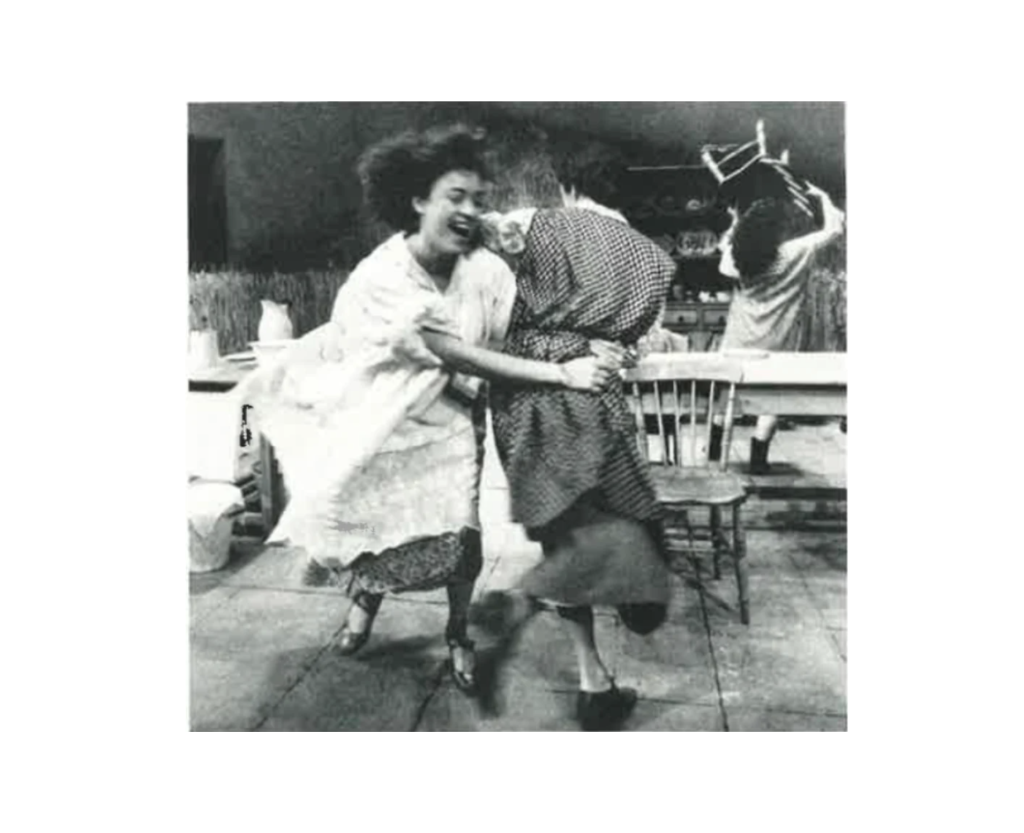
The Theatre Festival, the major highlight of Dublin’s artistic calendar, this year featured 19 international productions, including five operas and four dance events.
There were also 12 new Irish plays and several classic revivals, including the recently established O’Casey Theater Company’s first production, The Shadow of a Gunman, directed by the playwright’s daughter, Shivaun O’Casey.
As if this were not enough, there was also a festival within the Festival, as the Gate Theatre, with the sponsorship of Beckett’s alma mater, Trinity College, Dublin, and Radio Telefís Éireann, Ireland’s national radio and television broadcasting service, mounted all 19 of Samuel Beckett’s plays.
The Power of Darkness, John McGahern’s free adaptation of the play by Tolstoy, is the best Irish play in the Abbey since Tom Murphy’s Too Late for Logic.
This one fairly shrieks of the west of Ireland, and there were some elements I wouldn’t be able to take in any other play, like the stage Irish drunk and the bloody wrappings of an unwanted fetus, but the strength of the play, the production by the Abbey’s artistic director Garry Hynes, and the lighting were exquisite.
A rich old farmer, Mick Lally, is poisoned by his young wife (Bernadette Shott) at the instigation of her lover’s mother, Marie Mullen. The crime provokes a chain of disasters. The murdering wife is wracked by guilt. She marries her lover Paul (Sean McGinley), who turns into a wastrel and seducer.
Paul tries to hang himself, but the end of the rope is attached to a new character Paddy (Alan Devlin), a Bacchanalian drunk with flowers in his hair who brings a whole new dimension to the play. His appearance signals an entirely new constellation of relationships among the characters you thought you were beginning to know and understand.
The Power of Darkness, despite its reserved critical reception at the Festival, strikes me as a masterpiece.
McGaher, long-feted as one of Ireland’s most important novelists, demonstrates a considerable dramatic flair in this first attempt at drama. Power provides the thrills of melodrama, and moments of high comedy (in the moment when the old man’s death is revealed, for instance), but is nonetheless serious enough to force the audience to rethink its spontaneous but careless laughter. You want the old man to die; he is such a bastard-but when he asks for forgiveness, he is too human to be killed in that comic way of pills and three sips of poisoned tea.
The ending, when Paul tries to kill himself and then confesses to his father (Tony Rohr), who affirms family solidarity above all else, is morally ambiguous. Paul is too much of a coward to kill himself, and, when he finally goes into the wedding party through huge doors into the light, he takes off his shoes and socks as if going in as some kind of penitent. A very dark and explosive force that until the climactic moment turned inwards to hide itself, finally opens out into ceremony and religious doctrine.
For those who might imagine the story to be too remote, from some dark age long past, the playwright refers us to the findings of the infamous “Kerry babies” tribunal of 1984. (Two dead babies were found in Kerry. One of them, buried in a field the second found on a beach.) It is the nature of things, McGahern believes, that such a climate also creates “the dramatic hope of redemption.” Much of the negative reaction to the play was based on an appalling lack of understanding of the objectives of the playwright. McGahern has been obsessed by the Tolstoy original since he was commissioned, years ago, by the BBC to adapt it for radio. He always thought it made more sense in an Irish setting than in an English, and his adaptation benefits from his meditations on Greek tragedy and Eugene O’Neill’s Desire Under the Elms, itself based on Phaedre. His stunning new work, with its suggestion of an eternal cycle of sin and retribution, has the sense of magnitude of the O’Neill classic.
In Her Father’s Footsteps
Shadow of a Gunman at the Dublin Theatre Festival: some thought it the best play of the Festival. It certainly was stunning, with Niall Buggy playing Seamus Shields in an entirely original way.
Gone was the cantankerous, cowardly Dublin codger.
Here we had an idle, hypocritical, almost middle-class pseudo-philosopher, who, with his “She did it off her own bat-we didn’t ask her to do it,” turns rather evil in the end.
His shallow selfishness allows him to easily forget about Minnie’s death, while his roommate, the poet Donal Davoren (Ian Fitzgibbon); is all too content to imagine himself the hero who inspired Minnie, who loved him and will die for him. He is consumed with guilt for her death and laments “pain, pain, pain forever.”
The play is both a masterpiece of another era and an apt work for the present. In this production, the words seem new. You see the appalling equation of writer and gunman, and you hear O’Casey’s damning indictment of the latter as though it were written yesterday: “It’s the civilians who suffer; when there’s an ambush they don’t know where to run. Shot in the back to save the British Empire, and shot in the breast to save the soul of Ireland.”
Shivaun O’Casey, the playwright’s daughter and director of the Festival production recognizes The Shadow of a Gunman, first produced in 1923, as “a powerful and dangerous work. I know that this is how my father would have seen it.”
It was the first production of her newly-formed company which is dedicated to the revival of O’Casey’s plays. “It was the first one that my father ever produced,” she told me. “And for the community we are working with in Newry, I wanted to start at the beginning. It is a cross-Atlantic, cross-border international theater company. Half the people are from the United States, half from Ireland and England. Derry has Field Day (the company which concentrates on producing the work of Brian Friel and Beckett) and so I chose Newry in County Down, because it didn’t have any professional theater, and I thought it would be beneficial for all sorts of reasons. Newry is between Dublin and Belfast. And yes, I feel we can help to break down the differences between people.”
Bringing the play to the Dublin Theatre Festival seemed highly appropriate to her.
“My father was a Dubliner all his life, he loved the warm-hearted, gossiping people. And he was commissioned to write the Drums of Father Ned for the very first Dublin Theatre Festival in 1957. The Bishop refused to say a votive Mass if Sean didn’talter some of his play. And if Joyce’s Ulysses in Nighttown, wasn’t rewritten. Hearing this, Beckett withdrew his play too. So it’s great that plays by O’Casey and by Beckett are part of the Festival this year.”
The new company’s funding comes from a mix of government grants, businesses, and private sponsorship.
“My plans are to establish a solid company and to direct his later work, starting with Red Roses For You, and also to organize workshops with writers so they can work with actors.”
O’Casey also has touring agreements with Irish, English, and American Actors Equity which will bring the production of Shadow to Pittsburgh and Philadelphia for a week each, to Boston and New York for two, and to Washington, D.C. for a full five weeks.
In Dublin the production was accompanied by a stage documentary, Shadow of O’ Casey, written and produced by O’Casey herself, in honor of her warm memories of her father, whom she calls Sean. He was “a giving, loving, excitingly interesting man,” she said. When she was 17, her brother Niall died of leukemia. Sean wrote a beautiful keen which brought tears to Shivaun’s eyes as she recited it from memory: “The young sapling was taken away and the old withered oak was left standing…. Taken away in the prime of his youth, just as he was about to enter the sweet meadows of summertime.”
Laudatory Notices for Lughnasa
The success of Brian Friel’s Dancing at Lughnasa continues to grow beyond all expectations. The play opened to extraordinarily positive reviews in New York, with Frank Rich, chief critic at the New York Times leading the plaudits.
This play does exactly what theater was born to do,” surmised Rich, “carrying both its characters and audience aloft on those waves of distant music and ecstatic release that, in defiance of all language and logic, let us dance and dream just before night must fall.”
John Simon of New York magazine was no less forthright. “The ultimate wonder is Friel’s central image, the dance, which never stops during this restrained feast of a play. It is always there in one of several forms, a dormant volcano of passion always ready to erupt, and, when it does so, eliciting pure awe.” Clive Barnes, another influential voice in New York’s theatrical scene, wrote in the New York Post, “This is a play in no way to be missed- simply a wondrous experience.”
Others were equally positive with the exception of Jeremy Gerard of Variety, who saw the play as, “oddly dispassionate, and the inevitable revelations, when they come, strain credulity.”
Irish America’s reviewer, Francis Haines, in the first American review of Lughnasa (February issue), found, “This very moving play, with a powerful sense of search and loss at its core, beautifully employs music and memory, narration and action, scenes and monologue, as well as all of Friel’s usual virtues-wit, pathos, intelligence, and imagination.”
Since opening at the Plymouth Theatre on Broadway, Dancing at Lughnasa has taken in over $1 million at the box office and is currently striking in 94.5 percent of capacity at the 1,037-seat theater. Only two big musicals-Miss Saigon and Phantom of the Opera-are drawing higher capacity houses on Broadway.
In addition, Lughnasa picked up another very prestigious award in London when it was named Play of the Year by the Evening Standard Drama Awards. Last April, the play won the 1991 Laurence Olivier Award for Best Play in London.
Editor’s Note: This article was originally published in the December/January 1991 issue of Irish America. ♦
Leave a Reply