
It’s long, long way from St. Patrick’s School on the edge of Belfast’s New Lodge Road to the sky scrapers of New York, never mind the plains of the Midwest and the fantasy of Disneyland, but that is precisely the journey made by some 900 children from the North of Ireland on a six week trip of a lifetime under the auspices of Project Children.
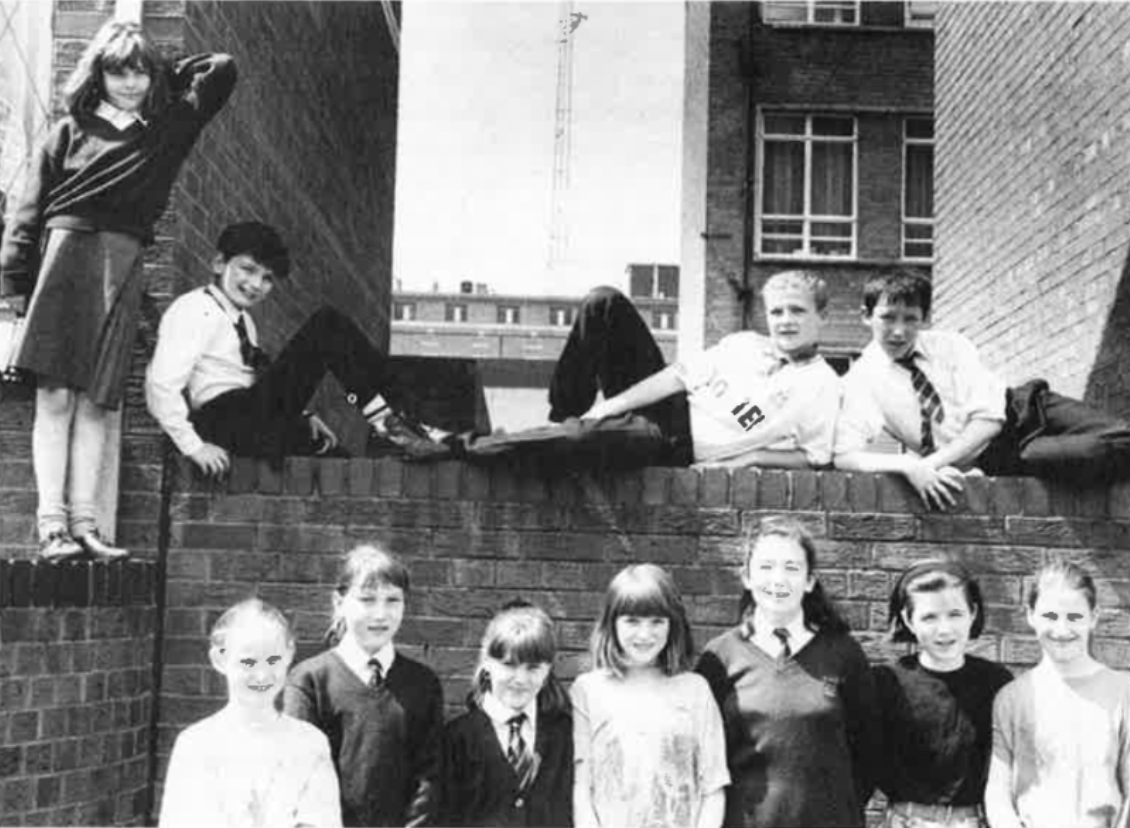
In the playground of St. Patrick’s School, overshadowed by the radio masts, surveillance cameras and brooding military fortification of what is
euphemistically called “North Queens Street Police Station,” a group of children destined to travel to America talk with excitement, trepidation and wonderful naivete about what they are going to be doing and where they are staying. Neil Quinn, destined to stay with Janine and Dave Donaghy and their three children, Kevin 11, Tim 9 and Tess 4, in Syracuse, New York, dominated the group and is blase as he poses for a photograph. “New Jersey is near Syracuse.” “The people I’m staying with have a swimming pool in their garden.” “I’m going to miss my mummy but they said I could phone home anytime I wanted.” The Donaghys are involved for the first time.
The thought of pizza, McDonalds, pools, hot weather, even a bedroom to themselves, with a TV in it, all bring a sparkle of excitement and blushing bashful admissions that they “can’t wait” to get there.
Along with the squealed enthusiasm as one child bids to outdo the other in terms of decibels, secret asides are quietly confided to their friends, well out of earshot to teachers. Some are scared but as the countdown continues and the host families contact the children and their parents via phone and letters, the excitement is palpable. Photographs are dispatched of the child, and family portraits, with dog and pool and grandma and even bedroom, are returned by hosts.
The imagery is like soap opera: plain, clean, uncomplicated and immensely inviting.
The level of expectation is intense with more than one parent saying they wish they were going to America with their offspring. They want to go not only for the security of watching over their children and knowing they are safe so far away from home, but in many cases, because they too could do with a vacation. A break in the routine of dole checks and grocery shopping. Basically getting away from “Nor’n Ireland” and the news of conflict that punctuates every hour of life in staccato news bulletins that open with the heart-stopping phrase, “reports are coming in.” Such is life in places like Belfast, Strabane and South Armagh, and whether the children come from poverty, deprivation, broken homes or quite simply they and their parents need that little bit of a helping hand, Project Children is putting these kids on board two 747 Jumbos for America.
For the moment all is forgotten as preparations are made. Suitcases are bought or borrowed, likewise clothes, especially shorts, T-shirts and swimming gear are all packed and re-packed. Documentation is read and checked continually to prevent any possibility of mistakes before finally the children, along with mummies and daddies, all head for Belfast International Airport.
The scene is one of organized (actually very organized) confusion. The kids are numbered, labeled and for such a huge gathering, remarkably well behaved. A whole army of coordinators look after check-in, passports, and luggage; it is a well-practiced routine and rarely, we are told, does anything major go wrong.
Of course there are tears, lots of them, but no one reneges and the plane leaves full to the doors.
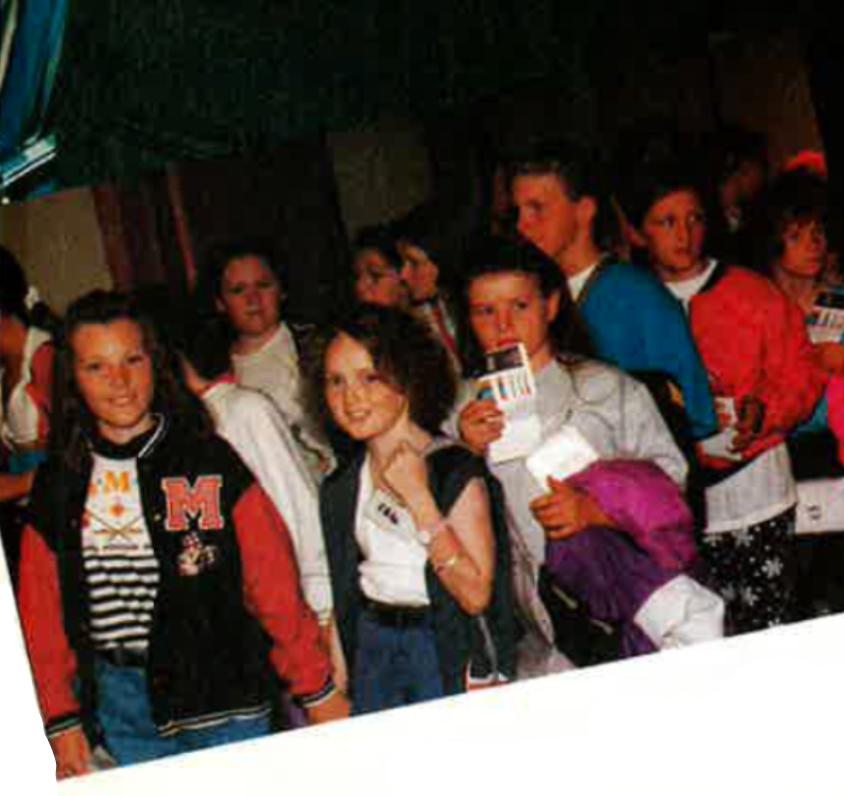
As Margaret Dawson of St. Patrick’s School and “veteran coordinator” observes, “our coordinators walk the Atlantic.” It aptly describes part of the unique flight from Belfast to JFK.
Project Children were the first to ever have a trans-Atlantic flight from Belfast and they have some more unique facilities afforded them.
The Immigration and Naturalization Service (INS) send two officials on the plane so that all the documentation can be cleared in-flight. At JFK, Project Children have a hangar to themselves upon arrival and they walk straight off the plane to buses provided by the Port Authority. On occasions, air traffic controller have even been known to put all other planes on hold to facilitate the Project Children flights, such is the standing of the charity and its workers.
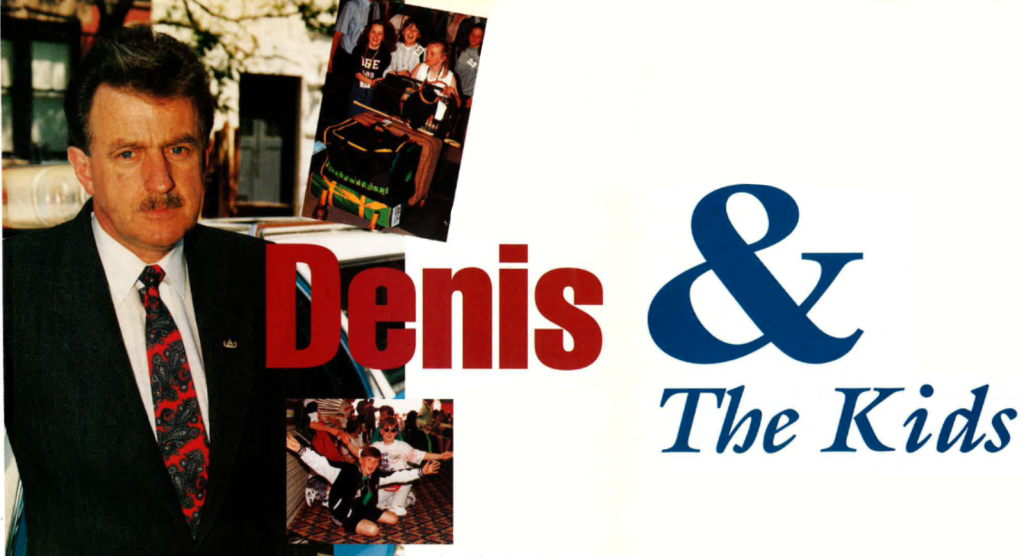
Mr. Project Children
Denis Mulcahy is, in the words of one of his hard-working coordinators, “Mr. Project Children.” It was an idea he and his brother had in 1976 to give children from the North “a break.”
He is also “the man” when it comes to bomb disposal in the five boroughs of New York City. He is the longest serving and most experienced member of the squad and was recently promoted to 1st grade Detective.
Among the multiplicity of files, trophies, badges, bombs, videos and books that fill and clutter his office is a small, pockmarked, and singed Stars and Stripes that was close to “ground zero” in the World Trade Center explosion. Its survival is undoubtedly symbolic, perhaps like his own and that of his Project Children.
He appears at first a casual, laid-back type of man, instantly affable, but his work both professionally and with Project Children belies that image. He is methodical and systematic. He works by routine and instinct but seemingly finds time to relax.
He is almost certainly one of the few people who can legally carry Semtex plastic explosives in his pocket around the streets of New York. It is, he explains, to sensitize the dogs before they conduct a sweep.
The vast complexities of bringing over 9,000 children to the U.S. over 16 years seem to mirror and perfectly utilize the talents he uses professionally. The natural charisma in his personality is reflected in not only how his professional colleagues perceive him but also how the voluntary coordinators and hosts undertake mammoth tasks at his behest to ensure success for the venture.
Not wishing to tempt fate, as he does every time he walks the line on the job, one coordinator remarked “I really don’t think we could survive without him.”
A native of Rock Chapel, County Cork, 49-year-old Mulcahy could have retired five years ago but dismisses such suggestions out of hand as he mixes anecdotes about work, Ireland and Project Children. Clearly a practiced, but genuinely modest, raconteur, he has a very precise, but not blinkered, focus on what he does. It is consuming but not exclusive. Should he ever decide to write a book, there is more than enough material.
Over the years he has become philosophical about the vast array of problems and minor crises that arise. Homesickness is now one of the minor considerations. Of course with any group of 900, you are going to get bumps and bruises, tears and tantrums, no matter what, but all are handled with the same diplomacy, and through a vast network of contacts where Mulcahy undoubtedly receives a lot of professional courtesies.
Criticism and Diplomacy
He handles criticism of Project Children in the same diplomatic way but doesn’t shy away from the issues raised. There are detractors who feel the premise is fundamentally flawed, i.e.: taking the children from a crisis into what amounts to a near fantasy and then returning them to the same crisis.
Mulcahy’s answer is twofold.
Firstly he is not suggesting that Project Children is a panacea or a solution to the conflict with all its attendant complexities. It is quite simply a break, a holiday, a new and hopefully rewarding experience for both the children and the hosts. Travel being the best education.
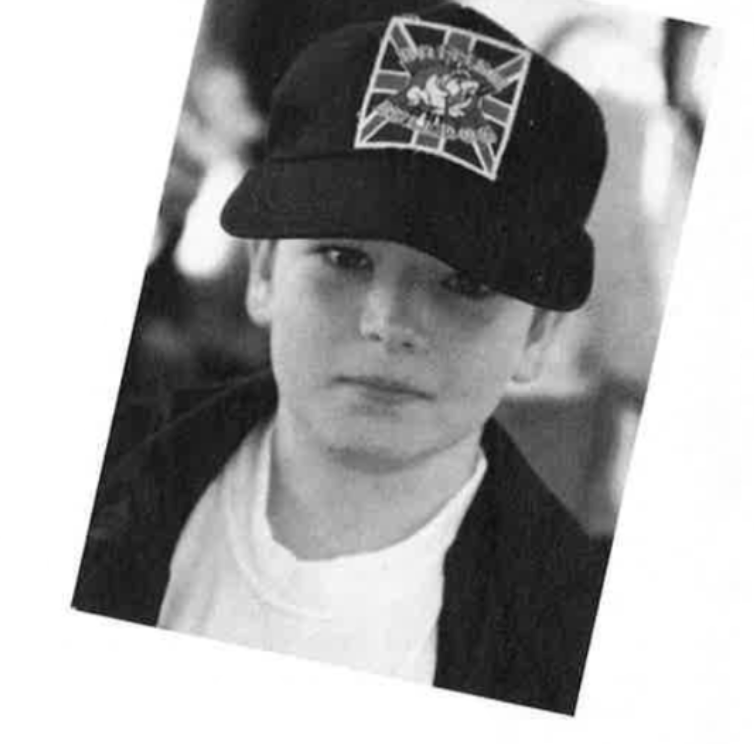
Secondly, as an organization they have, with the help of child care professionals, studied the psychological effects on the children and have concluded over the years that it is not in any way detrimental.
“It goes without saying that we would not continue something that would have a bad effect on the kids.”
It is not an attempt either by philanthropic Americans to teach “uncivilized or tribalistic” Irish children how to live together. The vast majority of hosts are undoubtedly richer for the experience and if any missionary zeal existed prior to their charges’ arrival it very quickly disappears.
Criticism that the money could be better spent in Ireland prompted Project Children to start a number of pilot schemes in the North where by schools, groups, or individuals are paired off for a number of events prior to their departure for the U.S. This is the second year, and the long-term viability or indeed desirability has yet to be assessed.
Mulcahy is a man comfortable with his life and applauded publicly and privately by hosts, kids and their families. Many are happy to acknowledge an unrepayable debt for the break that changed so many things in their lives and futures. His nomination for a Nobel Prize brings the wry smile of a man who is more used to doing than receiving. Surprisingly, perhaps, for the leader of an organization with such a public profile over the years he is more inclined to head for the rear of the gathering than the top table. It is a mark of the man and his motto that he is indeed more interested in “changing things one child at a time” than receiving accolades and attention.
American Hosts
Janine and Dave Donaghy, a nurse and a social worker respectively, found that Neil Quinn fitted in very well with their three sports-oriented kids, Kevin, 11, Tim, 9, and Tess, 4. Neil loves soccer and was enrolled in a soccer camp. He reckoned his fellow students were “just all right” when it came to the skills needed to play the game. “They play more baseball.” A day trip to Water Safari was “really great,” and there is no doubt in his mind when asked about returning. “I’m coming back.” The feeling was absolutely mutual: the Donaghys “would dearly love to have Neil return.”
Ciaran Donnelly rapidly adopted the accent and style of his young partner Joe Vorholt whose parents Tom and Angie hosted him in their St. Louis home. In their veterinary clinic he came across “loads of animals but mostly cats and dogs.” Totally assimilated, he like so many of the others, spent a great deal of his summer in the backyard swimming pool. In the sweltering mid-summer heat the pool was the place to go “everyday.” He seemed a lot less boisterous than when I met him in Belfast, and said he missed “chips” most of all.
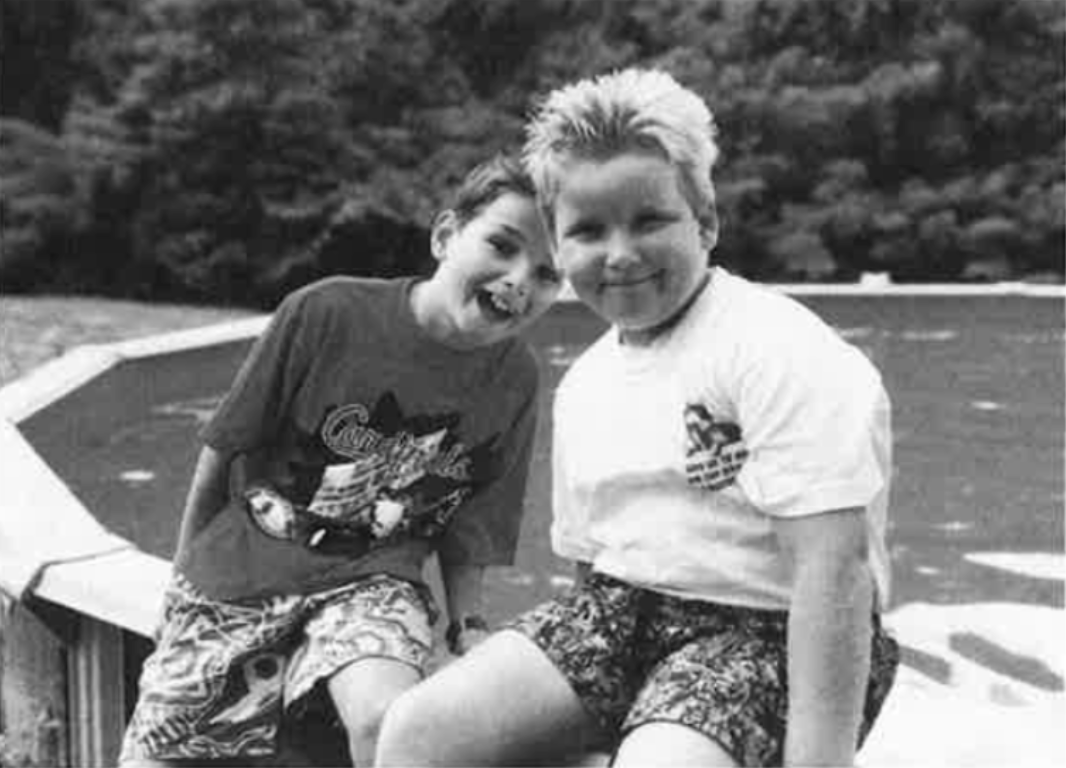
Francis MacBride and her cousin Grainne Rafferty from Derry both learned how to swim on their trip to New Jersey. Francis and her friend Lisa Doherty were re-in-vited to the home of Hank and Alice Waters after a year break so that they could partake in a family wedding. “I learned to dive this time,” says Francis. Lisa’s only complaint: being misquoted in a local paper. “It’s brilliant because the people in America are like your mummy and daddy all over again.” You’ve got two sets of parents. A diet of swimming, movies (“Free Willie is so sad. I loved it”) and trips to Great Adventure, Wildwood and Pennsylvania made for a “class time,” with only one major dislike, “American sausages; they’re like rubber.”
The highlight for Francis was a Project Children picnic at which she met up with friends from home and a two-day road trip to Canada on which she “wasn’t even sick and when I go to Belfast I’m sick.” The fact that there were “deers and squirrels in the back garden,” added to the excitement.
The Waters are planning a trip to Derry this Fall to visit their summer charges.
For the vast majority it is the “trip of a life time” and for some it is habit forming. Margarite O’Neil has been brought back five times by her host family and her “boyfriend” of three years has even come over to stay in Belfast with her family.
Hardly surprising after 17 years and nearly 9,000 children, many of those who came over as kids are now married and resident in the United States. Kevin Brady and John Chivers, two of the original group of six children who came over in 1976, reside in Florida and New York.
“Let’s Be Friends”
As the visit ends a million promises are made: “Let’s be friends.” “We’ll write.” “Come back next year.” Like all such promises many fade like the summer but enough are kept and built upon to ensure many more summers of Project Children.
Presents from hosts and presents for families are loaded into bags that are much bigger and more abundant than on the outward journey.
With a complete transformation in fashion sense the children reassemble at JFK airport clutching bears, baseball bats and a wealth of memories. Summer exploits are exchanged. One youth confesses he beat up every kid on the block but quickly recants when another classmate swears “he couldn’t beat his way out a paper bag.” Another has spent his third summer in the California home of Batman star Michael Keaton and two more boasted of having their pictures in the paper in Montana.
The flight home is pure expectation; “homesickness for their American families” comes a few days later.
On board the 18 or so chaperones are once again “walking the Atlantic” and looking forward to putting faces to voices they have only heard on the phone. It is the very last stage of a project that started in the fall of the year before and everyone just wants to kick back in the Emerald Isle.
In a hotel at the foot of Slieve Gullion that straddles the border, the Sacred Heart Club of Newry host a dinner for Project Children.
There are tears and cheers as Denis Mulcahy’s formal nomination for a Nobel Prize is announced and the efforts of coordinators like Marie Mc Vicker Villeto are recognized as she receives the Cuchulainn Award. A native of Belfast and now Poughkeepsie, she fights back floods of tears as the award is announced.
The summer of ’93 is over and back in Belfast Neil Quinn started his first day at Secondary School. The presents he received and bought are proudly displayed amidst the immaculately clean and compact “front room” of his New Lodge home. Pictures are shown and described and “please God if all goes well he’ll go back next year.”
His are not the only set of pictures preserved in an album. His mother has one “good as new up the stairs” of her trip to America when she was 11.
Editor’s Note: This article was originally published in the January/February 1994 issue of Irish America. ♦
Leave a Reply