
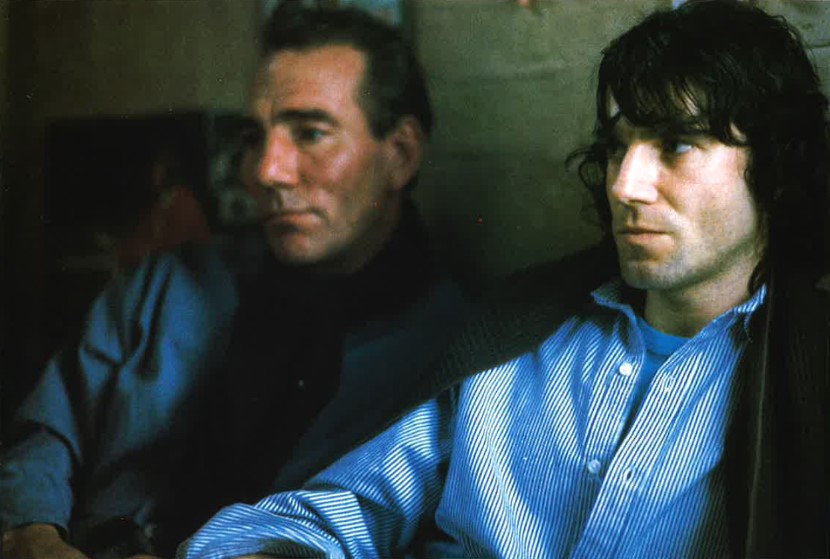
Pete Postlethwaite astonished critics and cinemagoers alike with his performance in In the Name of the Father. It came as no surprise when the previously little-known actor won a coveted Academy Award nomination for his portrayal of Guiseppe Conlon. Jane Campbell caught up with Postlethwaite in London, where they talked about the movie and the challenges of playing Guiseppe — a man declared by many to have been “a saint.”
Pete Postlethwaite in person appears to be extremely healthy. For anyone who has seen his utterly convincing performance as the wrongly imprisoned and desperately ill Guiseppe Conlon in In the Name of the Father this is the first thing you notice. On a street in London’s Soho he looks — in tweed jacket and cap, with red cheeks under a few days’ stubble — like someone who has come up from the country for the day. It turns out that he has. He lives in Shropshire with his wife and young children and is in town to do some sound work on a film he had just made for Central TV.
We wander around sticking our heads into pubs until we find one where the juke-box is sufficiently muted to allow conversation. No one takes any notice as we settle down with pints and a tape recorder (“They’re used to this–it’s silly city, Soho,” he remarks) to talk about In the Name of the Father.
Postlethwaite was born and raised in Warrington, an industrial town in the north of England. He started out as a school teacher but after a couple of years had saved enough money to go to drama school to do what he really wanted to do–act. Work in the theater and television followed, and in the past few years there have been film parts (Distant Voices, Still Lives, The Last of the Mohicans) but this is his highest-profile role to date.
He got involved in the film through Daniel Day-Lewis with whom he first worked at the Bristol Old Vic while the latter was a drama student there. Contact was renewed during filming of The Last of the Mohicans and it was Day-Lewis who suggested him for the part to director Jim Sheridan. “I went to meet Jim; we had a chat which seemed all right, then I went to do a bit of a screen test by which time I was fired up like mad because I knew the story of the Guildford Four; I’d followed it and had in fact campaigned.” He looks off across the bar.
“Then I read Gerry’s book Proved Innocent and through that I met Guiseppe Conlon. I just knew him and I thought, ‘I’ve got to play this,’ so I went all out. I worked like mad on the Belfast accent, went to an Oxfam shop and got a suit and shoes and cardigan, and from the moment I left the flat to go and meet Jim and Dan and do these screen tests I was in character. As far as I knew at that moment I was Guiseppe Conlon. I was speaking in a Belfast accent. I turned up at this hotel in Kensington and said ‘Can you tell them Guiseppe Conlon is here?’ and they looked at the list and the name wasn’t on it and I said, ‘You’ve probably got Pete Postlethwaite down but he couldn’t make it so he sent Guiseppe Conlon.’ So I went up and about three hours later I emerged having kept in character the whole time. I really went for it and put myself on the line, and I think Jim was convinced.”
Speaking now in his own northern English accent, Postlethwaite’s matter-of-fact tones convey authority, and you can imagine that it would be difficult to deny him something once he’d decided to go after it.
Once he had the part, what did he do to prepare for it? “I went up to Belfast to meet the family. I met Sarah [Guiseppe Conlon’s widow]. Couldn’t have done it without her. I had all the equipment and the emotional volition but I would never have been able to get as near as I think we do get, without her extraordinary generosity of spirit. She allowed me to share in the details of their lives, she let me read his letters–six to eight years of letters from prison. You got the whole history, you got the man, the family. I didn’t try to be a facsimile; nor did Dan try to mimic Gerry. We went from an internal point of view of what made their hearts and souls work and strangely the result has been incredibly convincing to people who knew them very well.”
Conversation is briefly drowned out by someone hitting the jackpot on the poker machine to our right, then I ask whether it was difficult to play a man whom Jim Sheridan has described in interviews as “a saint.”
“I did feel great responsibility to that man’s life, name, honor, everything he’d done and gone through. And of course the shady bits about the man. Good friends would say he’d never buy a drink but would always tap you for a pint. But the essential spirit of that man speaks to us all. He was like any ordinary man but he happened to raise ordinariness to an extraordinary level given the circumstances in which he found himself; a day didn’t go by that he didn’t collar someone and say, ‘I’m innocent you know, I’ll tell you the story.’ It was blatantly obvious to even the most hardened people that this was an innocent man.”
Making the film “proved to be every bit as much the kind of adventure that you would dream of. It’s such a deeply distressing tale on many levels that it was necessary that there should be a sort of divine madness going on, and of course Jim was the leader of the dance. He is a dreamspinner of truth; he is so accurately, organically aware of the truth of any particular situation that he can see through that truth to a more universal truth which may even be a dream. He’s a magician and one of the most ego-less people of that ilk and in that position that I’ve ever met. He’s also a determined bastard. He asks, ‘What’s the next point to make in the story–is it the one in the script or is it something else?’ He won’t be hidebound by scripts or schedules.”
This eulogy is interrupted as a man on his way out of the pub pauses to say, “I seen you on the telly.” Postlethwaite nods pleasantly. This is six days before his Oscar nomination for best supporting actor is announced and a week before the film opens in the U.K. so it is likely he’ll be in for a lot more recognition before long. I ask what it is like working with Daniel Day–Lewis–the man whom a thousand magazine articles have failed to lay bare.
“Dan is a great actor–why are people so envious of that, so determined to undermine that or find reasons why? He is an electric performer and an interrogator for the truth. He knows the whole thing is a sham–that’s his a priori. As soon as you’re in a film it’s a sham so you’ve got to get beyond that. He’s not trying to hood-wink people so I don’t know why they should get so aggressive about his methods or his way of working. Peter Brook [the English stage director] was doing stuff like that a long time ago; finding out Glenda Jackson was afraid of spiders and throwing a box in front of her.” Annoyance makes him speak emphatically:
“It’s just a way of finding out and not being complacent and saying ‘Yeah I’m a good actor, I can play that part.’ Dan’s major question about this whole film was under what circumstances would a person who was innocent actually sign away not just his life but lots of other people’s lives as well? What on earth would make somebody do that, and in order to find out he goes to extraordinary lengths–he’s not just going to sit by and say, ‘well they did’ and make it up.”
Postlethwaite welcomed the chance to work in Ireland. “I fell madly in love with Ireland through this Irish girl I knew when I was a teenager. Her family came from County Down. We had no idea of the politics; all we saw was this extraordinary nirvana. If I didn’t live in Shropshire I’d live in Ireland because there’s a healthy laughing cynicism about the whole business of life. They have been the outsiders and the slaves in a way for a long long time, and that automatically creates resilience. I find an openness there; there’s an attitude of ‘I’ll hear your views, I’ll disagree, but I’ll still have a pint with you.’ In England we’re so entrenched, categorized and cauterized and demographied.”
And of the end result, he says, “I was surprised when I first saw a rough cut of the film at its epic nature. I thought it was about a family who happened to get embroiled in this extraordinary thing, which happened to be a political thing, and by chance it was an Anglo-Irish thing, but I think it’s a film about what happens to ordinary people enmeshed in extraordinary situations. It’s the same kind of thing that’s happens time and time again–people are taken out of their environment and accused of doing extraordinary things … That’s what makes you angry and frustrated–why don’t we rage against the dying of the light sometimes and stand up and say, ‘how dare you do this?’ We try to be placatory and see everyone’s point of view but they don’t; they come in with extraordinary procedures to cover up stuff, to stop this, to mum that, to put a gag on that, at the same time spouting wonderful rhetoric about believing in moral justice and moral values and here we are still trying to talk it through and be reasonable.” He is passionate as he talks about “them,” the establishment forces behind the cover-up.
In the weeks leading up to the release of the film in the U.K. the British press has been full of stories about the film’s “factual errors.” While none has sought to deny that a horrible miscarriage of justice led to the wrongful imprisonment of the Guildford Four and Maguire family and the death of an innocent man in prison, it has been argued that the film’s credibility is undermined by, among other things, inaccuracies in the depiction of legal procedures. Absolutely no allowance is to be made, it seems, for the difficulty of compressing 15 years of two men’s lives into a 135-minute movie. Artistic license is revoked when the good name of British justice is at stake. Does this attitude make Postlethwaite angry?
“Not really. In these days of damage limitation and preemptive strikes I find it perfectly understandable that certain areas of the press would find it necessary to diminish either the power or veracity of the story, especially with it being hooked up to a big Hollywood studio. So okay they didn’t spend all those years together in one cell, Paul Hill didn’t eat sausages at Annie Maguire’s. What does make me angry in retrospect is that these people who are so clear and conscionable about finding out these facts, why were they not here asking these kinds of questions when there was the original internment and then the appeal? There was obviously a rat being smelt somewhere along the line; why didn’t these journalists ask the questions then?”
He and Emma Thompson have taken some flak for being involved in a film which, while not anti-British, is anti-British establishment. “The Daily Telegraph quoted me as saying, ‘I can’t wait for this film to hit England.’ Read like that it does sound like, ‘He can’t wait to stick it up you lot,’ which isn’t the case at all. I just think it’s important that it be shown in England as much as it be shown in Ireland. I also feel as an Englishman–sometimes I’m not very proud to be an Englishman but the majority of the time I am–and as an artist, that I am able to criticize my own society. More qualified perhaps than even an Irishman. In this case the problem is that no one likes to be criticized from inside the family. They think we should close ranks, but when you see that kind of rabid injustice going on you have to do something about it.”
He checks the clock over the bar; it’s time to go to catch the train back to Shropshire. I remark upon the irony of such a great film and, by all accounts, wonderful working experience, having come out of a massive and tragic failure of the justice system. He looks thoughtful: “It’s being mad that keeps us sane. I was talking to the people up in Belfast about this situation … Somebody said, ‘Anybody who isn’t confused up here doesn’t really know what’s going on.’ It’s from a book called The Crack: A Belfast Year and it sums it up brilliantly. We try to convince ourselves before we go to sleep at night that we are aware and do know what’s going on, but we actually don’t; you know we really don’t.”♦
Editor’s Note: This article was originally published in the March / April 1994 issue of Irish America. ♦
Leave a Reply