
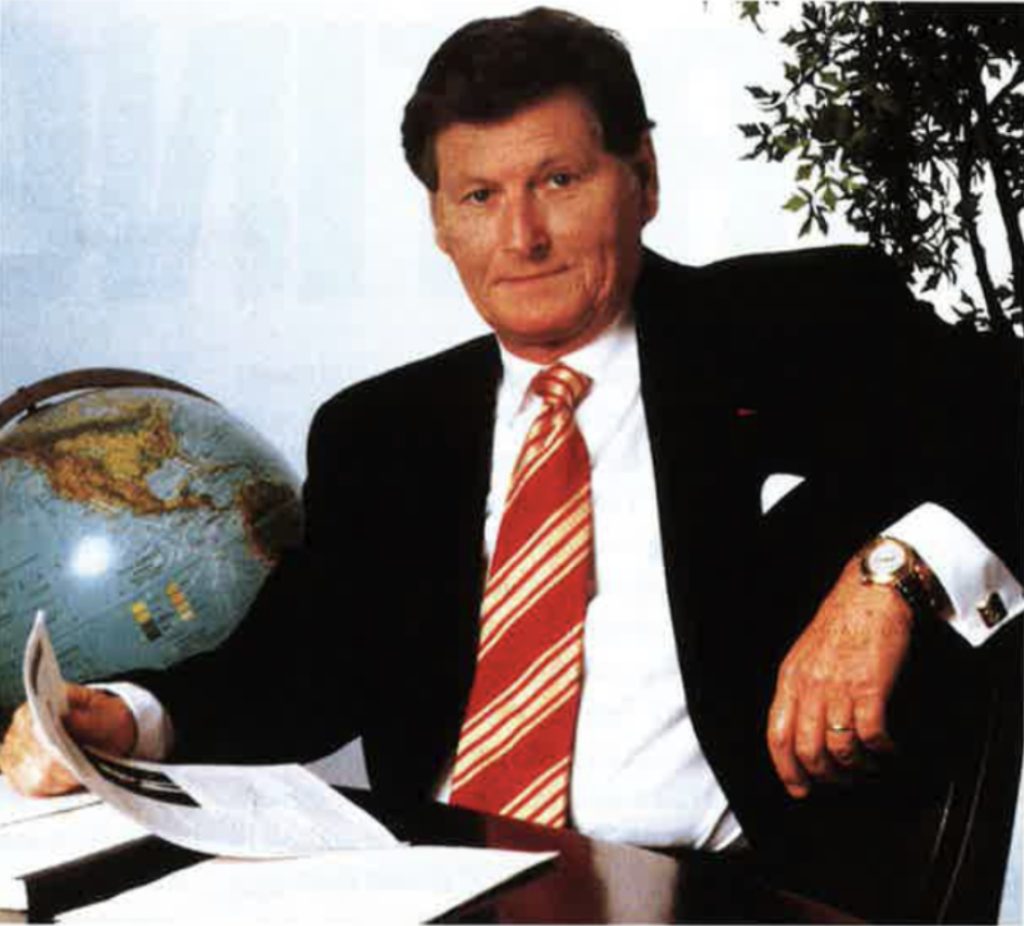
The Jefferson Smurfit Group, Ireland’s largest company, successfully launched its U.S. subsidiary on the New York Stock Exchange recently, despite widespread jitters about new offerings on Wall Street.
Niall O’Dowd interviews company Chairman and Chief Executive Michael Smurfit.
Going public on the New York Stock Exchange is a little like watching your children being born — you are never quite sure how it will turn out, and it is clearly not for the faint-hearted.
When an Irish company brings its American subsidiary public, there are several other factors involved. Unlike the U.S., where a company can relatively anonymously go about its business, the appetite in Ireland for companies taking on America is insatiable. Every step in the process is widely reported and analyzed, with a fair share of begrudgers hoping the deal comes undone.
When the company going public is also Ireland’s only multinational and the largest business employer in the country, then the interest is even greater. The Jefferson Smurfit Group logo is almost as familiar as Coca-Cola in Ireland, so pervasive is their presence countrywide. The company, after all, is a $4 billion corporation with $3 billion in external sales, with outposts in a far-flung business empire ranging from Latin America to Europe to Africa.
Thus, there was much at stake when the largest public offering ever made by an Irish company on the New York Stock Exchange was underway. Its architect was Ireland’s leading entrepreneur, Michael Smurfit, 56, who staked an impressive career on his belief that the time was right.
The signals were mixed. Jefferson Smurfit Corporation, the American subsidiary of the Dublin-based Jefferson Smurfit Group, was going public at a time when their base businesses — paperboard and packaging products — were just recovering from the worst slump since the Depression.
In fact, so bad were the market conditions that customers had become used to decreasing prices for the paper products for over four years. In that light, a wrong move and the public offering could easily fail in a jittery market — as another Irish company, Guinness Peat Aviation, learned to their cost last year. Fourteen other public offerings had been withdrawn in the immediate period before the Jefferson Smurfit Corporation launch.
Indeed, the paperboard and packaging business has been going through the worst time of almost any major industry in the U.S. Says Michael Smurfit, “This recession was the worst since the Great Depression for my industry. It literally lost billions of dollars worldwide.”
As to why he decided to go public, Smurfit says, “It’s a feel. That’s what makes a difference between the entrepreneur and the professional manager. Last October I had sensed that the market was beginning to turn. There was no point in selling into a declining price market. I realized the time was right.”
The company was also leveraged as a result of its billion-dollar buyout of Container Corporation of America, a Mobil Oil subsidiary in 1986. Thus, the company was faced with significant repayment of debt over the next few years, and it was clear that they needed more equity.
A “very good reception” at the various meetings with institutional investors and at the road shows to promote the public offering helped boost the confidence of the company executives and their partners at Morgan Stanley, led by Irish American Don Brennan. Still, the acid test was yet to come.
By his own admission, Michael Smurfit is a man who has “been to the cliff a number of times in my business career and looked over it.” No entrepreneur will build a $4 billion business empire from small beginnings unless he is prepared to walk such a line.
This time the stakes were possibly higher than at any time before. Failure to go public would have crippled future projects, could well have resulted in lasting damage to the company. Almost 30 years of company growth could have come crashing down with an attendant impact on the Irish economy, which is just beginning to pull out of a lengthy recession. Smurfit himself says the public offering was “as close as I’ve ever been in my business career to something not working.”
On the upside, Michael Smurfit knew with the quiet determination that characterizes the man that no stone would be left unturned. “This is one of the big steps you have in your life; this is a fulfillment moment of the entire year’s dreams. I came here first in 1974 so this was the ‘coming together’ of all those years, if you will,” says Smurfit, leaning back in his chair in his Fifth Avenue office.
The reference to 1974 is to the jumping-off point for the company’s involvement in America, the last building block put in place by the Chairman and Chief Executive who has built his father’s small packaging and paper concern into the $4 billion dollar international corporation it now is.
He started out working on every facet of the company from the factory floor up. His father, Jefferson Smurfit Sr., was an Englishman who made his home in Ireland and commenced his paper mill business there. In an ironic twist, because he was Catholic, he was opposed at every turn by many of the Irish Protestant-owned companies who had monopolized the market up to then.
The family firm that Michael and his brothers, Alan, Jeff Jr., and Dermot took over in 1967 was a far cry from the multinational company that exists today. Within a few years, having taken over four of the six largest firms in their business, Jefferson Smurfit was the largest company in Ireland.
Following that there was a rapid expansion to the U.K., Europe and the U.S. In 1974 they bought into Time Industries, a small Chicago- based packaging company, and commenced their American cycle of expansion.
After the Time deal they bought Alton Box in Ohio, and in 1982, Diamond International. In 1986, the purchase of the Times Mirror Publishers Paper subsidiary in Oregon began a diversification into newsprint. Also that year, in a joint venture with Morgan Stanley they purchased the giant Container Corporation of America, a Mobil Oil subsidiary, for over one billion dollars.
The combined company is now the largest producer of paperboard and packaging products and also the largest producer of recycled paperboard and recycled packaging products in the U.S.
The impact of the subsequent recession on such a price sensitive market sent JSC profits into a tailspin. The newsprint division, for instance, which was once making $80 million a year, turned into a $40 million loss in just two years.
The company fundamentals remained strong, however, and from adopting a holding approach during the recession, Michael Smurfit gauged that the market was finally turning, and that it was time to go public.
Going public in the personal sense is something Michael Smurfit does reluctantly. “I don’t like the limelight. I try to keep a low profile,” he says.
Given the profile of the company, however, publicity in Ireland is an inevitable consequence of being a very big fish in a small pond. With just a handful of politicians and businessmen who could qualify under the term “international success,” there is inevitably a focus on his activities. “It’s a sort of sport,” he says referring to the constant coverage. “You’ve only got politicians and businessmen and there are only a handful in the bracket of real success. It’s inevitable I suppose.”
Unlike many of his compatriots, however, he usually shuns the limelight, preferring a close circle of friends who have helped him build his empire to the international jet set and the gossip mongers.
He is as happy at the racetrack as anywhere. Last year, his horse Vintage Crop did the impossible, capturing the Melbourne Cup after flying round the world from Ireland. It was the kind of calculated gamble that Michael Smurfit has perfected all his life. In his sporting pursuits at least, Michael Smurfit gets very positive coverage
But he has also felt the sharp edge of the hostile media more than most. A few years back, as part of his commitment to Ireland, he took over the position of heading up the hopelessly outmoded state owned telephone and communications system known as Bord Telecom. Within a short time the company was transformed to the point today where Ireland has one of the most efficient phone systems in the world.
A newspaper report about a sweet property deal involving new headquarters for Telecom became a public brouhaha with Smurfit among others accused of profiting from the deal. After a lengthy inquiry he was completely exonerated, though he resigned on principle while the inquiry was in progress.
“It was probably the worst period of my life except for my parents dying,” he says. “The most hurtful thing was not being believed and being forced into a resignation that was totally unnecessary. Propriety has always been my middle name. For some reason after doing business for 38 years in an honest and straightforward fashion someone had the impression that I wasn’t to be believed. It took me a while to get over that.
“At the time, I was going through my own health trauma because of a back operation that did not work, which was compounded by having to go through the difficult months of the inquiry which went on longer than anyone anticipated. But I knew where I was heading, and I knew where the goal posts lay, and last July the Telecom report was finally publicized, and in October I got some new treatment that relieved my back. Also in October, from the trip I’d taken around the world, I sensed the mood change in the industry worldwide, and I was determined to go public right away, and presto! prices started to improve in December and now we’re on our way.”
In early May of this year the Jefferson Smurfit Corporation U.S. subsidiary successfully went public on the New York Stock Exchange in a $400 million offering of which the Irish parent company had already agreed to take up $150 million. The total restructuring, including loan refinancing, was $2 billion. The company is now quoted on the NASDAQ exchange and opened at $13 a share. At press time the share had advanced to 14 1/8.
The price seemed initially disappointing as newspaper reports had calculated anywhere from $16 a share on up. On news of the $13 a share the company price dropped sharply on the Irish stock exchange, something Michael Smurfit calls “a knee jerk reaction.” “They didn’t understand it because there was a sort of feeling that $17 or $20 a share was out there. Clearly when you’re making a prospectus as sellers the underwriters were looking to get the most they possibly could. The issue was actually making the offering a success rather than having a failed offering.”
Coming in the wake of troubled times in the paper and packaging industry and the unsuccessful attempt to launch Guinness Peat Aviation, another Irish company, which resulted in its near bankruptcy and subsequent takeover by GE, the Jefferson Smurfit success in launching was all the more gratifying for the principals.
“I’ve always had great inner strength and confidence in my company and myself. You have to keep an organization’s heart going, which was difficult for me at the time of the recession. Things are now open to us. We’ll be able to do acquisitions. We have a natural capability to grow the business again. This year for example we will be spending $170 million,” he says.
Looking back on one of the toughest periods in his business career Michael Smurfit now says, “The reality is that in the past few years when profits were going down your motivation of the troops was ‘head down and let’s get through the storm.’ There was nothing you could do about price drops and market conditions. Now we’re growing the business again, opening doors, moving ahead. I wouldn’t know what else to do if I wasn’t running this company, and I wouldn’t know what else to do if I wasn’t running it the way I run it.”
Editor’s Note: This article was originally published in the July/August 1994 issue of Irish America. ♦
Leave a Reply