
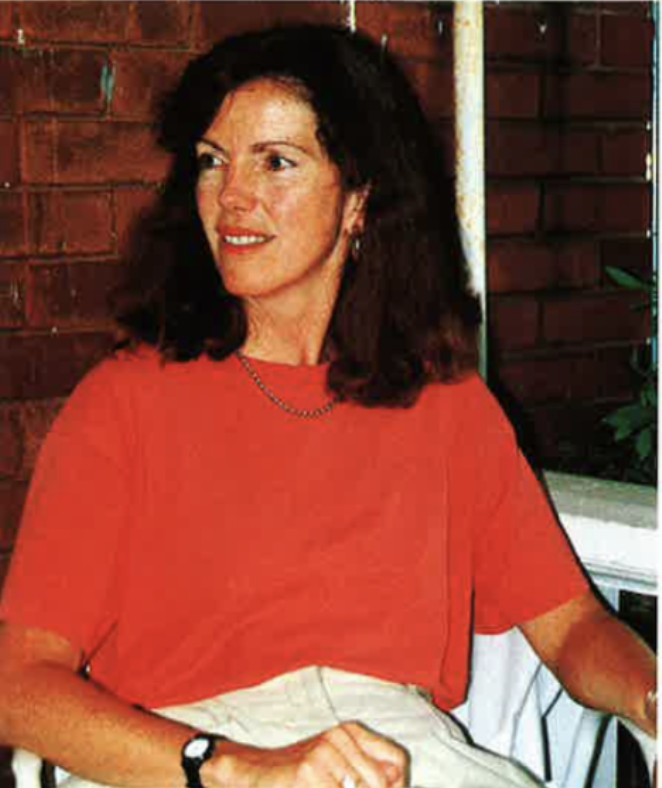
Canadian writer Jane Urquhart returns to her Irish Roots
Even with three successful novels, a collection of short stories, several volumes of poetry, and a prestigious French literary award under her belt, Canadian-Irish writer Jane Urquhart still gets excited by the little things.
Like touring Ireland to promote her latest book, Away, which has hovered near the top of the Canadian best seller charts for almost a year and amassed critical acclaim on both sides of the Atlantic. Months after the promotional trip, Urquhart still sighs blissfully when she recalls her public reading at Dublin’s Irish Writers’ Center.
“With all the things I knew and read about Dublin and its incredible literary connections and history, it was just so wonderful to be reading from my own book there,” she says, her voice rippling with retrospective excitement. “And then when I saw Away in bookstores there…it was just impossible to believe — my book available in Ireland!”
Since the appearance in 1986 of her first novel, The Whirlpool, which won France’s Prix du Meilleur Livre Etranger (best foreign book award), Urquhart has become one of Canada’s most renowned contemporary writers. Her second novel, Changing Heaven, also impressed critics, who compared Urquhart’s storytelling skills to those of Canada’s premier novelist Margaret Atwood, and marked Urquhart as a future star in the international literary sky.
Away is Urquhart’s first novel to explore her Irish roots. Opening in Ireland just before the Famine, the book is a compelling, deeply-felt and occasionally heartbreaking chronicle that traces a mysterious legacy bequeathed to four generations of women after one momentous encounter on the shores of Rathlin Island, off the coast of County Antrim.
It begins as islander Mary O’Malley is found lying in the arms of a dead sailor who was washed up on the beach after a great storm. In accordance with the legends of the time, the islanders believe the sailor is Mary’s demon lover returned to take her back to the sea, leaving only a changeling in her place. Obsessed thereafter by visions of the sea and her dead sailor, Mary becomes a warily-regarded stranger in her own community; she is away in the spirit kingdom.
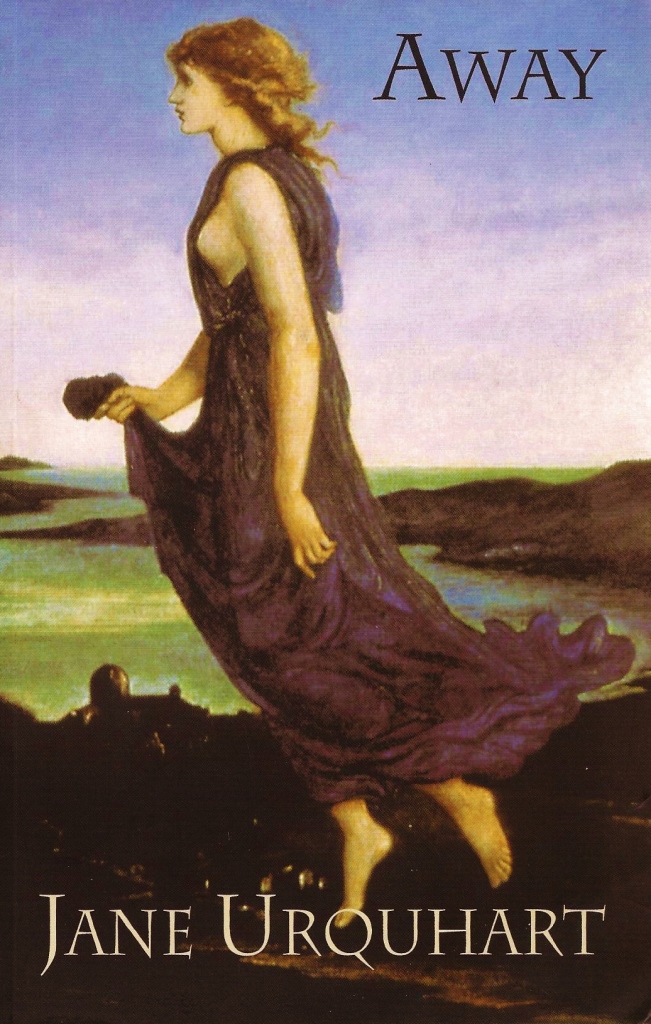
After a hastily-agreed marriage, Mary and family emigrate to Canada to escape the Irish Famine, but her peculiar spiritual aspects return after the Atlantic crossing, ultimately becoming a trait passed on through successive generations of O’Malleys. The novel concludes on the shores of Lake Ontario in the 1980s, as Esther, 80-year-old great-grand-daughter of Mary, recalls her past and slowly becomes aware that throughout her own life, she too has been away.
Urquhart uses the term to describe those who feel “a mystical distance from what is perceived to be the real world.” But her novel is more than a look at a family whose destiny is altered by an otherworldly nature. Away also focuses new attention on an aspect of Irish immigration history more often overshadowed by accounts of Irish successes in the United States: the desperate struggle that hundreds of thousands of Irish famine victims faced in establishing a new life in the remote territories of the Canadian Shield.
It’s a story to which the 45-year-old writer feels strongly connected. Urquhart’s own family, the Quinns, were among those who left Antrim in the 1840s to farm Canadian soil. The experiences of the characters in Away are loosely based on their stories, she says, and although tangible links to Ireland have receded over a century and a half, Urquhart retains a strong emotional attachment to the home of her ancestors.
“I knew early on in my writing career that I wanted to write about the Irish in Canada,” Urquhart admits. “Nobody has really done it before, and fortunately, as a young girl I spent a lot of time listening to uncles and grandparents talking about Ireland, so I managed by osmosis to pick up a sense of what the place meant to my family. Then, having heard so much about the country, I became obsessed with it.
“As I got older, however, it seemed peculiar that people who had never been there could feel so strongly about Irish beliefs, myths, and politics,” Urquhart adds. “So when I began writing Away I had two questions to answer: why certain beliefs about Ireland exist in a whole different landscape, and what happened to the magic when it crossed the water.”
When the fictional O’Malleys cross the Atlantic in Away they experience what Urquhart says was probably common for many of the Irish who survived the brutal journey and landed in Canada: their promised land offered small improvement over the situation in Ireland, and desperate hardships still had to be endured.
“The Irish were all sent to the Canadian Shield [a barren area of exposed or nearly-exposed rock stretching almost two million square miles across eastern and central Canada] because by the 1840s, all the arable land had already been snapped up, usually by Britons,” Urquhart says. “The truth is that those immigrants who could afford it went to the United States, because Canada was actually British North America at the time of the Famine, and for many, that meant living in the kind of fear they thought they had left behind in Ireland.”
That didn’t stop the immigration, however, and although a precise total for the amount of Irish who arrived in Canada during the Famine years depend on who is compiling the figures, it’s generally agreed that in 1847, the worst year of the Famine, more than 100,000 Irish were added to Canada’s population of 1.7 million, making the Irish the third-largest ethnic group, behind the French and British. In fact, according to Urquhart, a staggering 70 percent of the population were of Irish and Scotch extraction by the early 1880s, and this prompted a Government motion to make Gaelic the third official language of the country!
“When I was researching for Away I found reports about the St. Lawrence River being backed up with ships from Ireland for over 30 miles,” says Urquhart. “Can you imagine how many people that must have been? And remember that up to one third of those who set out on the crossing died on board.”
Urquhart’s fictional heroines and heroes miraculously survive the brutal ocean journey and a spell at Grosse Ile, the quarantine station in the St. Lawrence River where up to 25,000 Irish Famine-era cholera victims are buried. Remembering that the Canadian government plans to redevelop the burial ground into a national theme park, the author offers words of caution.
“The Canadian government needs a big change in attitude about the whole thing, and it really needs to be handled more sensitively,” she asserts. “Grosse Ile is a burial ground, a sacred thing, and you can’t turn it into a fantasy. It represents a side of Canadian Irish history that was never told because the dominant culture was British, and the history was officially ignored.”
In some ways, Away attempts to resurrect that hidden history. Esther O’Malley, the 80-year-old granddaughter of Mary with whom the book concludes, is saddened by a belief that her ancestors’ stories and the sense of connection to a magical existence are in danger of fading through time. Indeed, isolated from its supporting culture and assailed by the forces of a more pragmatic modern culture, the folk customs of any community might have been expected to have evaporated completely.
But according to Urquhart, who as writer-in-residence at Memorial University in Newfoundland had research access to one of the greatest Irish library collections in North America, some of the magic she examines in her novel still exists, and traces of the beliefs and superstitions from 19th century Ireland can still be found in at least one part of Canada.
“I’ve met people in Newfoundland who hold mythical beliefs that certainly stem from pre-Famine Ireland,” she says. “In some isolated areas that were visited seasonally by Irish fishermen, even the Irish accent has remained, and a fierce belief in otherworldly experience is common. The old stories and convictions probably continued through the generations because of the vehemence and strong feelings attached to them originally when families emigrated. This vehemence was then reinforced by the sense of being in a British colony where the Irish were still subject to serious discrimination.”
Urquhart herself is highly conscious of the importance of reclaiming and affirming tradition and an awareness of times past. With Away the author reconsiders the connections and continuities between the magical past and a more prosaic present, and suggests that even the distant past has value beyond mere sentiment and nostalgia.
“No one tells the old stories anymore, not even in the history classes in schools,” she says, with a sigh. “But somehow, the interest is still there; in the time since Away was published, I’ve received buckets of mail from people whose ancestors were Irish like mine. It’s as if by writing the book I’ve given them permission to revisit and reclaim their own history.
“Among other things, Away points out simply that the Irish were there,” she continues. “It wasn’t just the British and French who founded Canada and made it what it is. Canada’s multicultural experience began with the Irish, and I hope my novel brings some of that out.”
Editor’s Note: This article was originally published in the September/October 1994 issue of Irish America. ♦
Leave a Reply