
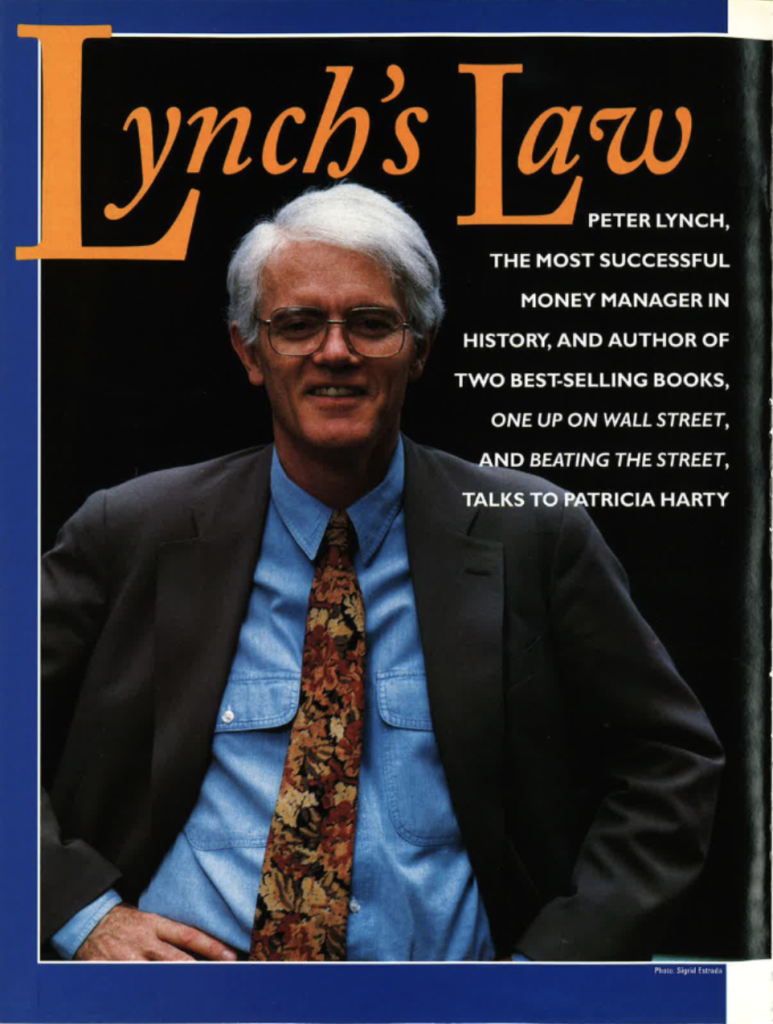
Peter Lynch, the most successful money manager in history, and author of two best-selling books, One Up on Wall Street and Beating the Street, talks to Patricia Harty.
Peter Lynch knows how to make money. If you had invested $10,000 in the Fidelity Magellan Fund when Lynch became manager, ten years later you’d have had $180,000. Under his stewardship, Magellan grew from a tiny fund of about $22 million in assets into the world’s biggest, with over $13 billion under management. No one has ever equaled his performance, and it is most unlikely that anyone ever will.
From 1977 to 1990, Lynch produced a total return to investors of 2,800%. When he retired in 1990, at the age of 46, he had outperformed every other mutual fund manager for 13 years straight. How did he do it? Without a doubt, Lynch has a knack, but the reason Lynch feels that he was more successful than anyone else is because he made it his business to personally visit every company before he invested. He’s the guy “who kicked the tires” before he put money into anything.
Lynch claims that he never had an overall strategy. He followed trends and scents like a bloodhound. He listened to his wife when she said that Hanes pantyhose, L’eggs, were great. He went to shopping malls and visited the Gap and Limited stores, and asked people how they felt about their Crysler mini-vans, and it paid off.
But the price was high in terms of quality of life. He left for the office at six a.m. six days a week and spent 13 or 14 days traveling, visiting some 40 companies. There was never enough time to spend with his wife and three daughters, or on the many charities he served.
Lynch says that perhaps he would have retired earlier, had the stock market not taken a major downswing in October ’87. At the time he was in Ireland facing the ultimate challenge, the eighteen holes of the Kileen golf course in Killarney, one of the most difficult in the world, the day the market dropped 508 points.
It seems fitting that the man Time magazine called “the nation’s #1 money manager” should have been on a golf course on that particular day, for Lynch first became fascinated with the stock market while caddying at a golf course near his home in Boston, a job he began at age 11 to help family finances after his father, a Boston College math professor, died of cancer. Investing was the talk of the fairways, and the stories he heard made him rethink the family position that the stock market was a place to lose money. He continued to caddy throughout high school and into Boston College where the Francis Quimet Caddy Scholarship helped pay the bills, and it was one of his regular golfers D. George Sullivan, then the president of Fidelity, who advised him to apply for a summer job with the company. The rest is history. As is the fact that Lynch’s unshakable faith in himself and in his investments saw him through the 1987 market correction.
Fortune magazine nominated him to their Business Hall of Fame saying of Lynch and their other nominees that “it is not enough to amass great wealth. It is not enough to lead great enterprises. They must have changed the world around them for the better.”
And in 1990, Peter Lynch, who had amassed great wealth, and led great enterprises, wanted to spend more time with his family and working for the many charity organizations he’s part of. He resigned as manager of Fidelity’s Magellan Fund but still retains an office at Fidelity. Two days a week he advises young analysts, continues as a member of the board of trustees of the Fidelity Group of funds and writes a column for Worth magazine, but his time now is devoted, mostly, to non-profit work. Inner city schools, libraries, hospitals, the R.F.K. Foundation, United Way, to name just a few. And last spring Peter Lynch took another Fund under his wing, when he accepted the position as treasurer of the American Ireland Fund, an organization that is dedicated to promoting peace, culture, and charity in Ireland.
Patricia Harty talked to Peter Lynch in his Fidelity office in Boston.
IA: You seem very busy [Lynch’s desk is piled high with paperwork] for someone who is supposed to be retired.
Peter Lynch: Four years ago last May I stopped running Magellan — it wasn’t really that I retired. I was still involved with Fidelity. I cut it back to five days and I’d leave for the office at eight a.m. instead of six, and maybe travel just a couple of days a month instead of 12 or 13. So it wasn’t that I retired and went off to live in the Greek Isles, or County Limerick.
I succeeded in spending more time with my family. I had weekends off and I saw everyone in the morning, but I still wanted to spend more time with my wife. So in June ’93, I said to Carolyn, why don’t you pull up your dance card and cross out every Monday and we’ll spend it together. So I now come in to the office four days a week — two days, roughly, I work for Fidelity, the rest of my time is devoted to charity work.
IA: How did you get involved with all these charities?
Peter Lynch: I worked with most of them before I joined Fidelity. I must have had hundreds of offers to go on corporate boards when I retired. I refused them all — I prefer to work with charities. I’m on the board of about 12 and Carolyn is on about six — so it’s really 18 — I get involved with her projects and she gets involved with mine.
IA: Why the American Ireland Fund?
Peter Lynch: I’m Irish on both sides. My mother’s name was Griffin. My grandparents were born here but my great-grand-parents are from Kerry, on both sides. I have a great fondness for the country and heritage. So when I was asked to work on the Fund, I was delighted. I think the way the Fund administers money is very smart. They don’t just make decisions here, they have a group in Ireland that looks over the projects, and instead of giving grants to three massive ones, they tend to give to 500 smaller ones. These grants have helped create jobs and restore some very appealing structures which would have disappeared if the Fund hadn’t helped.
IA: What do you think of Ireland’s economy?
Peter Lynch: I think it’s a miracle. Ireland has a higher job growth than any country on the continent; Spain might be close. What they’ve done reminds me of North Carolina here in the United States, or Texas. Ireland is really proactive — they’ve spent money to bring in industry. They offer training grants, and tax incentives, and now they have spent a lot of money updating the telephone system. They have figured out that tourism has a lot to offer, and have 35 golf courses under construction.
IA: How’s the American economy doing?
Peter Lynch: We lost 2.1 million jobs in the recession and now we have added 3.5 million back. We are now at 1.4 million jobs above where we were before the recession. In America the bigger companies continue to shrink, and become more productive. That’s the nature of an efficient country. If United Technologies or someone announces the layoff of 5,000 employees it’s always on the front page of the newspaper; you never hear of some firm that starts with five employees. Twelve hundred companies went public in the last few years — there are only 2,500 companies on the New York Stock Exchange. We are leading the world in software, in electronics, the latest tractors, John Deere, Boeing, our recorded music industry, our motion picture industry, Disney World, the list goes on and on. So for someone to say that America is not doing well is just wrong.
IA: More and more American money is being invested abroad — do you think that the American investor is losing faith in America?
Peter Lynch: America, historically, has had the least investment of any country overseas by individual investors. IBM has invested overseas. Digital has invested overseas. McDonald’s has gone overseas. But individual investors have never thought of going. Or pension funds. Or insurance companies or banks. Our big sources of investment are individual investors, college endowments, and pension funds. They have had very little money invested overseas. So we’re just moving up to, let’s say, maybe five percent of assets of pension funds in individuals are overseas. It used to be zero. In most countries a third or 40 percent of their investments is outside their country.
For example, it was very hard to invest in Israel 20 years ago-there was one public company-now there are 200. The same thing is true in Brazil, in Argentina, in Chile, Indonesia and Malaysia. If you look at these emerging markets, they’re going to have a growth rate higher than Europe or the United States. It’s a great opportunity.
So I think the fact that we’re, as a society, investing more overseas is typical of most advanced countries. It’s a good idea. But it’s still a very small percentage. And it’s going to increase – but it doesn’t mean people are negative on their own country. That’s a point that bothers me. It sort of seems to be the general perception. It’s 180 degrees wrong.
IA: So general perceptions can be wrong?
Peter Lynch: Yes. The other concept you get from the media is that Americans are lazy and inept. The most important vehicle invented in the last 30 years didn’t come from Japan, or Germany or Sweden – it came from Detroit. It’s the Chrysler mini-van. Last year Chrysler sold almost 600,000 mini-vans at a profit of $5,000 each- $3 billion. That’s an incredibly successful vehicle. They’re now shipping them around the world. Here’s the industry people thought was hopeless a few years ago. The auto industry is doing a great job. They’ve recovered.
Not only are the critics wrong when they say we’re inept, they are also wrong when they say we’re lazy. The average American now works 12 hours more per week than the average German, more hours per week than the average Japanese, and more hours per week than their father did. How have we sold ourselves this bill of goods that we’re inept and lazy?
IA: I’ve read that you’re a good Catholic. Fortune magazine mentioned that you carry your rosary beads in your pocket.
Peter Lynch: I’m very glad to be a Catholic, if that’s important. I have a great family and a great mother, and I’m proud to be RC.
You can’t say that the Church is just the priest and the nuns, and the bishop. It’s everybody. In fact, I joined our parish council. Our parish was running a thousand-dollars-a-week deficit. Now, through the help of lots of people we’ve turned that around, and we’ve just spent $700,000 renovating the church.
IA: Is your mother still alive?
Peter Lynch: No. She passed away in 1983. My father took sick when I was seven, and died when I was ten. My oldest brother is retarded, and she raised us, went out to work. She was just an amazing person. We said the rosary every Friday night. [He shows me his beads.]
IA: Are they from somewhere special?
Peter Lynch: No. I did a missionary trip to India and my wife did one to Nigeria, and I think she picked them up there. We work in a Catholic group called New Internationals. On Sundays in Lent and Advent, we say the rosary as a family — it’s a great tradition.
IA: In the last few decades Irish Americans have achieved prominence through the financial industries — mutual funds, merchant banking, stockbrokers — right across the board. Do you think they have a particular gift?
Peter Lynch: I don’t think so. It’s an industry that they were given a lot of opportunities in. It’s a meritocracy and that helps. It’s open to everybody.
I remember growing up, my mother would show me ads that said, Catholics need not apply. And I remember when Tip O’Neill had to almost boycott a bank in Cambridge that had no Catholic employees, while 90 percent of their deposits were from Catholics. It’s not that long ago, we’re talking the 1950’s. But this is a business that’s been open for 40-50 years to Catholics.
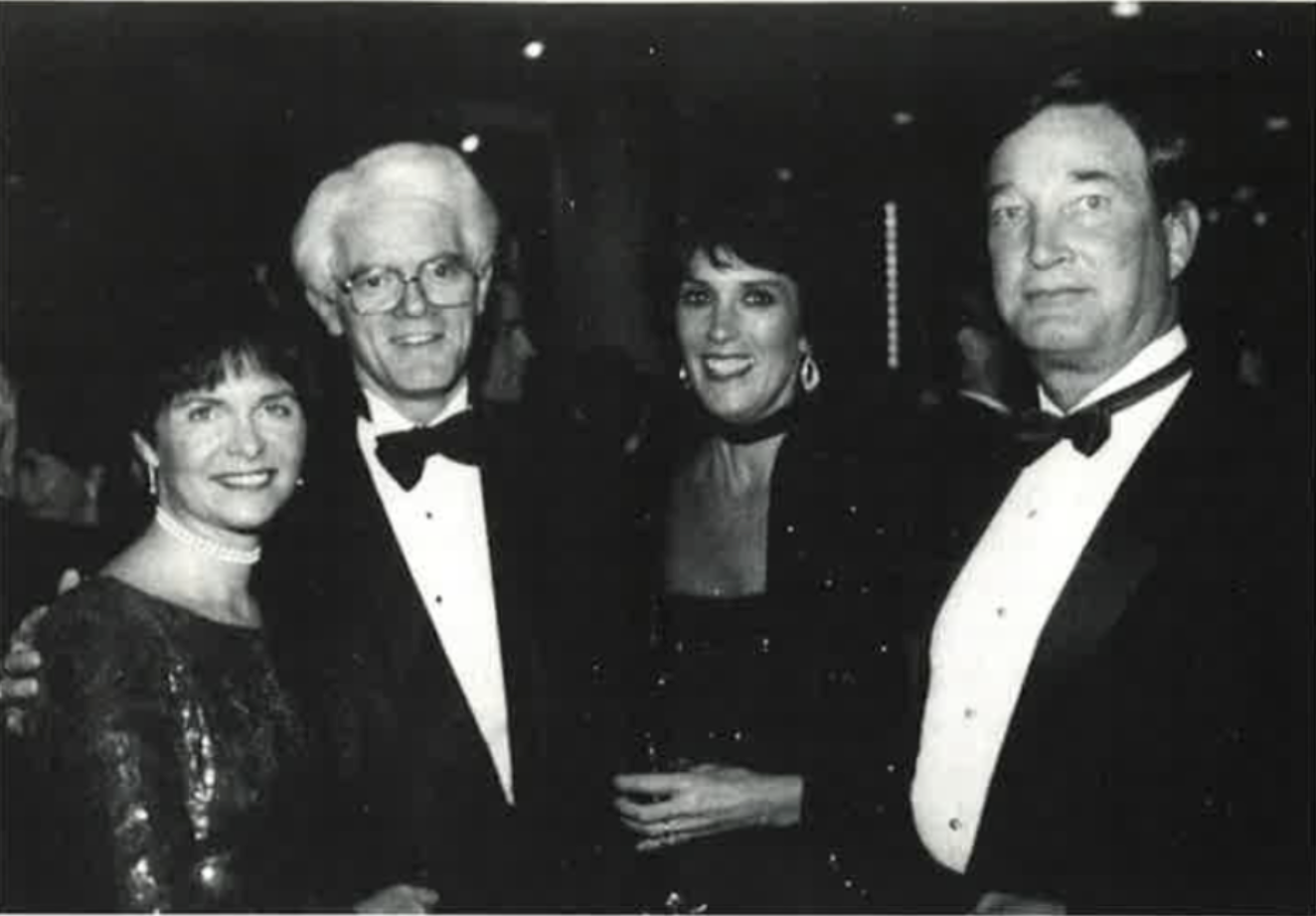
IA: I read that Peter Lynch brought in a “creative sea of change” at Fidelity. It seemed to refer to your Irishness.
Peter Lynch: Well, when I applied for a job at Fidelity in 1965 there were 75 applicants for three spots. But I’d caddied for the president of the company, D. George Sullivan, for ten years, and I got the job — it was the only job interview I ever did. Fidelity had an Irish president in the 1960’s. There were some firms that were closed to the Irish. Not Fidelity. Fidelity’s been open for the best people for a long time. Forever.
IA: I’m constantly amazed at the influence that the Jesuits have had in this country. You yourself talk about a Father Collins of Boston College, and many of those in our Business 100 attribute their success to Jesuit institutions such as Boston College or Fordham. Do you think that’s changing? Are Irish American kids still retaining their Catholicism?
Peter Lynch: I’m not sure. When I grew up you knew outright discrimination. You either saw it yourself or heard it from your uncles or parents. And in those circumstances your religion was very important, and maybe there was this extra determination to do well. My mother would always say, don’t get mad, get even.
That’s not true today. Irish Catholics can get into country clubs, and Dan Tully’s the chairman of the board of Merrill-Lynch. Everything is open. So maybe because that prejudice isn’t there, people aren’t as driven. I don’t know. There had to be some incentive in the fact that there was discrimination.
IA: How do you motivate your young analysts now?
Peter Lynch: Pick motivated people. I mean these people are ready to go. They’d work for free. They love the business. We interview probably 500 people to maybe hire six. In fact, we have an Irish person — Fergus Shiels — I don’t know how many years he’s been out of Ireland — he was one of them we hired five or six years ago.
IA: How could you sleep at night and be in charge of so much money?
Peter Lynch: I never had trouble sleeping at night in my whole life. The only thing that concerned me was, would people just leave when the market went down?
I ran the fund for exactly 13 years. Nine times in that period of time the market went down. And nine times my fund went up.
In the 93 years of this century, 50 times the market’s gone down 10 percent or more. Not 50 down years. The market may have been up 26 percent one time during the year, and finish the year up 8. But it had declined in the middle.
Less than 50 declines of 10 percent or more in 93 years. That means about once every two years. And of those 50 declines 15 have been 25 percent. That’s what I’ve always tried to explain to people in my end reports. I’m very confident the market will be higher 10 years from now, 20 years from now. But what the stocks will do in one or two years you don’t know. It’s like flipping a coin. But the fact that you know you really carefully researched all these companies, and they have a good balance sheet, and if you like a stock at 8 and the market goes down to 7, then it goes to 5–well, if the company is still valid, you’ve got to love it at 5.
If you put all your money in one stock it’d be a little scary. If you like 50 companies, you’d probably be dead wrong on five of them. And five would turn out better than you expected. But in total the 50 would do well. It’s not like a lottery ticket. I mean you own a company. If the company does well the stock does well. And I think that’s what I relied on.
Obviously you make some mistakes. But the nice thing about the stock market is if you put a thousand dollars in a stock and you’re right you can make 5 or 10 thousand. If you’re wrong you lose a thousand. So the ones you’re right on make up for your mistakes.
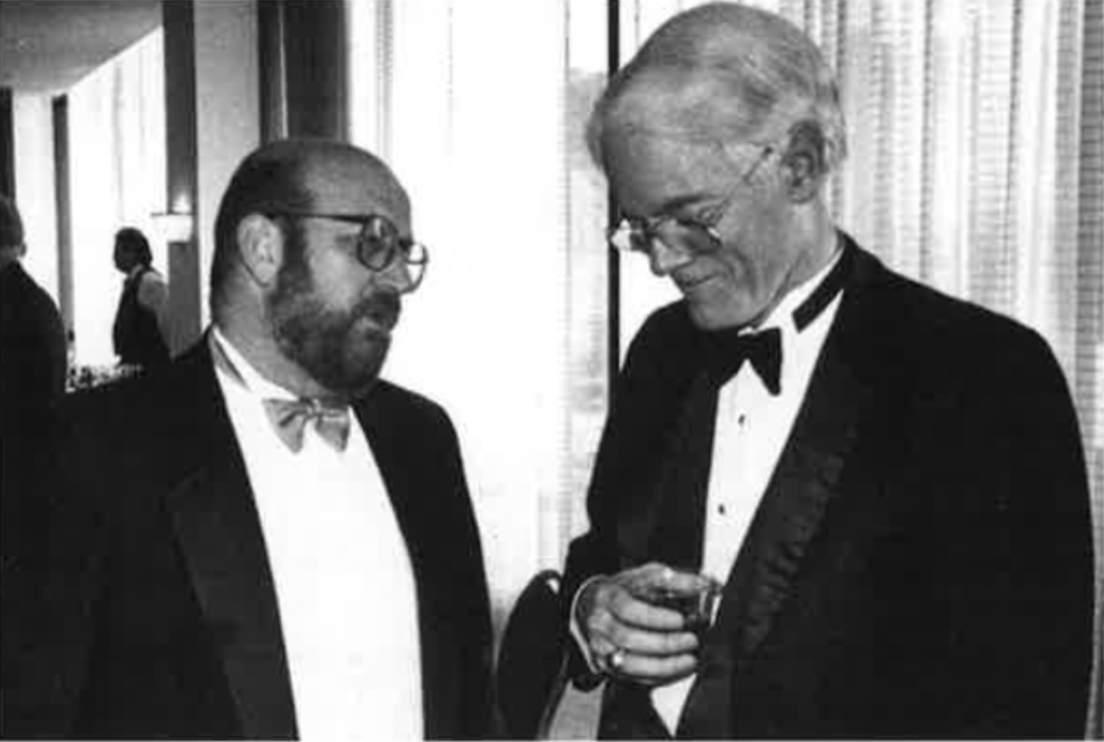
IA: In Beating the Street you talk about Joan Morrissey who teaches her students at St. Agnes school about the stock market with play money.
Peter Lynch: Yeah, those kids were great. The amazing thing is to find out that these kids in this little school are doing all this work in seventh and eighth grade. And then they go to high school. I don’t think there’s a high school in the country that teaches the stock market. I think what a tragedy for a country.
IA: Who are your peers? Or do you have peers? What do you think of Warren Buffet?
Peter Lynch: Well, in fact, someone’s doing a book on him, and I just wrote the foreward for it. He’s fantastic, incredible. Unbelievable. He’s the best.
IA: What books do you read? Or do you have down time?
Peter Lynch: I’m reading Russka by Edward Rutherford — a thousand pages on the history of Russia. I’ve read almost every Michener book. I read a lot of biographies. I’ve read books about Benjamin Franklin, three books about Teddy Roosevelt, J. Edgar Hoover, Douglas MacArthur. I just finished Harry Truman’s life. And occasionally I’ll read a Tom Clancy or a Robert Ludlum, but mostly I read biographies or history.
And I read a massive amount of company reports and quarterlies. My wife and I play bridge, and once a month I play poker, so there’s not a lot of reading time.
IA: I really like the way your books are written. To me there is a lot of common sense in there. They kind of demystified the whole business of investing.
Peter Lynch: Thank you. Whenever I’d give a talk at a college or high school, or for some organization, someone would say that’s the first time the stock market’s ever made sense to me, you ought to write a book. I said, well, the problem is I’ve got this full time job. So, Simon &Schuster solved that by finding John Rothchild and we worked together. He’s incredible. For example, I wrote 28 pages on the turnaround of S.S. Kresge falling apart, finding the K-Mart formula and rolling with it. That became one sentence in the book. I wrote over 3,000 pages for the first book; maybe it was 250 when it was done. I don’t think there would have been a second book without John Rothchild. He’s a great person.
IA: Do you ever doubt yourself, or feel like you’ve lost your touch?
Peter Lynch: No, no. I mean, you can’t — if the market is going to go down it’s going to go down. Investing is a passive business. If you buy Chrysler you can’t go out and make people buy cars, you just have to hope they are going to buy the cars. When you’re at church or at a movie theatre, or at the supermarket, you might ask people, do you like your mini-van? Do you like your new jeep? But you can’t make people buy the cars. You can’t control the market. You just have to sit back. It’s not like, if you run a factory and you go in and work extra hours and find new ways to make more widgets or motivate people to work a little better — you don’t do that in the stock market. You just have to say, I dislike this company and I like this company, and I’ve looked at this one. I always thought if you looked at 10 companies you’ll find one that’s interesting. If you look at 20 you find two. If you look at a hundred you’ll find 10. The person that turns over the most rocks wins the game.
IA: Well, that’s where you were really different, wasn’t it? Because you went out and you really investigated companies before you invested?
Peter Lynch: Also, I had no prejudices. I’ll look at any industry. I’ll look at the savings and loan industry, the utility industry, the textile industry, the steel industry. If people just say, I’m only going to look at the growth industries — I mean I look at everything. I think I was very flexible and didn’t have any prejudices.
IA: Is there anything in your background that prepared you for a career in investing?
Peter Lynch: I think the fact I like to play bridge and poker. What I like about poker and bridge is if you consistently play right you’re going to win. But there’s luck involved. In bridge there might be six spades out against you. The odds are they’re split 3-3 or 4-2. But you might make a bid exactly right and they’re split 6-0, and you get a terrible score. But you played it right. If you’re playing poker and you’ve got a straight, and all the other hands look terrible, you make your bet, and all of a sudden out of nowhere comes four eights. You say, well, I played the hand right. I lost but . . . .
IA: So that’s what you tell yourself if there’s a “correction” in the market.
Peter Lynch: You have to understand you’ll make mistakes. It’s not your fault. If you’re consistent and you keep doing it, you’ll win.
A lot of people in this business got all A’s in college, they got all A’s in high school, they never made a mistake. They knew all the people that fought in the 30 Years War. And they keep gathering information. And by the time they get all the information the stock’s gone from 5 to 40. So you have to make decisions without all the information. You have to take some risks.
So, if you’re willing to take a risk and say, well, this is it, I’ve done the best job I can do, I’m going to buy the stock. You get that, I think, from studying history. You could see it if you studied Napoleon, or Bismarck. History is important.
Look at Eisenhower when he launched Normandy. The odds were that those people may not make it, and the first day wasn’t going so well. You had to say, that’s it, I’ve done the best job I can do.
IA: Do you have any advice to young people out there, my readers, who want to get into this business?
Peter Lynch: Well, you don’t need to do it with money, you can make up a paper portfolio. You can say, I have $10,000, or I have $50,000, and I’m going to buy these stocks, and this is the reason I’m buying them. And you write down a paragraph stating your reasons. This new product, new market, or scrap prices are improved, or inventories are down six months in a row, whatever the reasons, you keep following your companies. And you may find out that you’re really good at buying turnarounds, or really good at buying small local companies. You can do this without any money.
You only need a few good stocks in a lifetime. You don’t need a lot of triples and five baggers. You can start with five or ten thousand dollars and you don’t need a lot of good stocks in your life to make a lot of money.
People have this idea they have to buy a stock every day, and they make 3.1, they sell, they buy another. That’s just gambling. As I explain in the books, people are careful when they buy a refrigerator, when they buy a microwave oven. And then they’ll put $10,000 in some stock they heard about on the bus, and they wonder why they lose money.
IA: Can you explain to me what derivatives are?
Peter Lynch: Let’s say somebody sells a group of bonds. Somebody will set it up so you can buy just the interest on the bonds, or you can buy just the principal on the bonds, or you can buy three-year interest on the bonds. I mean divide it up 93 ways, and then people can participate in that. To me the people who are doing that — and they may have a reason for it, because they may use it as a hedge. They’re scared to death that rates are going to go down or rates are going to go up, and they want to buy this to protect themselves. So for some people it’s an insurance policy. It’s a hedge. For some people it’s just outright gambling. I don’t do it — when I bought companies I never bought them on margin.
IA: A quote keeps going around in my head about what Oscar Wilde said about men being in love with their wives. Can you tell me why you fell in love with your wife?
Peter Lynch: She’s fun to be with. Whatever we did we had a good time. And she laughed a lot. She’s cute as hell, and beautiful, just the most fun person I ever met. So, I guess that was a good combination. For our 25th wedding anniversary she bought me a farm in Ireland — in Limerick.
I lived all my life inside of Route 128, so I’m the kind of person that sees a sheep and I take 36 pictures of it. I think she said, here’s a person that needs a farm. And our kids like to ride horses, and here there’s just nowhere to do it. Over in Ireland they can ride all day. We were there in March–school vacation — all the lambs were being born, the calves were being born, the daffodils were out, it was just great.
IA: What do you hope for your own kids? What are they interested in? Your oldest daughter is 19 now.
Peter Lynch: Well, she just turned 20 on the 19th of June. I’m not sure. I hope they just have a great life and have fun, and work hard.
IA: I was interested where their names came from. They’re so simple. Mary and Annie and Beth.
Peter Lynch: We’re big on the saints. I had an Aunt Mary, and my wife’s middle name is Ann. And she said if we have a boy we’re going to name it Peter, if a girl we’ll give her the middle name Peter. My wife wanted Peter in there somewhere. So, our third daughter is Elizabeth Peter Lynch. They’re just wonderful children. Good lineup.
IA: Do you think you were just lucky with your marriage? The divorce rate in this country is incredible.
Peter Lynch: I think it’s very lucky that we both are strong Catholics — we never miss church, and we pray a lot together. That’s a strong binding. And I think that Exodus is worth reading, I think the Ten Commandments are a pretty good deal. And, you know, if you’re financially successful I think that helps. And a lot of marriages are hurt by financial setbacks or the fact that both people have to work. That can’t help.
IA: What do you think of Bill Clinton?
Peter Lynch: I think he’s very well meaning. I wish him the best of luck.
IA: That’s it?
Peter Lynch: That’s it. I’m a Democrat. I think he should really be making education the priority. Half the children aren’t graduating high school. It’s hopeless. And to think we’re spending all this political energy to work on national health insurance, which I think is a worthwhile cause. I think you really ought to have something for catastrophic situations– for people who are devastated by some terrible problem and they go through all their life savings. That’s what you’ve got to establish. But on a scale of one to ten, health insurance is about a three, and education is about a 50. Many kids don’t have a chance.
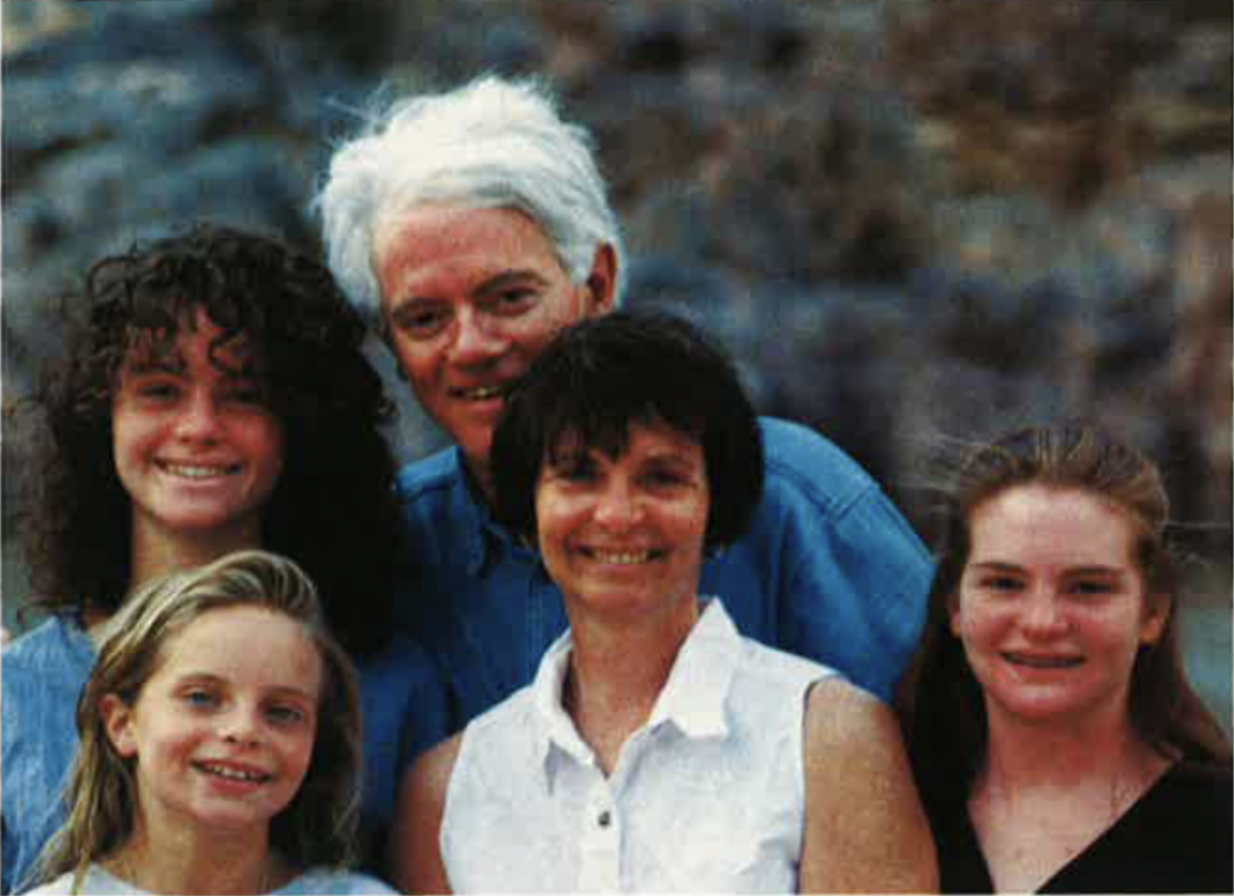
IA: What do you think has gone wrong? Do you think it’s that teachers aren’t paid enough?
Peter Lynch: No, it’s not the money. It’s just that there used to be discipline. When I went to a public school the teacher would say, you didn’t do your homework? Shape up or you go see the principal.
They still do in the Archdiocese of Boston inner city schools. There’s no admission exam. They take every kid and 98 percent of those kids graduate. There’s 25 different ethnic groups — 14 different languages. It’s 95 percent lay teachers, and they’re doing a great job. They have discipline. They have the right to throw the kid out. They don’t do it — out of 13,800 kids the most they’ve ever suspended is five. Not five percent, five.
But the teachers have the right to say, okay, you’re going to detention hall. Five detention halls and you’re not on the sports team, eight detention halls and you’re out of here. Teachers ought to have that right. I mean there are truly disruptive children. And the poor teacher can’t do anything about it.
IA: What do you consider to be your greatest achievement?
Peter Lynch: I really don’t know. I think this work I’m doing with the inner city schools — last year we raised $1,700,000 for scholarships. And the Archdiocese helped 3,000 kids stay in school. I’m hoping to do more next year. I’m pretty proud of that.
IA: It’s a lot to be proud of. I’m delighted to say that many of our Irish American Business 100 do seem to be interested in giving something back.
Peter Lynch: My mother would say, that of those who are given a lot, a lot is expected.
IA: Thank you Peter Lynch.
Editor’s Note: This article was originally published in the September/October 1994 issue of Irish America. ♦
Leave a Reply