
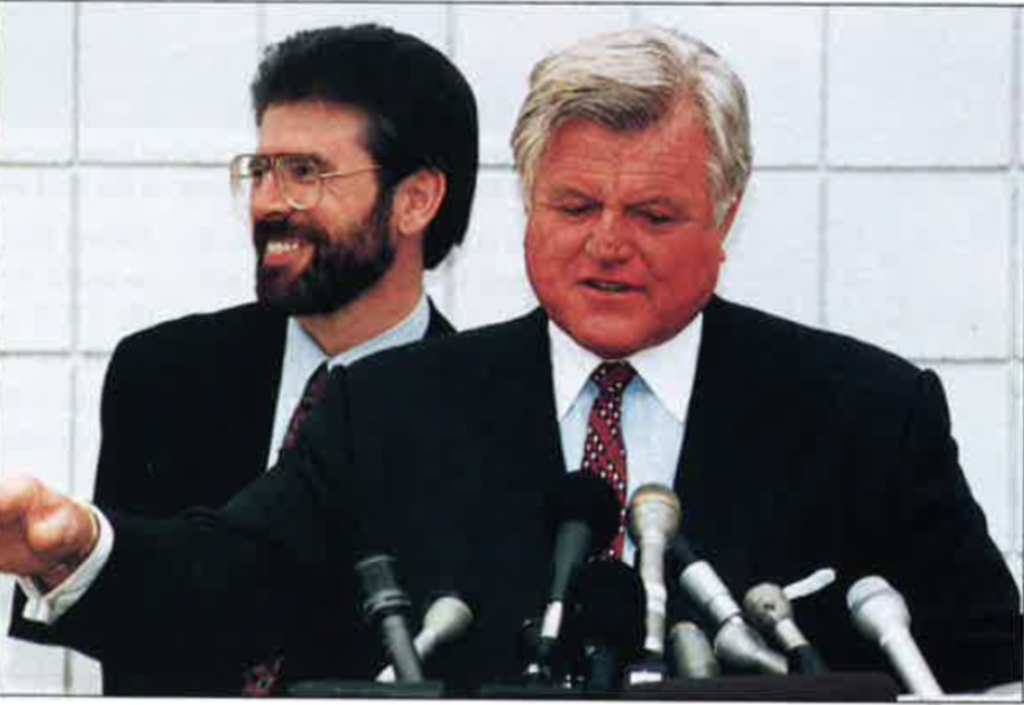
Emer Mullins reports on how Irish America flexed its muscle to help the historic peace process in Northern Ireland.
It ended, finally, after months of speculation, months of hope, and months of hard work by the strongest Irish American lobby yet seen in Washington.
The IRA declared a “complete cessation” of military activity on August 31, 1994, bringing to a close a terrible 25 years in Ireland’s history. And bringing to the fore the work of some dedicated and tireless Irish Americans who were an integral part of this peace process.
“We urge everyone to approach this new situation with energy, determination and patience,” said the IRA statement declaring the ceasefire.
Eight weeks later, the political climate in Northern Ireland has changed irrevocably, and a landscape is emerging that would have been unthinkable even a few months ago.
In the days following the historic announcement, Sinn Fein president Gerry Adams and Irish Prime Minister Albert Reynolds shook hands outside of Government Buildings in Dublin for the first time. They were joined on the steps by the Social Democratic Labor Party leader, John Hume, the face of constitutional nationalism, whose behind-the-scenes talks with Adams had been a moving force behind this peace.
While the British government criticized the IRA for not specifically saying the ceasefire was “permanent” rather than complete, the British government has since been criticized for not moving quickly enough to the IRA initiative.
The White House, however, firmly behind the peace process, showed its commitment by granting a visa to veteran IRA man Joe Cahill in order for him to brief Irish American republicans on the ceasefire, then followed quickly with a second visa for Gerry Adams, who spent two weeks touring the U.S. garnering support.
The American angle had turned out to be a crucial one, though, long before that.
The American Angle
In September, 1993, an Irish American delegation, led by then-congressman Bruce Morrison, Bill Flynn, chairman of Mutual of America, Niall O’Dowd, Irish America’s publisher, and Chuck Feeney, chairman of the General Atlantic group, visited Belfast to meet with various politicians and community groups. The IRA responded with a seven-day ceasefire. Almost exactly a year later, the same group, assembled by O’Dowd, and joined this time by two labor leaders, Joe Jamison and Bill Lenahan of the Irish American Labor Coalition, was back in Belfast. The delegation had been working and waiting quietly for a long time to hear the IRA announcement. Through the work of Bruce Morrison and O’Dowd, the Clinton administration had been briefed on developments in the North and on the delegation’s efforts to coordinate American support for a peaceful settlement.
Bill Flynn, as chairman of the National Committee for American Foreign Policy, had invited Gerry Adams to address the committee in New York last February. His involvement started in a non-spectacular fashion. “I was approached by people from Noraid (Irish Northern Aid) who asked me for a contribution,” Flynn has said. “I said I couldn’t do that because I didn’t agree with their methods, though I told them I did agree with their eventual goal – the reunification of Ireland.” When Flynn was asked bluntly what he was doing about it, he recalled for Vanity Fair that he felt like a draft dodger. So he began to move in American business circles to garner support in persuading the IRA to call a halt.
The battle for the Adams visa in February was also spearheaded by Senator Edward Kennedy Smith, the U.S. Ambassador in Dublin. Senator Kenned is recognized as having clout with President Clinton when it comes to Irish affairs, and his sister, the ambassador, had become close to John Hume, a welcome figure on Capitol Hill for many years.
The IRA was receiving many positive signals from America, and the strategy was working.
The White House
In the White House itself, the President’s national security advisor, Anthony Lake, and his staff director, Nancy Soderberg, were aligned with the Kennedy-Hume axis against the forces of the U.S. State Department, widely considered to be fighting in the British corner.
When the ceasefire was announced and welcomed by Clinton officially, and Gerry Adams planned another U.S. trip, the British moved immediately to block his possible access to Washington, crying that the IRA had never declared the ceasefire to be irreversible and it was too soon to be seen embracing Adams as a statesman.
Adams’ visit to Washington was to be the first by a Sinn Fein leader since Eamon de Valera traveled there as head of Sinn Fein early in the century. The British, worried that their so-called “special relationship” with the U.S. was being undermined, insisted that a unionist delegation be received in Washington before the Adams trip to show U.S. was being evenhanded in its approach.
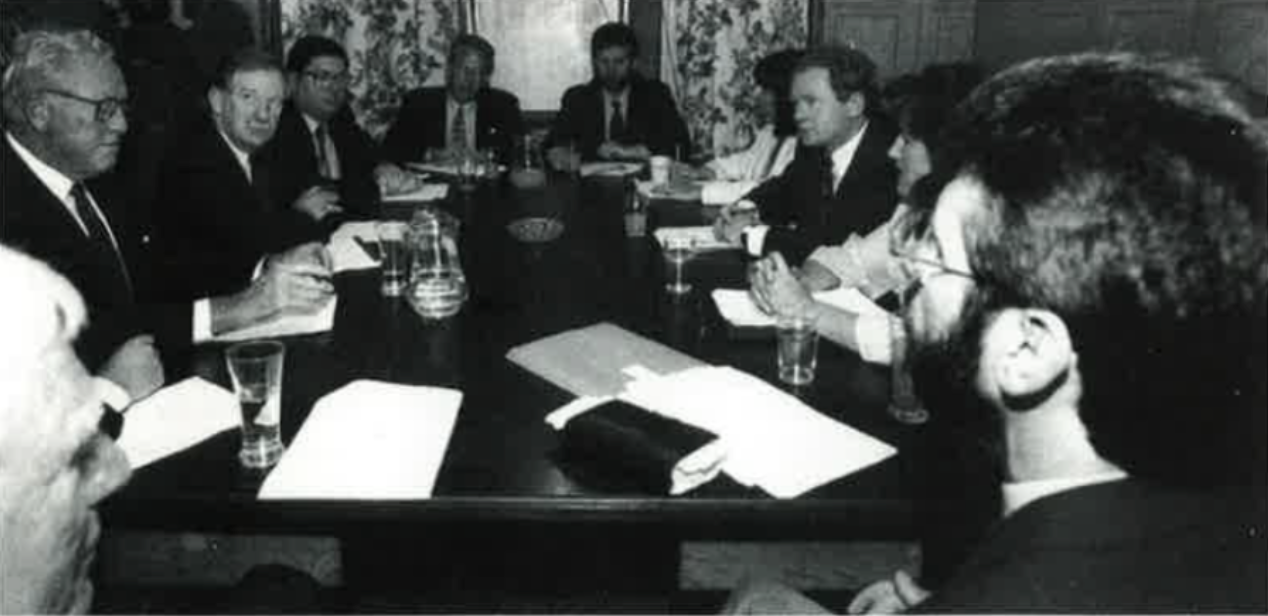
While a steady stream of Irish politicians revolved though the doors on Capitol Hill – such as John Hume, Deputy Prime Minister Dick Spring, and Official Unionist David Trimble – the turf war between the State Department and the Irish Americans continued.
Senator Kennedy showed his commitment by personally greeting Adams when he landed in Boston on September 24. Congressional support was firmly behind Adams also, in the form of the Ad Hoc Congressional Committee on Irish Affairs and the Friends of Ireland group. New York Congressmen Tom Manton and Peter King met with him, as did Speaker of the House Tom Foley, widely considered an anglophile.
While British Prime Minister John Major wrung a concession from President Clinton that he would not personally meet with Adams, the Irish American lobby pulled out all the stops for the Washington leg of Adams’ trip.
Feverish activity took place while Adams made his way through seven U.S. cities, including New York, where he was received by Mayor Rudy Giuliani and the city council, and by the time he was ready to fly to Washington the chips were down.
“The British are clearly afraid of what Adams can achieve with a White House meeting,” commented Bruce Morrison.
“I think somewhere in the right wing of the Tory government they think they still rule America,” Adams told a crowd in Springfield, Massachusetts. “They are afraid of the people becoming empowered, the 40 million people who declared they had roots in Ireland. They’re afraid of you.”
The U.S. should pressure the British to begin peace talks now with Sinn Fein, Adams said, and Irish Americans should “act as guarantors” for peace.
Down to the Wire
The Sinn Fein leader’s first trip to Washington began on October 3. And after all the frantic behind-the-scenes maneuvering by both sides, the U.S. government officially ended its 20-year-old policy which prohibited contact between U.S. administration representative and Sinn Fein.
The end of the ban came in the form of an early morning telephone call to Gerry Adams from vice president Al Gore. The phone rang at 9:30 a.m. in the home of Ethel Kennedy in Hickory Hill, Virginia, and Sinn Fein had its success in Washington.
Adams also received a letter from Clinton’s National Security Advisor, Anthony Lake, which praised him for taking a “courageous step forward for peace.” The letter also contained an invitation for Adams to meet with White House officials that afternoon, including Nancy Soderberg, Lake’s Staff Director. “During the meeting,” wrote Lake, “we would expect to discuss ways to assist Sinn Fein in solidifying support for the political process, how best to assist in promoting talks under the Forum for Peace and Reconciliation proposed by Prime Minister Reynolds as well as the round-table talks convened by the Irish and British governments aimed at reaching a last and just agreement with all involved parties.
“We would also expect to discuss a normalization of relations with Sinn Fein party officials as progress is made and to solicit your views on tangible ways the United States can help promote trade, investment and economic prosperity in Northern Ireland.”
The die was cast. Gerry Adams met with Speaker Foley, Senate minority leader Bob Dole (who told him if he was in the White House, Adams would have entered through the front door), New York Senator Al D’Amato, and Senator Daniel Moynihan.
Irish America had done its work.
Editor’s Note: This article was originally published in the November/December 1994 issue of Irish America. ♦
Leave a Reply