
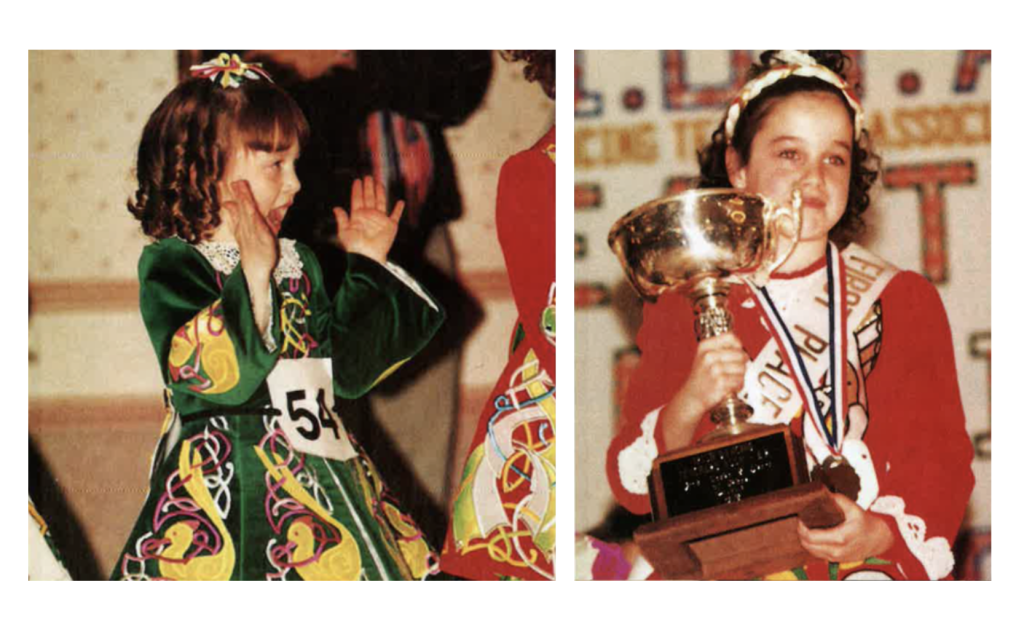
Of all the cultural traits that have survived down through the generations, dance and music are the most direct and soulful link to our ancestors. Through bad times and good, in the grand hotels of today and in the mining camps and city ghettos of yesteryear, the immigrants kept the tradition alive, and in increasing numbers are carrying it back to Ireland, nourishing and replenishing the spirit of the Old Sod. Oistin MacBride captures the excitement and the emotion of the Eastern Finals of the Oireachtas.
It’s like the play-offs; the semifinal of the Championship. Tension and tears, practice and perfection that grip the heart-strings and catch your breath with displays of excellence and character. But it’s not competing for the Stanley Cup or the Sam Maguire that engenders such emotions. It’s the Eastern Region Oireachtas, the final round for aspiring dance champions hoping to make their mark and step out in Galway, Ireland, next Easter for the World Championship of Irish dancing.
For the uninitiated the most striking aspects of the Oireachtas (pronounced orrucktas) are the sheer number of people involved and the dazzling array of intricately embroidered colorful costumes that adorn over 1,700 competitors. Together with peacock proud parents preening their charges and beaming grandparents struggling to capture the moment on not so simple “point and shoot” cameras there are over 6,000 people spending the Thanksgiving weekend in the Westchester Marriott watching the brightest and best dancers on the East Coast.
Every inch of space is taken up by participants, who with spoilage capes over expensive costumes and hair nets holding an impossibly large numbers of curlers, practice in the foyer, the restaurant, and in spite of a bitter cold wind, one solitary dancer even takes to a rear sidewalk for final tuning of her steps.
Doll-like figurines with masses of red hair in cascading ringlets, impish smiles and shiny tap shoes instantly catch the eye as they pass by. “She’s so cute” is repeated endlessly for the little angels who run on oblivious to the praise and admiring glances.
With military precision the competitors find their way through the masses to the appropriate ballroom and after endless reassurances and last minute advice from nail-biting parents are lined up in numerical order for the first of up to three dances; four if they make it to the Parade of Champions. Organizers make the handling of such large numbers of entrants look easy but given that this is the silver jubilee of the Oireachtas and most of the original organizers are still active dancers and teachers it is obvious they have had a lot of practice.
Irish dancing has taken huge steps in the United States in the last 25 years, and even bigger ones in the last five, according to Peter Smith, President of the North American Féis Committee. He is an irrepressibly happy man who for 35 years has taught his pupils to love dance and the Irish culture simply by personifying all that is good and wholesome within its traditions. His rewards are the high kicking, floor stomping dances performed with precision by pupils of all ages who, in performance, display a calmness and maturity far beyond their years.
In the middle of outlining the humble beginnings of the first Oireachtas which followed a meeting in the old Irish Institute on 48th Street in Manhattan one of the ringlet-topped “little angels” found her way to a quiet part of a second-floor lobby where Smith was talking to Irish America.
After politely excusing herself Caitlin Ensore, an exceedingly diminutive 8-year-old from New Jersey, threw her arms around her teacher and said, “I just wanted to thank you for all your hard work.” The spontaneous gesture of thanks brought a chorus of “ahhs” to the lips of fellow organizers Anna O Sullivan and Joan Mc Niff; Fadelma Mullin Davis, Regional Director, and a glaze to the eye of Smith.
“That is what makes it all worth while,” he replied and clearly it’s a feeling shared by them all as they plot the course of the last 25 years.
“Irish dancing used to be pleated skirts with shamrocks sewed on and black walking shoes with huge shinny buckles,” says Smith. Now costumes with hand-embroidered designs taken from Celtic mythology and with a dizzying array of colors bedeck every dancer. They cost from about $400 upwards and are generally imported from Ireland. The shoes are purpose made and cost between $75 and $100; punts go for around $35.
The first Oireachtas was held in the Tower Ballroom in Woodside, Queens, New York; now they dance as far apart as Florida, San Diego and Toronto and use the best facilities they can find. Gone are the back rooms of bars and cold draughty halls where the only way to keep warm was to keep dancing.
The standard of dancing has also moved forward in leaps and bounds thanks to the expansion in the number of members of the Irish Dance Teachers Association of North America from 30 in 1969, to over 300 today. They have almost as many teachers who run schools and academies all over North America and Canada. They are under the direct auspices of An Coimisiun (The Irish Dance Committee) in Dublin which ensures uniformity in judging and competitive rules around the world.
Perhaps the biggest injection of fervor that dancing could have received both in Ireland and especially in North America was the awesome and spine-tingling “Riverdance” performed at the Eurovision Song Contest. The dancers Jean Butler from New York and Michael Flatley from Chicago won acclaim far beyond the bounds of the Irish dance fraternity but as Anna O’Sullivan rightly points out with a sense of bemusement “at the media discovery” there are many more just like Jean and Michael at the Oireachtas.
For male dancers it was a godsend according to Smith who admits that sometimes it is hard for young boys not to be drawn away to other activity and to bypass the comments of their peers who consider it less than many. With their saffron kilts, black jackets and swirling sashes there are many who prefer the boys’ styles and dances.
It is easy, in spite of the intensive practice from one year’s end to the next and the mammoth effort put in by parents and children, to forget that there is a competition taking place. The entire weekend is a major social event punctuated by bouts of raw nerves, electrifying performances and dizzy anticipation.
In the girls under 11 there are no less than 81 entrants and the ballroom where they dance in front of three international judges is packed to overflowing for the four hours it takes to see them dance.
Michelle Loftus from Havertown, Pennsylvania, has been dancing for four years and attends Campbell Academy. In a group of 30 she get’s one last practice on the dance floor while her teacher gives her last minute instructions and her parents vie for a ringside seat. In a pale green costume and with red hair and freckles she looks quintessentially Irish. When the dance order is picked she is near the last.
Caitlin Murray from Albany is back for the second time and is hoping to improve on her placing last year. Like Michelle she has a shadow from the Boland School putting her through her paces one last time. Parents Jean and Paul find a spot along the wall and go through every step with her. Watching the parents’ eyes and expressions tells the tale of how they performed. Gasps and grimaces, smiles and hands over their mouths as the three-minute dance counts down with amazing speed. “Don’t forget to smile, keep your chin up, remember to go back to where you started, good luck.” The children invariably outperform their parents when it comes to remaining calm and just enjoying themselves. When it’s over they just keep on enjoying the weekend while parents and teachers carry out post mortems.
Late afternoon and there are twenty who have earned a recall to dance again for another set of judges. Michelle and Caitlin part company, one with smiles, the other in tears at not doing as well as hoped for. Comforting parents reassure their charges while tension builds for the dance-off. By five o’clock the qualifiers for Ireland and the winners of each section are about to be announced. The squeals, screeches and shouts of hundreds of competitors as they and their friends are picked to go to the World Championships are absolutely deafening. There are hugs and more tears, this time of delight, as parents instantly begin discussing travel plans and rush to pay phones to tell waiting relatives that they are going “home” at Easter. For many it will be the first trip, and the anomaly of bringing an American Irish dancer back to Ireland to compete in the world championship, becomes a reality.
Medals are inspected and trophies are hoisted aloft by tiny little girls with tearfilled eyes. Hundreds of photos are taken and camcorders roll to make sure the moment is captured. The screaming barely subsides long enough for Peter Smith to be heard announcing the next set of qualifiers and the Parade of Champions that ends the emotion-packed weekend. More hugs and kisses, phone numbers exchanged, last minute purchases made from one of the many concession stands that sell everything from shoes to crystal, and promises to keep in touch with kindred spirits. Only one last thing to do. Make reservations for the next Oireachtas — it’s fully booked within weeks of this one ending.
Editor’s Note: This article was originally published in the January/February 1995 issue of Irish America. ⬥
Leave a Reply