
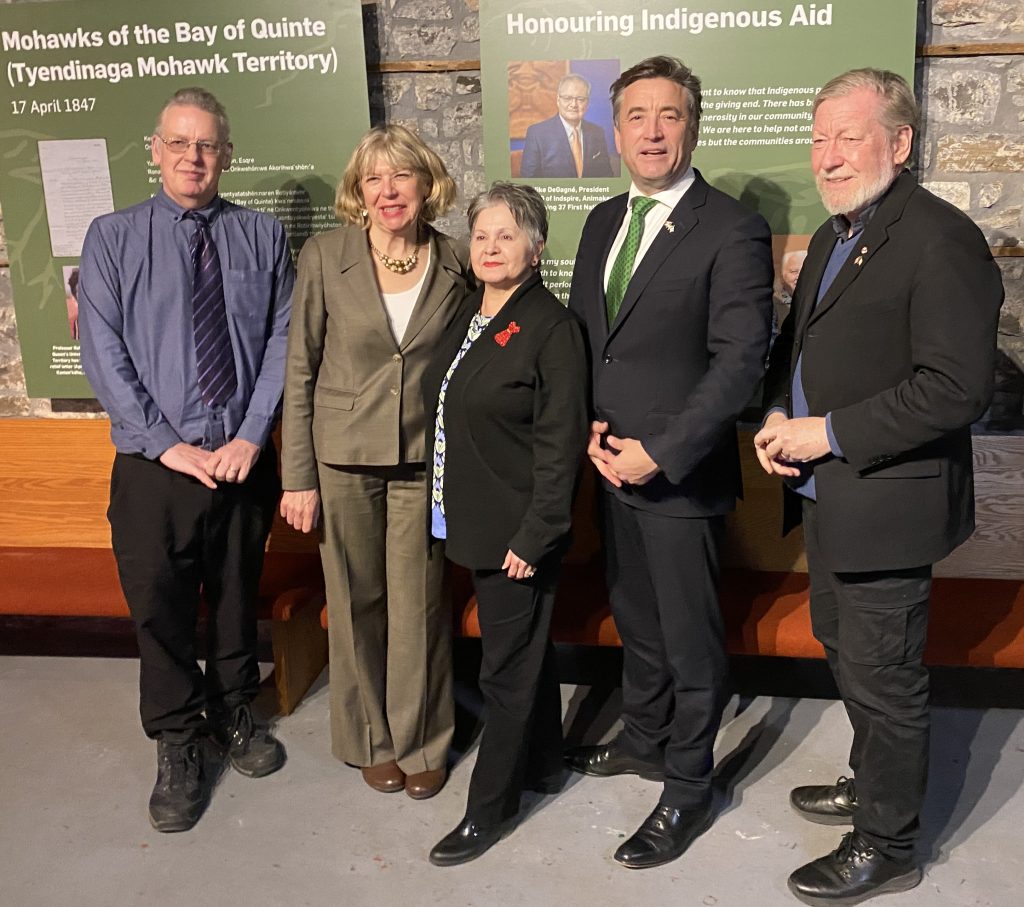
Earlier this summer Ireland’s new Ambassador to Canada John Concannon expressed gratitude to the First Nations of Quebec for their contributions to Irish Famine relief in 1847. He thanked them in a new video entitled Honouring Indigenous Famine Aid from Quebec and Ireland Lacrosse created by the Irish Heritage Trust.
“I would like to pay a special tribute to all of the First Nations in Quebec for the incredible generosity that you showed the Irish people during our Famine period,” Ambassador Concannon said.
“I had an opportunity to pay a special visit to the Wendake people in Quebec and thank in person the chief, Pierre Picard, to express our thanks as Irish people,” he added.
“At a time of great suffering and hardship for Ireland, it demonstrated the kindness, compassion, and humanity of the First Nations people in Quebec. When it was a very difficult time for us, the First Nations were there for us, and we will never forget that.”
“We would like to offer gratitude on behalf of the Irish who came to Canada in the 1840s during the Great Famine,” added Bryan O’Gallagher, Ireland’s Honorary Consul to Quebec. “We would particularly like to thank the Huron-Wendat Nation of Wendake, the Abenaki Nation of Odanak, and the Mohawk Nation of Kahnawà:ke who offered assistance to our people in troubled times.”
These donations for Irish Famine relief from the First Nations of Kahnawà:ke, Odanak, and Wendake were offered in response to appeals for aid from Quebec’s Catholic clergy in March of 1847. Recently discovered archival records by Professor Mark McGowan of the University of Toronto and Dr Jason King of the Irish Heritage Trust corroborate an Indigenous oral tradition of contributing funds for the Irish that was recounted by the late Mohawk Council of Kahnawà:ke chief Christine Zachary Deom.
“We need to ensure that these stories are carried on and respect the importance of the oral tradition,” said Professor Jonathan Hamilton-Diabo from the University of Toronto who is also a member of the Kahnawà:ke Mohawk Nation. “They need to be shared. We need to pass them on to future generations.”
These collections for Famine relief from First Nations in Quebec took place in Catholic religious ceremonies that were syncretically blended with Indigenous artefacts, beliefs and cultural practices. Wampum belts were suspended over the altars in the Kahnawà:ke and Wendake churches to mark spiritual connections with ancestors and seal these First Nations’ alliances with one another. “Wampum is part of worship. It has been integrated into Catholic rituals and spaces,” said Professor Nicolas Renaud, Director of First Peoples Studies at Concordia University and a member of the Huron-Wendat First Nation of Wendake.
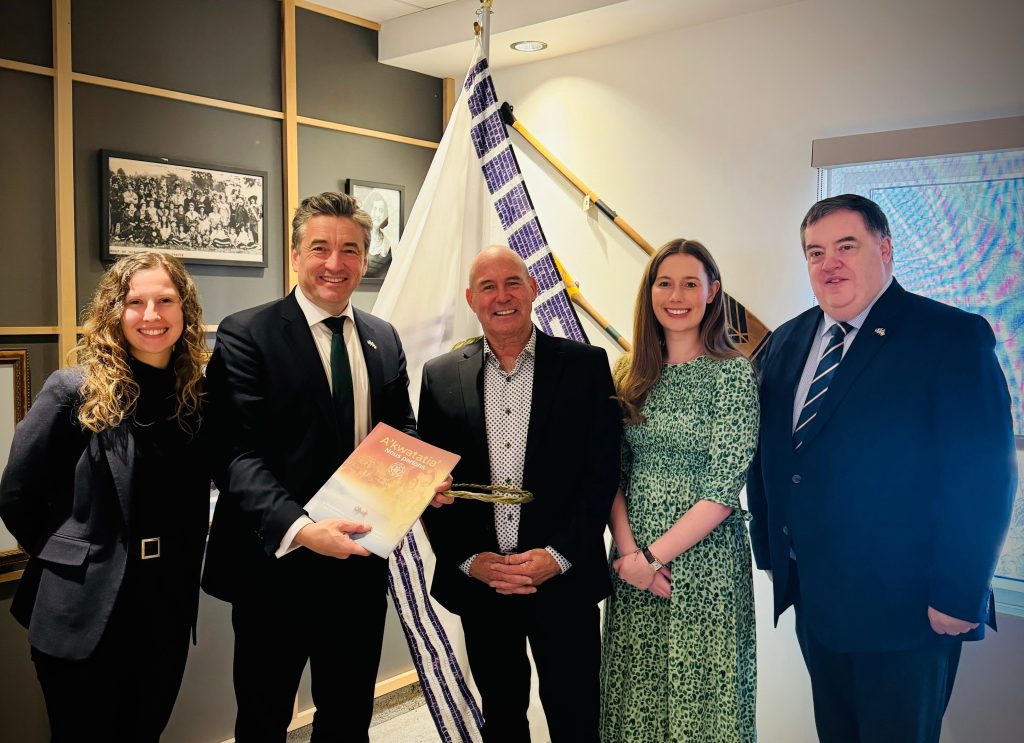
From Left: Elyna Bergeron, Ambassador John Concannon, Wendake Chief Pierre Picard, Elisabeth O’Higgins, Honorary Consul Bryan O’Gallagher.
These wampum belts framed Indigenous donations not as charitable acts but as forms of communal sharing within networks of clan and kin. “A lot of these wampum belts were speaking to the Virgin,” suggested Renaud. Mohawk and Wendat societies are matrilineal. Their creation stories begin with the figure of a pregnant woman falling from the sky—Skywoman, or Aataentisc—who bears some resemblance to the Virgin Mary reimagined as a clan mother in their worldview. “To speak of the Virgin as a clan mother implies that everyone who comes from that mother is kin, brothers and sisters,” said Renaud.
“We can understand that in 1847 the Wendat knew very little about the Irish, except that their brothers and sisters in the Catholic family were in need. In the 1800s, people in Indigenous communities were poor. They had very little,” he added.
“Yet as was the case in traditional societies, even if you were hungry yourself, if you had a bit of food, and someone was in need, you split it in two. It always had to be shared. It is in this context that the Wendat gave for the relief of the Irish Famine.”
“It is our responsibility to show kindness, to show generosity, and to help those that are in need,” agreed Claudette Commanda, Chancellor of the University of Ottawa and a member of Kitigan Zibi Anishinabeg First Nation. “As First Peoples, we certainly understand the hardships and realities of hunger.” In providing aid for the Irish, “we have created a relationship of brothers and sisters. We have created a relationship of friendship,” she added.
In paying tribute to First Nations in Quebec, Ambassador Concannon has sought to strengthen this friendship and ensure that their legacy of generosity is not forgotten.
You can watch the video here:
Wonderful story. Thank you, Irish America Magazine, for making the past present and inspiring!!