
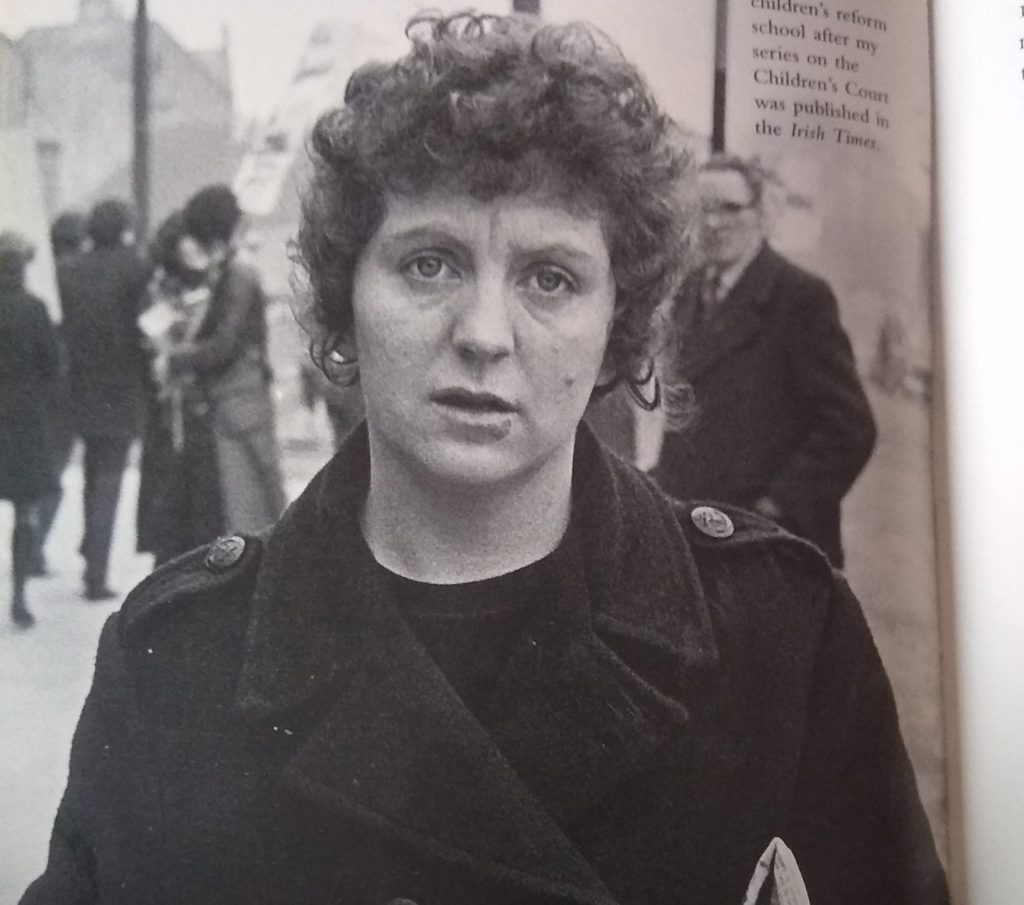
“You never knew what she would say next.”
Though she stood just under 4’11”, Nell McCafferty was larger than life. She was a fierce Derry Girl, activist, journalist, author, broadcaster, feminist, socialist, storyteller, lesbian, and much more. Nell was a force in the secularization and transformation of Ireland, fighting to make her country take its place in the modern world. Behind the haze of cigarette smoke, frizzy hair, and colorful language, there was a brilliant mind working to excise Ireland from the legacy of colonialism and the stranglehold of the Catholic Church. After her death on August 21, 2024, Taoiseach Simon Harris paid tribute to her fight, “In an Ireland trying to emerge from the shadows and find who it was, Nell McCafferty was one of the people who knew exactly who she was, and she wasn’t afraid to enter every battle…she left Ireland a much better place than she found it.”
Nell was born in 1944 in the Bogside area of Derry and once claimed, “From around the age of my First Holy Communion, I knew I was an outlaw.” She was one of the first Catholics admitted to Queen’s University Belfast, where she joined the Civil Rights movement and became close friends with the group’s leaders, Bernadette Devlin and Eamon McCann. Nell’s mother, Lily, kept an open house and meals for all the university’s activists.
After graduation, the ever-restless Nell traveled and lived throughout Europe,
finally moving to Israel to work on a kibbutz. She returned to Derry in 1968, just after intense rioting shook the city – it was the beginning of the Troubles.
In 1970, she moved to Dublin and began as a staff writer for The Irish Times, giving an impassioned voice for those living in poverty and desperation in Dublin. A crusader for children, her columns railed against a court system that would send children as young as seven to brutal reform schools. But her greatest passion would always be reserved for women’s rights, and in 1971, she was one of the founders of the Irish Women’s Liberation Movement. The IWLM had a mission: equality for women in the home and workplace, support for single mothers, and, of most urgency, contraception, still illegal and unattainable in Ireland, which, after finally gaining independence from Britain, had devolved into a theocracy and patriarchy.
Nell led the IWLM as they took off on the “Contraception Train” from Dublin to Northern Ireland, where birth control was legal. She trooped up to a Belfast chemist, demanding. “The Pill,” but when told she needed a prescription, she ordered her sisters to grab hundreds of aspirins, remove the packaging, knowing Irish Customs hadn’t a clue what a birth control pill looked like. In Dublin, in front of a mass of female supporters, she announced to Customs she was taking a birth control pill as she downed the aspirin. The customs men in Dublin dropped their eyes and waved the women through. Irish and international television crews filmed the entire affair; it was a public relations coup.
She returned to Derry in 1972 to join her civil rights comrades in a march to protest Catholic prisoners’ internment without trial. As a child of the Bogside, she had a deep affinity for the republican position during the Troubles. “In the south, I was a feminist, and in the north, I was a fighter.” The march happened to be the Bloody Sunday massacre when British paratroopers opened fire on marchers, killing 14.
“It altered our world,” she later wrote. “It went deep into us. It is in the Derry air. It is limned in our blood.”
Nell later wrote a book, The Armagh Women, campaigning for republican women in Armagh Prison, where, denied political status and under constant assault by the guards, they held a No-Wash Protest. Nell wrote: “There is menstrual blood on the walls of Armagh Prison…flies and slugs grow fat as the women grow thin.”
Despite their suffering, Nell concluded that the women gained power and agency from their ordeal and posed the question: “Can there be national liberation without women’s liberation?”
She reported on the struggles of Catholic working-class women in Ireland. She became involved in what became known as “The Kerry Babies Case”(1985), writing a book, A Woman to Blame, about the injustice inflicted on Joanne Hayes. She was a young single woman, the police claimed, who first murdered her baby, then conflated her case with another murdered baby found on a beach.
“The Kerry Babies Case” put in relief Ireland’s harsh treatment of unmarried mothers long before the horrors of the Magdalene Laundries became public. Nell described the “medieval” interrogation of Hayes and the sham trial that followed. Her book was an indictment of the criminal justice system that condemned an innocent woman whose only sin was conceiving a child by a married man. Years later, DNA evidence exonerated Joanne Hayes.
In 1980, Nell fell in love. She heard the columnist and academic Nuala O’Faolain speak, an “incandescently brilliant speech,” and her life changed. Nell and Nuala lived together and fought for women’s rights, drawing the ire of bishops who claimed feminists conspired to destroy the traditional family. They were the “best-known closeted couple in Ireland,” but after 15 years, the relationship ended. Soon after the split, Nuala wrote the bestselling memoir Are You Somebody? In her book, Nuala airbrushed their relationship, maintaining it wasn’t sexual and anyhow, she “never thought of Nell as a woman.” In interviews, Nuala kept affirming her heterosexuality, claiming she would “still walk across 59 women to get to one man.”
The Nell-Nuala controversy became a sapphic soap opera that kept the public enthralled, especially when Nell counter-punched with her 2004 autobiography, titled simply Nell. In it, she expressed her profound hurt at Nuala’s dismissal of their relationship, “like we were lodgers,” and claimed Nuala had a deep fear of being thought of as a lesbian. She summed up, “It was a love story, a love story that failed.” She came out on the popular national TV program, The Late Late Show, and said with tears in her eyes, “Being gay is the last great taboo in Ireland.”
Fintan O’Toole has said Nell “hovered between being a pariah and national treasure, much loved and much hated, sometimes by the same people at the same time.” Her outspoken voice indeed created controversy. She once said she was the only woman, outside of Roddy Doyle novels, allowed to say “fuck.” Nell had a broad audience as a regular contributor to RTÉ radio and television, but was banned from broadcasting after saying what no one else dared to say in 1987: she supported the IRA. The ban lasted three years. And ever outrageous, in 2008, she posed naked, at the age of 64, for Daniel Mark Duffy, “‘I think I’m gorgeous. I like the idea of a tribe of women elders doing it.”
At her funeral on August 24, 1924, veteran civil rights campaigner Eamon McCann said she had changed the world, “and in the course of that she entranced as many women as she alarmed men … they had never seen or heard the like of her.”
Codladh sámh Nell.


Leave a Reply