
The Jan. 3, 2026, U.S. military operation in Venezuela will not be forgotten anytime soon. However one may feel about Venezuelan President Nicolas Maduro, the U.S. decision to forcibly extract an acting head of state raises fundamental questions about national sovereignty. We might now inhabit a world where any stronger nation could dispatch a few drones and special ops forces and, within hours, depose the leadership of a weaker nation on an entirely separate continent.
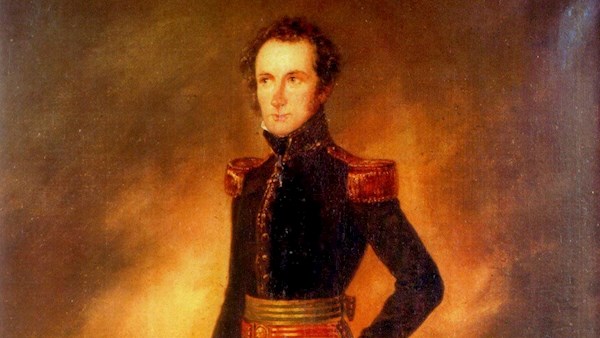
It’s impossible to know how these recent events would have resonated with Daniel Florence O’Leary, a Westerner who ended up devoting most of his life to military and diplomatic service on behalf of Venezuela and was heavily involved with the burgeoning independence movement in early-19th century Latin America.
O’Leary was born in Cork on Feb. 14, 1801. The website irlandeses.org (Society for Irish Latin American Studies) relates that his father, Jeremiah O’Leary, was a well-established merchant of butter. In the early years of the 19th century, profits were as rich as the product he was selling, thanks in large part to lucrative contracts with the British Navy. But the end of the Napoleonic Wars in 1815 saw his business sour.
Amid his father’s bankruptcy, the younger O’Leary, then just age 16, decided to hit the road. He did what was expected of any young Irishman — risk his life for Venezuelan independence.
Actually, it’s not quite as goofy as it sounds: Thousands of Irishmen and Englishmen went to fight for South American liberation. The legendary Venezuelan statesman Simón Bolívar, who led almost half of Latin America to independence from the Spanish Empire, had been placing newspaper advertisements in Western Europe to persuade young men to get involved with a cause that was bound to repay them handsomely (if they survived).
Soon after arriving in South America, O’Leary had asked to join a Venezuelan unit so he could improve his Spanish language proficiency. He also quickly learned about combat and the ways prisoners of war get executed when their captors wish to preserve gunpowder.
O’Leary would have a lifelong scar after his face was slashed open with a sword during battle. As the website of The Dictionary of Irish Biography relates, he would see combat in lands now belonging to Colombia, Bolivia, Ecuador, Peru and, of course, Venezuela.
He enjoyed an impressively quick series of promotions. Though the nature and extent of O’Leary’s formal schooling remain unknown, it is clear he was highly literate and could also impress people of lofty standing. By age 20, he was already appointed aide-de-camp to none other than Simón Bolívar, the grand liberator himself.
In 1827, O’Leary — who would eventually reach the rank of brigadier general — married Soledad Soublette, the younger sister of Venezuelan General Carlos Soublette.
After Bolívar’s death in December 1830, O’Leary and his wife went to Kingston, Jamaica, where they had their first of nine children and where he wrote about the decade of historic freedom fighting he had just partaken in. O’Leary had great source material, such as Simón Bolívar’s personal documents (he ignored an order to destroy these materials after Bolívar’s death). The end result was a whopping 32-volume opus called Memorias del General O’Leary.
Moises Enrique Rodriguez, author of the book Freedom’s Mercenaries, explained that three of the volumes give a narrative account of the wars and the other 29 volumes consist of relevant correspondence and various supporting documents.
Because O’Leary’s Memorias were controversial for a number of reasons, he had requested the work not see publication until a decade after his death.
O’Leary would return to his Cork hometown once, in the year 1834. The occasion was undoubtedly bittersweet, though, as almost all of his 9 siblings had already died by then.
In Britain, he served in a diplomatic-type role on Venezuela’s behalf, before heading to Paris, where he published a biography of Bolívar that saw editions in the English, French and Spanish languages.
He then went to Madrid, where (along with his brother-in-law Gen. Carlos Soublette) he sought diplomatic recognition for Venezuela. This endeavor proved complicated: Spain wanted money in exchange for granting such recognition. Venezuela objected to this demand, and didn’t have the money available anyway.
In Rome, O’Leary was received by Pope Gregory XVI on Apr. 10, 1837. It was surely a memorable event for the lifelong Catholic Irishman. But his effort to obtain official Vatican recognition of Venezuela was unsuccessful.
Returning to South America, O’Leary (who still technically remained a subject of the United Kingdom of Great Britain and Ireland) served as British consul in Caracas, Venezuela, before transferring to a similar position in Bogota, Colombia. There he settled with his family, living on a ranch called “El Chocho.”
In 1852, O’Leary made a voyage to Europe in an effort to get expert medical advice regarding his health concerns. Some of medicine’s most esteemed practitioners in Britain, France and Italy assured him there was no underlying health issue, maybe just some anxiety accumulated from many years of high-stakes military and diplomatic engagements.
But it turned out that O’Leary’s instincts about his health were spot on: Only several weeks after returning to Bogota, he suffered a fatal brain hemorrhage, dying on Feb. 24, 1854, at age 53.
About three decades after his passing, his remains were relocated to Venezuela’s National Pantheon, a cemetery for national heroes, including his former commander-in-chief, Simón Bolívar.
O’Leary has not gone forgotten. As recently as 2010, the Venezuelan ambassador to Ireland presented the people of Cork with a plaque in his honor. And in 2019, Irish President Higgins unveiled a replacement plaque.
Meanwhile, on the Venezuelan front, Caracas still has a prominent public location called O’Leary Plaza, and the Venezuelan Army has a battalion named for O’Leary.
Now, as Venezuela’s recently-deposed Nicolas Maduro languishes in U.S. custody, he has all the time in the world to reflect on how he might have protected himself more effectively and how easy it was for the Americans to penetrate Venezuela’s Presidential Honor Guard. If only Maduro had used the O’Leary Battalion for his security, he might still be in charge.
Leave a Reply