
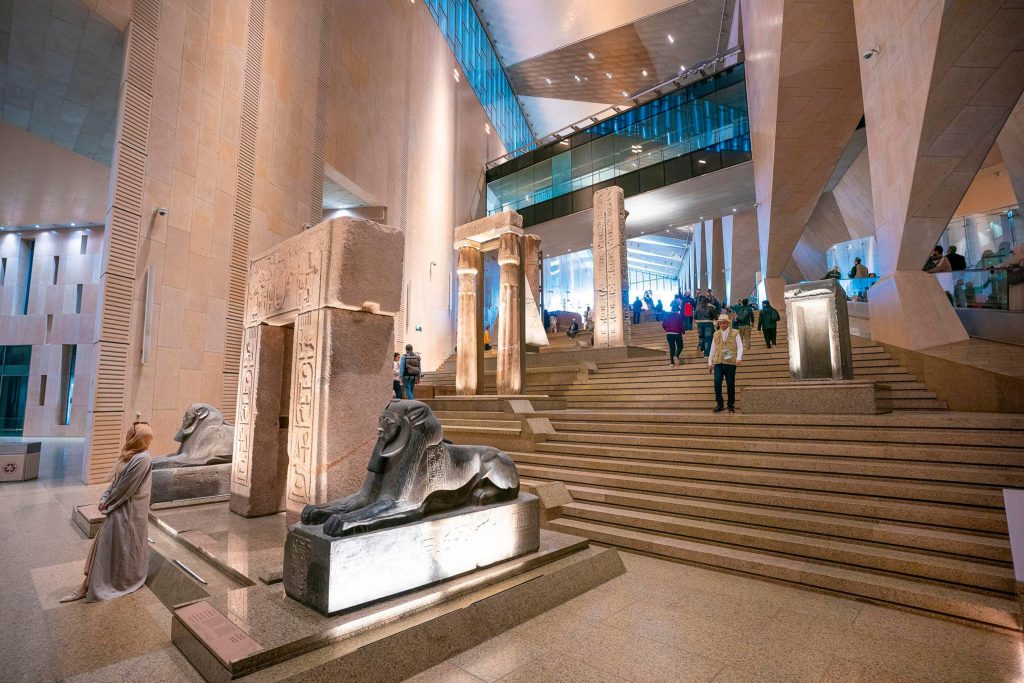
The recently opened Grand Egyptian Museum in Giza, outside Cairo, is breathtaking. The sixth largest museum on earth, its immense size, vast collection, and innovative design are simply awesome. So also is the story of the gifted architect who designed it; Irish-born Róisín Heneghan, a woman whose journey from isolated Belmullet, Co. Mayo, to the heights of the architectural world is equally as amazing.
Heneghan’s phenomenal success is as unlikely as it is inspirational. Born in 1963 in the rural West of Ireland at a time when the field of architecture was dominated by men, she studied architecture at University College Dublin and received her degree in 1987. She was accepted to study at Harvard University’s prestigious architecture program where a tutor paired her with a Chinese American student, Shih Hu Peng. The two not only collaborated well on the project but also married and founded a small architectural firm together in New York named Heneghan Peng, which they moved to Dublin in 2001. That same year the firm won the coveted American Institute of Architects Award.
In 2005, the Egyptian government announced a competition for plans to build a huge archeological museum near Cairo. Over fifteen hundred firms submitted designs for the prestigious project, the largest number of entries ever for an architectural competition. The competitive field included world-renowned architects such as Frank Gehry and Zaha Hadid. When the Egyptians announced the tiny Irish firm had won the architectural community was stunned, but so were the winners. When the architects received a phone call saying that they had won, the couple were so astonished at first that could not believe their ears. At first, she thought it was a prank. “When we heard we had won,” Heneghan said, “we couldn’t believe it. We called them back and asked: Are you sure?”
Completing the billion-dollar project proved almost as monumental as building the pyramids themselves. The project required the collaboration of 300 people from 13 companies, across six countries, in fields including landscaping, engineering and exhibition design. The Grand Egyptian Museum had been scheduled to open in 2012, but it took nearly two decades to complete. The project took almost as long to build as the Great Pyramids themselves. It was delayed by financial crises, the 2011 Arab Spring – which deposed Egypt’s president and led to years of turmoil – the Covid-19 pandemic, and regional wars. Finally, it opened with great fanfare and ceremony in November to rave reviews. So how did a tiny, largely unknown Irish firm beat the most prestigious architectural firms in the world?
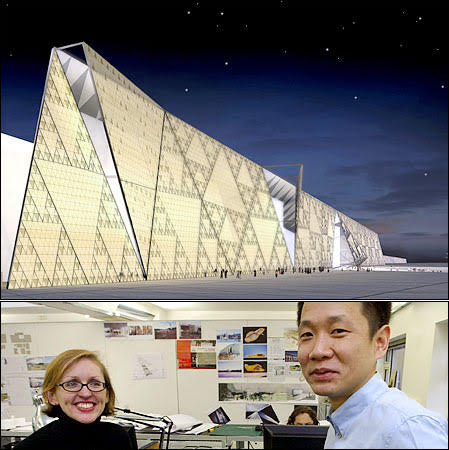
“The most important thing,” Shih-Fu Peng says, “is the site.” They examined the site closely. “It’s knowing what not to do,” Heneghan added. “It’s looking,” Peng said. “Looking before stepping. Most people are so confident they step before they look. We look before we step, let’s put it that way.” Peng also noted, “We walked the site. We spent four or five hours sitting on the desert plateau, overlooking Cairo, until the sun set into the evening. We realized at that point that our roof was too high. And so, we took it down.”
The gigantic museum, covering 5.4 million-square-feet, sprawling over an area larger than 90 football fields, is really several museums in one. The museum complex includes the main building, a conference center, a courtyard, a Nile Valley park, the Khufu Boat Museum and a conservation center. It displays some fifty thousand objects. The museum will eventually house more than 100,000 ancient artifacts from the 30 dynasties of ancient Egypt.
Some of the main attractions include the 3,200-year-old, 11.36-metre (37ft) statue of King Ramses II, a 4,500-year-old boat, one of the oldest intact ships in the world, belonging to Khufu, the pharaoh renowned for building the Great Pyramid of Giza, and the Tutankhamun Gallery, a 7,500sq-meter (80,000sq-ft) space featuring more than 5,000 artifacts unearthed from the tomb of Tutankhamun, the boy king who ascended to the throne and ruled during the Eighteenth Dynasty nearly 3,400 years ago. The minister of tourism and antiquities, Sherif Fathy, said he expected it to draw up to five million visitors a year, and developers are rushing to build about 12,000 hotel rooms to host them.

The Egyptians decided that the Dublin firm’s design better meshed the modern and the ancient better than any other proposal. Instead of creating a modern monument to rival the pyramids, the couple instead focused on the height difference between the fertile Nile Valley and the desert that rose 60 meters above it, ingeniously embedding the museum into the plateau instead of placing it on top. Because the museum’s north and south walls are aligned with the Pyramid of Khufu and the Pyramid of Menkaure, the huge structure blends so seamlessly into the iconic landscape that it has been called “The fourth pyramid.”
In a press release for the museum the firm said that the design “makes the pyramids feel like a part of the museum itself.” The design’s incorporation of triangles throughout the structure builds continuity between the ancient and the modern. The triangular façade and overall geometry have been called dramatic, and they create a “silent architectural dialogue” with the ancient landscape. Following the line of the plateau, and the lines created by the pyramids, a series of stairways ascend six stories upwards, widening to reach the apex of the space, where huge windows dramatically reveal the majestic view of the pyramids of Giza.
The most impressive feature of the huge site is the huge triangular-shaped free-standing wall that unifies the different buildings in the museum and creates a new edge to the plateau. The awesome stone wall is 800 meters long and over sixteen stories high. The wall required the quarrying of some four football fields of special translucent alabaster stone that dramatically changes over the course of the day as the sun strikes it from different angles. The stunning façade of the museum is composed of frosted glass panels. The huge numbers of different types of visitors also posed a challenge: how to create a space that would appeal to the average tourist, native Egyptians and the academic experts.
Heneghan says. “It is a design for four or five million people a year. And a significant number will be international tourists, who will spend maybe two hours. But others will want to be here for four hours and more, so you need to have a fast route, and you also need to allow the specialists to come, and they’re going to want to be more focused.”
Heneghan’s design incorporates a gentle cooling of the air as you come in from the desert heat, so that you are not immediately blasted with the chill of air conditioning. “We want you to decompress a little, to slow down.” The slow progression to the views of the pyramids helps visitors slowly come to a point where they are truly ready to appreciate what they are seeing. “Cairo,” she says, “has spread out and around the pyramids, so when you come up here, you’re not seeing the traffic around them.”
Winning the Grand Egyptian Museum proved a game-changer for Heneghan Peng, transforming it overnight into one of the most prominent architectural firms in the world. The company has since gone on to win international design competitions for prestigious projects such as the Giant’s Causeway Visitors’ Centre on the Antrim Coast, the National Gallery of Ireland’s historic refurbishment, a faculty building and library for the University of Greenwich’s School of Architecture and Construction, in London and the Old Library redevelopment at Trinity College Dublin amongst many others.
Henaghan’s genius has been recognized at home. In 2024, Heneghan was inducted into the prestigious Aosdana, an Irish association or academy of artists, each of whom must have produced a distinguished body of work of genuine originality. Heneghan and her firm have convincingly proven that a woman from Belmullet Co. Mayo is the equal of any architect on the planet.
Leave a Reply