
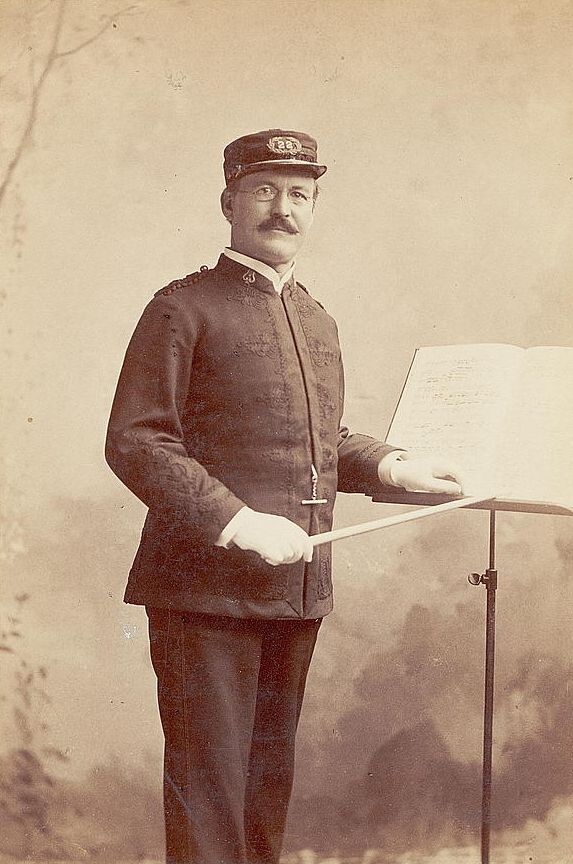
During 1992, the centennial of Patrick Sarsfield Gilmore’s death, many cities across the United States are honoring “The Father of The American Band.” However, Ireland is where it all began for the great bandleader.
The greatest bandmaster of the last century was a native Irishman named Patrick Sarsfield Gilmore. Born in Galway on December 25, 1829, the third child of Patrick and Mary (nee Sharkey) Gilmore, he was, as a contemporary would later write, “nature’s Christmas gift to a music loving world.”
Two weeks later he was baptized in the old Ballygar church, across the road from his home (now site of the Town Hall). Since he was born so close to St. Stephen’s Day, December 26, he was named Patrick Stephen Gilmore.
Gilmore was musically gifted even as a child—fiddles, fifes, and drums, many of them made by his own hands, were his toys.
Those were stirring times in Ireland. Agitation and O’Connell’s repeal movement were sweeping the country. Bands and protest meetings were the order of the day. At age 13, Gilmore accompanied his father and members of the local temperance band to O’Connell’s monster repeal rally in Athlone. Here in a meadow outside the town, beneath a giant beech tree that still flourishes, Daniel O’Connell addressed one of the largest gatherings ever assembled on Irish soil.
Not to be overawed by this vast gathering, the British authorities decided on a show of military splendor, parading all their regimental bands in full view of the multitude.
This was to have a profound effect on the impressionable young musician, for this was his first encounter with a fully equipped, well-trained, and disciplined military band. He noted with an expert’s eye, the keyed bugle, the cornet, trombone and bassoon, and for the first time felt the inadequacy of his own fife and drum band.
From that day on Patrick Gilmore had but one thought in mind to return to Athlone and become a member of a regimental band.
Every spare moment he spent with bands. Several bandmasters held the lad in particular favor, discovering in him musical talent of an unusual order. He joined a town band composed of young businessmen, and he was the youngest of them all, being but 15 or 16.
Even at this early age he began writing music, and he produced marches and polkas, one of which, a polka, became exceedingly popular and was published by a Dublin music house. In 1848, he became member of a regimental band that was being transferred to Canada.
Since British Army musicians were not then enlisted men, but were hired as civilians, Gilmore had little difficulty getting his release, and he immediately headed for Boston, then the music center of the United States. Within three months of his arrival he was named leader of the newly formed Charlestown Band, subsequently becoming leader of the Suffolk and the Boston Brigade Bands.
While a member of “Ordway’s Minstrels, ” he was hired by the arch-showman, P. T. Barnum, to boost the merits of Barnum’s latest acquisition, the Swedish nightingale, Jenny Lind.
In 1855, at age 26, yielding to a tempting offer of a thousand dollars a year, he went to Salem as leader of the Brass Band. It was at Salem that he incurred the enmity of the “Know-Nothing” party, then at its peak. Having been cautioned by them to change his name if he expected regular bookings, they were totally unprepared for the change Gilmore made: he dropped “Stephen” and took instead one of the proudest names in Irish annals, “Sarsfield.”
It is recorded that his bookings did indeed suffer, but his star was on the ascendant and his band was invited to Washington for the inauguration of President Buchanan in 1857.
Gilmore remained with the Salem Band for about four years, during which time he met and married Ellen O’Neil of Lowell, organist and choir director at St. Patrick’s Church.
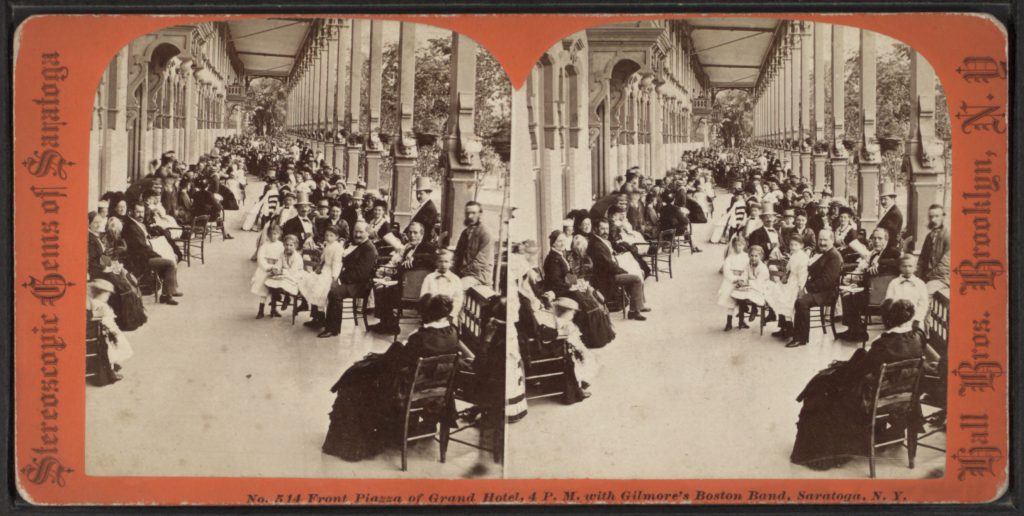
This courtship produced one of our most popular barber-shop melodies, While Seeing Nellie Home or The Quilting Party as it is also known. Returning to Boston, Gilmore organized a band named after himself and introduced the public to a series of promenade concerts which became the rage of Boston.
By this time he was known as the greatest E Flat cornet player in the country as well as a promising composer. Among his more notable numbers were God Save the Union, Music Fills My Soul With Sadness, We Are Coming Father Abraham, and the extremely popular Good News From Home in which he expresses a nostalgic fondness for his boyhood home.
As the nation girded for civil war, Gilmore and his band offered their services at recruiting rallies and parades. At Fort Warren in Boston Harbor, where the Massachusetts 12th Regiment was encamped, he set to music the words written by Captain Halgren, John Brown’s Body, a song that was to become, the most famous marching song of the Civil War.
In 1861, he and the members of his band enlisted as a unit of the 24th Massachusetts Regiment and accompanied the Regiment to the front. Three years later, when stationed at New Orleans, Gilmore was placed in charge of all the bands in the Department of the Gulf by General Banks who honored him with the title of Colonel.
Here he staged a musical spectacular to celebrate the inauguration of Governor Hahn of Louisiana. Assembling a chorus of 5,000 school children, many of them from Confederate families, and massing all bands under his charge, he came up with an orchestra of 500 pieces.
Among the musical novelties he introduced were guns which fired by electricity on the first beat of every bar in patriotic numbers. In recognition of this political as well as musical triumph, the prominent citizens of New Orleans tendered Mr. Gilmore a complimentary dinner, presenting him with a silver goblet, filled to the brim with gold coins.
To this public tribute, Governor Hahn added a personal letter to President Lincoln, mentioning Mr. Gilmore as one who had “done great good to the cause of the Union” by his faithful and patriotic services, “a musician of the highest ability” and “a true gentleman.”
Just before the end of the war, Patrick Gilmore reached back into his Celtic past and wrote the words and music of the rollicking When Johnny Comes Marching Home, under the pen name, Louis Lambert. This musical plea for peace, rising above the lachrymose sentiment of the day, was an instant and enduring hit.
The war over, there was peace in the land. But Gilmore lived in a tempest of yearnin nd he knew the anguish of hopes that met slow fulfillment. He had seen the horrors of civil war and tried to lighten the hearts of Union combatants with martial melodics. Now, to bind up the wounds of a shattered nation, and to “commemorate the restoration of peace throughout the land,” he again prescribed music concerted in a mammoth “National Peace Jubilee.”
In 1868 he took his plan to Washington, using the coincidence of the Grant presidential inaugural, but was rebuffed. He then tried New York but met with no better results.
Returning to Boston he vowed to “do it myself.” With his winning Irish ways, Gilmore talked to millionaire bankers, conservative music leaders, doctors, lawyers, and merchants. He won the backing of Julius Eichberg, director of the Boston Conservatory, and endured the enmity of John S. Dwight, editor and musical czar of Boston.
Eben D. Jordan, founder of Jordan Marsh Company was enthusiastic about it—he subscribed $1,000, as did a number of other business men. There was no auditorium large enough to hold even a tenth of the expected audience so Gilmore built a huge coliseum. The structure was capable of seating 30,000 persons in addition to the chorus of 10,000 singers and an orchestra of 1,300 instruments.
This immense auditorium was created in less than three months in St. James Park, on the present site of both the Sheraton Plaza Hotel and Trinity Church. In lettered gold, “Gloria in Excelsis Deo et in Terra Pax Hominibus” was hung atop the coliseum, while the decoration of the interior carried out the general theme of peace. Not all the labor was on the building itself. Plans were made for special trains from distant points at reduced rates. Illumination was provided by three thousand gas jets that were supplied by a specially installed eight-inch gas pipe. Temporary tracks for horse cars were laid along Boylston Street.
Gilmore himself sent out hundreds of letters and signed each one, “Praying that the grace of God be with the undertaking and direct it to a successful end.” The great English dramatic soprano, Parepa-Rosa, the darling of the public at this time, agreed to fill the soloist spot.
With startling realism, one hundred Boston firemen, complete with blacksmith sledges and anvils, were trained to hammer out the rhythm of The Anvil Chorus from Verdi’s I/ Trovatore. Twelve cannon, placed outside the building, a bass drum with a diameter of eight feet, and most of the bells of Boston as well as a gigantic organ, completed the assemblage. Cannon and bells were controlled electrically from the conductor’s podium.
From the first day, June 15, 1869, of the Jubilee, Boston was crammed with music lovers assembled from all over the world. For five days the Jubilee lasted, with thousands unable to gain admittance. President and. Mrs. Grant arrived on the second day. All Boston was hysterically excited over the gigantic celebration.
The whole program was a superb success, but the great soprano, Parepa-Rosa, the spectacular arrangement of the Anvil Chorus, and Patrick Gilmore himself were the outstanding features of the festival. Overjoyed and grateful, the Mayor of Boston presented Gilmore with a gold watch and a check for $32,000.00. He and his wife left immediately for a European vacation.
Gilmore returned from Europe all agog over another great musical festival. The siege of Paris and the Franco Prussian War had ended; so, to celebrate the event, he planned an International Peace Jubilee. Taking a little time out to write an 800 page book titled The History of the National Peace Jubilee, he charged with renewed vigor on his plans for this, “the greatest of all musical festivals.” To give it an international flavor, Gilmore planned to bring over the greatest of Europe’s noted bands.
Armed with a letter from President Grant, he again visited Europe in the fall of 1871. Calling on kings and premiers he wheedled them into sending their top bands to his World Peace Jubilee. From England came the Grenadier Guards Band. France sent the Garde Republicaine Band and Germany sent Kaiser Wilhelm’s Grenadier Regiment Band. Belgium and Austria each sent a band. Johann Strauss, “the waltz king,” after much coaxing from Gilmore, agreed to come and conduct some of his own compositions for the occasion: the beautiful Jubilee Waltz and Boston Dreams.
Since the first Coliseum had been totally destroyed in the devastating gale of October 1869, a new one was planned near the same site with even larger dimensions and capable of holding 50,000 people, as well as a chorus of 20,000 voices and an orchestra of 2,000 musicians. Money was no longer a problem. At this time Gilmore was the idol of Boston. The Boston Pilot, in a biographical sketch of him in 1872, said, “The Pilot has heretofore chronicled the labors, and given to its readers portraits of the many men of the Irish race who have made their homes in America and their mark on the history of its progress, but never has it recorded a more remarkable career and one dependent solely on a bright genius, a brave will and an energetic practical mind than that of the subject of our present sketch, Patrick S. Gilmore!
“No man is better known throughout the land or has more friends or is better beloved and no man ever more truly deserves the esteem and love and great fame that he enjoys.”
With plans for the festival almost completed word reached Gilmore that the Irish Constabulary Band headed by Sir Robert Steward was not coming. This was a bitter disappointment to Gilmore. Sir Robert had written a Fantasia on İrish Airs which he planned to conduct at the festival but the British authorities decided that only one band should represent Great Britain, namely, the Grenadier Guards Band, led by Dan Godfrey.
Determined that his native country should be represented amongst the other great nations, Gilmore sent a special agent to Dublin to recruit 30 of the best musicians available. They were rushed directly to Boston where they arrived with only two days to spare.
On June 17, 1872, Boston was once again the center of attraction for the eyes and cars of all the musical world. Never in the world’s history was there such a gathering of musicians. From the newspapers of the day we can get some idea of the overwhelming enthusiasm and excitement that prevailed.
The New York Herald Tribune describes the applause at the end of the opening day: “There followed a sudden outburst of the grandest demonstration of applause which has ever been witnessed within four walls in this continent. Old men, forgetful of rheumatism, rose to their feet and stamped up and down in wild frenzy.
“Tears rolled down the checks of many a bronzed face; the men embraced each other as if they had not met for years. The children even caught the infection, and added their shrill voices to the general chaos of sound.”
The Jubilee continued for 18 days and, although the crowds began to taper off after the first week, still an attendance in excess of 50,000 people at each performance was not uncommon.
The second Jubilee, somewhat due to the ease with which gate-crashers dodged admission fees, was a financial failure though a musical triumph. The world had seen nothing before, nor anything since, like these two spectacles which drew hundreds of thousands of people to Boston, enhanced business and aroused the jealous ridicule of cities like New York.
On September 24, 1892, Gilmore died —celebrated by the world and alone at last with his family and Father Hayes, a close and long-time friend.
Gilmore is buried in Calvary Cemetery, New York, and it seems strangely ironic that the man we hail as the “Father of the Concert Band,” this son of a monument and tombstone mason, is laid to rest with a simple army grave marker as his only monument. Surely he deserves more. Gilmore’s long musical crusade was an eminent success and although the purists sniffed, even his severest critics admit that he elevated the brass band to a dignified musical status and that it was he who claimed a place for the band on the concert platform. Always gentle and kind, he was a man of rare magnetism who dreamed impossible dreams and had the genius to make them come true.
By Michael J. Cummings
The author, a long-time Gilmore enthusiast, has amassed the largest collection of Gilmore memorabilia in the country, and is on the Board of Directors of the P.S. Gilmore Society. This article was first published in the Boston Pilot on April 19, 1969.
On September 26, 1992, there was a ceremony dedicating a new monument at Gilmore’s gravesite.
Leave a Reply