

A Family Tree that Spans Three Continents and Both Sides of the Equator
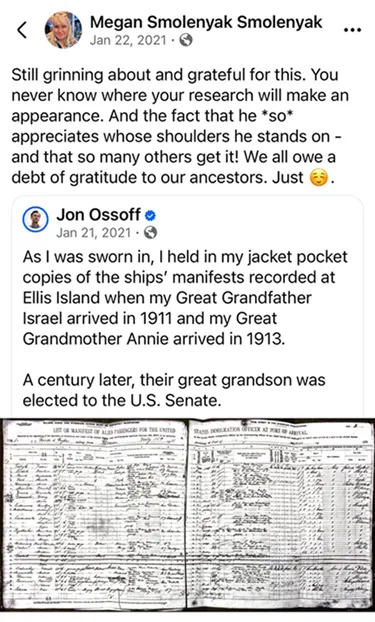
Back in early 2017, I became intrigued by political newcomer Jon Ossoff and decided to explore his ancestry. Lithuania emerged as the “old country” home of the Ossoff family¹, and I was delighted when he held copies of the arrival records of his immigrant great-grandparents in his pocket as he was sworn in as a U.S. Senator.
His second term starts in January 2027, so I thought it was time to take another look — particularly at the half of his family tree that stems from his Australian-born mother. But first, I wanted to take one more detour into his father’s side.
1. Senator Ossoff had two sets of great-grandparents who came from Eastern Europe, so he’s frequently described as being of Russian and Lithuanian Jewish descent. But hometowns that were once part of the Russian Empire are often situated outside of Russia as we know it today, and that turned out to be the case here. The other pair of his “Russian” great-grandparents emigrated from the area around Tetiiv and P’yatyhory, Ukraine (roughly a dozen miles apart and 100 miles southwest of Kyiv).
2. Combining his father’s side with what I’ll share shortly about Senator Ossoff’s maternal ancestry means that Lithuania, Ukraine, Australia, New Zealand, England, Scotland, Ireland, and the Channel Islands can all claim a piece of his past. He also has more distant roots in France and quite possibly Belarus and a smidge from Denmark.
3. Senator Ossoff’s mother arrived in the U.S. from Australia at the age of 23. Her father, Tom Fenton, passed away well before Jon was born, so he presumably learned about his grandfather’s remarkable World War II experience from her. Serving in the Australian Imperial Forces, he was captured in Crete by the Germans, but escaped by jumping off a prison train. There he encountered a resistance worker named Demetrios Savoulidis who sheltered him for about a year in Salonika. Savoulidis taught him to “speak and act like a Greek,” while Fenton taught him English.
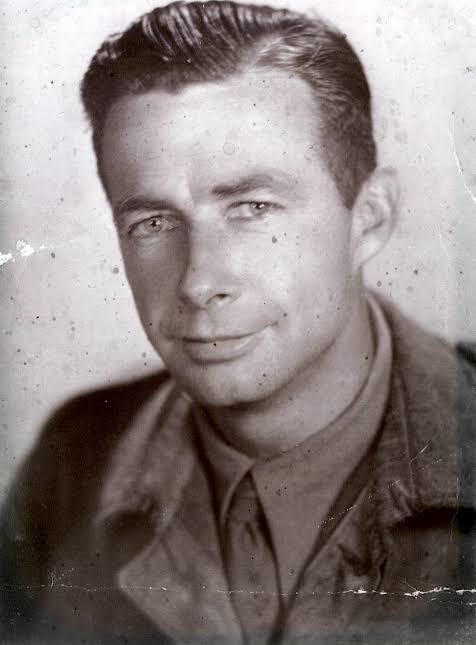
When the Germans warned of reprisals, he decided to leave, only to be recaptured as he was trying to cross into Turkey using a Greek passport. The Germans tried him for espionage, but he was acquitted and then spent about 15 months, partly at Stalag XVIIIA (in Wolfsberg, Austria) and partly in a labor detachment at a farm in Semmering, Austria. Semmering is a mountain pass town, so while there, he learned to ski. At some point, he was transferred to Stalag 357 in Fallingbostel, Germany, and it was there that he and other POWs were liberated by the British 7th Armoured Division in 1945.
After the war, Fenton reciprocated Savoulidis’s bravery and kindness by sponsoring him for migration to Australia.
4. Senator Ossoff’s family has a military history that extends far beyond that of his Fenton grandfather in WWII. Venturing over to the United States, his Ossoff grandfather served in the Army Air Corps as a Bombardier in the Pacific while his grandmother (they married a couple of years after the war) worked in the Army Nursing Corps. Turning back to WWI, Australian family members were killed or wounded in action in Belgium and France.
Yet another loss in the family would profoundly affect his Australian grandmother as her first husband, Sydney Webb, was killed in Crete in 1941. Barring this tragic event, it’s unlikely she would have remarried and Senator Ossoff’s mother would never had been born.
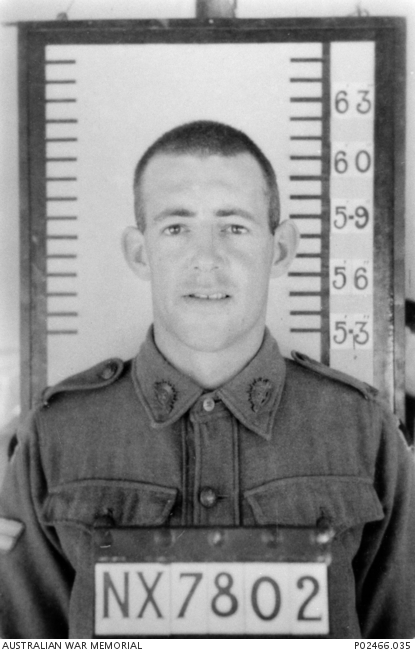
5. It’s estimated that roughly 20 percent of Australians have family trees that include convict ancestors transported from Britain and Ireland between 1787 and 1868. Prior to this time, most were sent to North America, but the American Revolutionary War removed this option. With British prisons becoming increasingly crowded, Australia eventually emerged as the preferred alternative. Once regarded as cause for embarrassment, convict heritage is now shrugged off or even celebrated. It also bears mentioning that while some were indeed guilty of serious crimes, many were transported for minor offenses such as petty theft, and those shipped abroad included a number of children and teenagers.
Given that Senator Ossoff’s Australian ancestry goes back at least six generations, it’s not a surprise that his predecessors would include a sprinkling of such people. For instance, one of his 3rd great-grandfathers, Edward Knock, was sent along with a brother from Kent, England for stealing sheep. The previous year, a 4th great-grandfather named Mathew Eaton was shipped from Ireland. The crime in this case was burglary, an attempt to steal fire arms, but did he really do it?
Mathew’s transportation to Australia left his wife destitute in Ireland with five children and a sixth on the way. Stating that her husband had been mistaken for one of his brothers, she repeatedly implored authorities to send her along with their children to Australia as well, but received no help. Mathew took up the case from his end in Australia, requesting assistance from government officials there. It took almost 14 years, but the family was finally reunited in New South Wales in 1849.

6. It’s well known that Ireland enjoys claiming its own, particularly when it comes to American presidents. Senator Ossoff has said that he does not intend to run for President in 2028, but it’s not hard to imagine that he might a little further down the road. In anticipation of that day, I’ll build upon what I just shared about the Eaton family.
They were from Killarney, County Kerry, and thanks to the paper trail created by Mathew and his wife, it’s possible to be quite specific. They resided at the heart of Killarney at the intersection of College Street and Fair Hill, as well as nearby Clover Lane.

But these were not Senator Ossoff’s only Irish kin. Another line contributes County Kilkenny to the mix with Thomastown and Castle Gardens taking the honors, and yet another tosses in Ballylanders, County Limerick, with hints of counties Wicklow and Cork. So should Senator Ossoff return to Ireland (he visited in 2022), he has plenty of places to mingle with cousins and perhaps enjoy a pint-in-a-pub moment.
7. Many of us are aware that our ancestors arrived by ship, but aside from perhaps touring an immigration/emigration-centered museum, rarely give any thought to what their journey might have been like. For those sailing from England, Ireland, Scotland, or the Channel Islands all the way to Australia – particularly around the 1830s-1850s when many of Senator Ossoff’s relatives departed – the trip must have felt as if it would never end.

Take the case of his Guernsey (Channel Islands) ancestors who made the trip in 1854. They left on March 4th and didn’t arrive until July 22nd, four and half months at sea. Making it even harder to bear, they lost a son during the voyage.
Another couple named Decis made the trip four years later and spent almost as long at sea – roughly four months (July 29th to November 24th) – but had a happier outcome. On October 11th, Mrs. Decis gave birth, meaning she spent roughly ten weeks at sea pregnant and an additional six taking care of a newborn. This branch of Senator Ossoff’s Australian family tree was taking root even before they stepped on shore, and generations later, his mother would bring this history to the U.S.
One of the best aspects of America is the grand kaleidoscope of our heritage. From Australia to Ukraine to Scotland, Senator Ossoff’s forebears have converged in the United States. So many of us sport an intriguing ancestral mélange, and he is no exception.
(1) Since then, at least one researcher traced this line back further to Slutsk, Belarus, and while I have no reason to doubt this, I have not substantiated it.
Leave a Reply