
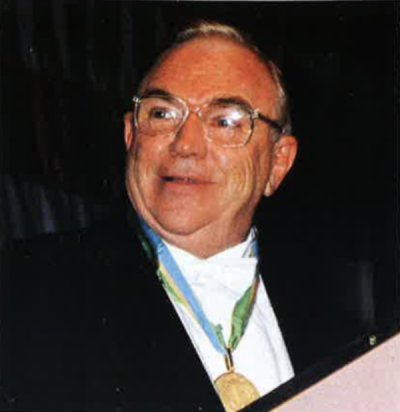
The following remarks by Donald Keough, president of Coca-Cola, were made during a recent visit to Ireland, where he spoke to the Drogheda, County Louth Chamber of Commerce.
The Irish presence in North America, both Catholic and Protestant, goes back to colonial times. But the really massive migrations occurred in the nineteenth century when wave after wave of Irish immigrants poured into the United States.
Well, they were dirt-poor. They were hungry. To settled Americans, they talked kinda funny, and they were subject to vicious discrimination for many years.
Less than seventy years ago, in the Boston and New York papers, help-wanted columns routinely ran notices saying: “No Irish need apply.”
So the American Irish, my ancestors among them, were busy fighting for their rights. One of the foremost advocates of true equality was that great patriot and poet and son of Drogheda, John Boyle O’Reilly. He was really the first civil-rights activist in the United States…many, many decades before the modern movement.
It is no surprise, then, that the Irish played such an extraordinary role in the U.S. Civil War. Fully two hundred and fifty thousand signed up for the Union side to fight against slavery.
And, it must be said, they also fought against a way of plantation life that perpetuated an old-world-like aristocracy which the Irish did not love.
At the famous Civil War battlefield in Gettysburg, Pennsylvania, where Abraham Lincoln paid such eloquent homage to government “of the people, by the people, and for the people, ” there is an Irish monument for those who fell in battle. With its weeping Irish wolfhound and great Celtic cross, it is a moving testimonial to the bravery of Ireland’s immigrant sons.
One of my ancestors, Captain Myles Keough, fought in the Civil War and afterwards fought with General George Custer. In fact, he was the last man to fall in the battle with the Sioux Indians at Little Bighorn. So impressed were the Indians with Captain Keough’s bravery, that they did not kill his horse. And that horse was the only survivor of Custer’s army.
The American Irish fought for their rights with all their might on the battlefield, in the sports arena, on the stage and screen, at the same time, and with equal fervor, they tried to assimilate into American life…to blur their heritage and become first and foremost American citizens.
This assimilation was not fully completed many say, until 1963, when John F. Kennedy journeyed back to Ireland as President of the United States, back to County Wexford which his emigrant forebearers had left more than a century before.
Meanwhile, over the years, many others of Irish descent in the United States have succeeded beyond anyone’s wildest dreams. From football coaches to writers to actors to Anthony Kennedy and Sandra Day O’Connor on the U.S. Supreme Court, the Irish have done wonderfully well.
The last bastion of..shall we say the “old prejudice”… was business…where very few Irish ascended to the paneled halls of corporate supremacy. Until quite recently.
But now! Well, Irish Americans are doing very well, indeed.
Fully one out of every four of the Fortune magazine 500 top executives today is an Irish American.
Many, like myself, who have drawn strength and wisdom from our Irish heritage, would now like to do what we can to give something back to this land…to encourage investment here, to help develop the potential of this great Irish nation.
Now, at last secure in their American identity, more and more Irish Americans are beginning to reach back, to try to rediscover their ethnic identity, not just to celebrate St. Patrick’s Day. Jet air travel has helped this process, and an estimated four hundred and fifty thousand Irish Americans make the pilgrimage back to the land of their ancestors every year.
What we are seeing, more and more, is a growing assertion of “Irish pride” all over the world. The worldwide base of support for and interest in Ireland is broader, more mature, and more successful than ever before.
There are seventy million people around the world who claim Irish heritage. In the words of Robert Hawke, prime minister of Australia, “Ireland is the head of a huge empire…an empire of which Australia and the United States are the principal provinces. It is an empire acquired not by force of Irish arms but by force of Irish character; an empire not of political coercion but of spiritual affiliation…
If we can tap into this resource, and fully awaken the “Irish-consciousness” of all the very successful and influential people of Irish descent around the world, the benefits accruing back to the “Mother” country could be great indeed.
Editor’s Note: This article was originally published in the February 1991 issue of Irish America. ♦
Leave a Reply