
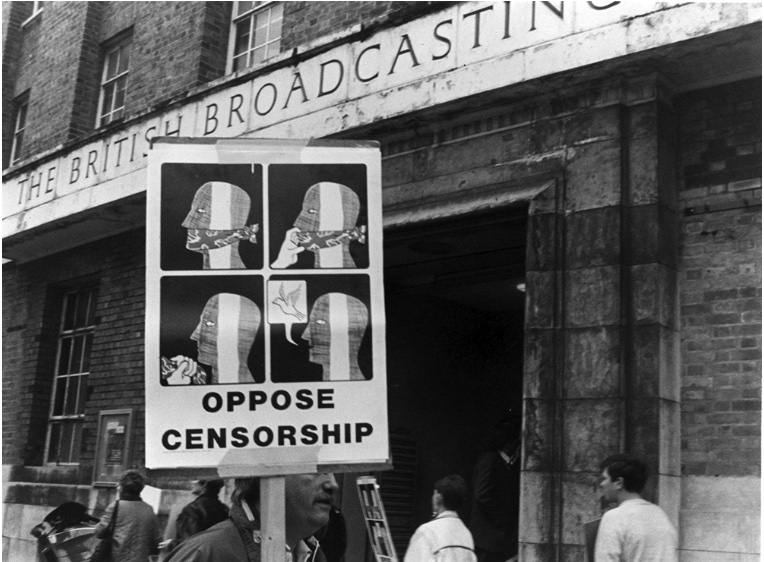
On October 19, 1988 the British Home Secretary, Douglas Hurd, imposed unprecedented peace time restrictions on broadcasting. The banning of direct interviews with eleven Irish organizations, including Sinn Féin, a legal political party with elected councillors and an MP at Westminster, was widely condemned.
This article documents the effect of the restrictions on British TV news.
If is now over two years since Douglas Hurd, the then Home Secretary, introduced a notice banning the broadcast of sound interviews with eleven Irish organizations, including illegal ones such as the Irish Republican Army (IRA) and the Irish National Liberation Army (INLA) as well as legal organizations such as Sinn Féin and the paramilitary Ulster Defence Association. When he announced the ban Hurd argued that “this is not a restriction on reporting.” However, this has not been the case.
The notice, introduced on October 19, 1988, under section 29(3) of the Broadcasting Act and Clause 13(4) of the BBC licence and agreement prohibits the broadcasting of: Any words spoken whether in the course of an interview or discussion or otherwise, by a person who appears or is heard on the program in which the matter is broadcast where: (a) the person speaking the words represents or purports to represent an organization specified or (b) the words support or solicit or invite support for such an organization.
What this meant in practice was left to the broadcasters to decide.
Confusing Guidance
Journalists reacted to the ban with confusion. Guidelines were hurriedly drawn up and then revised, following a letter from the Home Office which indicated that reported speech fell outside the prohibition. This meant that it was acceptable to quote a member of a listed organization or a speaker supporting a listed organization, so long as the originator of the words was not heard speaking them. A second confusion was whether a member of a listed organization could be held to represent that organization 24 hours a day.
The BBC made use of this definition of represent for the first time on February 16, 1989 when they interviewed Gerry Adams about jobs in West Belfast. Thirty seconds of sound on film was broadcast in Northern Ireland, with Adams speaking as MP for West Belfast rather than Sinn Féin MP for West Belfast. The Home Office showed it was keeping an eye on things when it phoned the BBC in London for an explanation. The technicalities of representing an organization have meant some comments being unexpectedly allowed and others ludicrously disallowed.
The Media Show broadcast comments from Sinn Féin councillor Jim McAllister speaking, in his capacity as an actor, about his role in Ken Loach’s film Hidden Agenda. In the film McAllister plays the part of a Sinn Féin councillor!
Meanwhile, BBC reporter Peter Taylor’s Inside Story showed a prison officer negotiating with the Officer Commanding (O/C) IRA prisoners in the H-Blocks of the Maze Prison. Because the O/C appeared as a representative of the IRA, he was subtitled and an actor’s voice related the negotiations, which were about the size of the sausage rolls served in the prison.
A key indicator of the definition of soliciting or inviting support in practice is to look at those who are not members of Sinn Féin but who have had their views cut and subtitled or have simply been stopped from appearing. There is now a long list of people who are not members of listed organizations, whose views have fallen victim to cautious broadcasters. They include Brighton Labour Councillor Richard Stanton, American author Margie Bernard and Labour MP Ken Livingstone.
Similarly, a Channel Four film Trouble The Calm had a passage excised and subtitled. A caption related that: Under government broadcasting restrictions, in force since October 1988, this woman cannot explain her husband’s beliefs and motivations which led to his imprisonment (5.8.89).
Two Years of News
In the year before the ban a total of 17 formal interviews with Sinn Féin members appeared on BBC network news, out of a total of 633 interviews on Northern Ireland as a whole. This figure includes 50 interviews with Tom King, the then Northern Ireland Secretary, who was interviewed more than anyone else in the period.
In the year before the ban a total of 17 formal interviews with Sinn Féin members appeared on BBC network news, out of a total of 633 interviews on Northern Ireland as a whole. This figure includes 50 interviews with Tom King, the then Northern Ireland Secretary, who was interviewed more than anyone else in the period.
In the year after the ban Sinn Fein appearances on network news dropped by more than 63 per cent. It is also clear that interviews with Sinn Fein, when they did occur, were shorter and less informative than those prior to the ban. BBC executives have acknowledged this point in private. The confidential minutes of the BBCs top Editorial Policy Meeting (EM) гесord that it was said by John Conway, the former Head of News and Current Affairs Northern Ireland, that when Sinn Fein Councillor Francis McNally was interviewed as the brother of a murder victim, the interview had said “much less than it would have prior to the ban.” (EPM 11.29.88)
Health Warnings Program References and Reference Upwards
In addition to being confused broadcasters have been cautious. They have been unambiguous in public about their opposition to the ban. John Birt the Deputy director general of the BBC has called for the ban to be lifted arguing that it “crosses a line that governments in democratic societies should not cross.” (DAILY TELEGRAPH 10.16.89) The National Union of Journalists
called off its one day strike after assurances from BBC and Independent Television executives that health warnings would be used to alert the viewer that the news report had been affected by government censorship. But, in practice, warnings have not always been used. News bulletins from South Africa have regularly been prefaced by such warnings. But health warnings on Ireland have only been used when Sinn Féin have been interviewed and they have been woven into the text rather than prefacing the report as a whole. Compare the following examples: Under government restrictions we cannot broadcast the sound of an interview with a Sinn Fein representative, but we can report that… (BBC. 2100, 8.14.89). This report… has been prepared under reporting restrictions imposed by the South African government. (BBC. 1300, 8.30.89).
Indeed the minutes of the BBC’s Editorial Policy Meeting show that senior BBC executives have explicitly ruled out blanket warnings because “it could sound propagandist,” and “it was important to avoid frivolous or point scoring references.” (EPM 11.15.88).
The intricacies of health warnings again occupied the meeting after BBC Northern Ireland subtitled an interview with Sinn Féin’s Danny Morrison in January 1989.
The BBC then banned subtitles on its news programs because in the words of one senior executive “It looked so dramatic. It looked like we were seeking to make a point.” Lord Donaldson, the Master of the Rolls, argued when the case against the Ban came to court that “If broadcasters took enough trouble they could totally defeat the ban.” (INDEPENDENT 11.22.89) But it is clear that this has been far from the minds of the broadcasters.
One explanation for the marked decrease in interviews with Sinn Féin is the time consuming referral process described here by John Conway, the former editor, News and Current Affairs, at BBC Northern Ireland.
“The perception has grown up that we can still interview Sinn Fein about the state of the roads, blocked drains or other innocuous local issues. Not so. Every broadcast interview with a member of the party has to go through a much finer filter and that’s what becomes so time consuming for editors and their journalists… To ensure that an interview with (a] councillor could be broadcast, the news editor at [Radio] Foyle had to check with me in Belfast and I, in turn, had to consult with senior colleagues in London about potential level and policy implications before the green light to broadcast was given. All that for the everyday voice of grassroots politics, which local radio is there to articulate.”
The temptation for journalists on tight deadlines is the time-saving device of simply leaving Sinn Féin out. Our research suggests that this temptation has frequently proved too much. It has also meant that some programs simply never get made. Paul Hamman, the BBC Producer who made Real Lives: At the Edge of the Union, has disclosed that “when I took this job 1 had a couple of Irish films up my sleeve, new ways of looking at Northern Ireland, but since the recent broadcasting laws were passed both of these films have hit the dust.”
The Oxygen of Publicity
The main argument used by Douglas Hurd in introducing the ban was that television had provided an “easy platform” on which to “propagate terrorism.” This argument draws heavily on Margaret Thatcher’s contention that broadcasters provide the “oxygen of publicity” for “terrorists.”
The assumption here is that cutting off that supply will suffocate the armed struggle of the IRA. It is clear, however, that the ban has not stopped the activities of the IRA. Far from the IRA or Sinn Féin gaining an ‘easy platform’ the evidence suggests that the opposite has been the case. As Phillip Schlesinger has argued, the easy platform view “over-looks the fact” that interviews with Republicans “are usually conducted on a hostile footing.” In the period before the ban, journalists’ questions were routinely hostile. For example, Sinn Féin councillor Paul Corrigan is asked, “How does it feel to be branded one of the guilty men?… You’re very silent Mr Corrigan.” Later Gerry Adams of Sinn Féin is asked if he feels that he has a “better line to God and God’s wishes than the bishops and the clergy do?”
Audience research by the BBC has indicated that past Republican interviews have increased hostility to Republicans. After the killing of Airey Neave MP, Conservative spokesperson on Northern Ireland, it found that an interview with the INLA “increased hostility to the IRA and INLA and aroused sympathy for the security forces.” (THE LISTENER 2,2.84). It is worth noting that British broadcasters have not broadcast an interview with an active member of the IRA or other republican paramilitary organization since 1979, nine years before the ban came into effect.
Public Offense?
A second argument that the government used in introducing the ban was what it caused “offense” But the deputy director general of the BBC, John Birt has argued that “there is no evidence the BBC can uncover that shows our audiences are offended by responsible and relevant journalism.” (DAILY TELEGRAPH, 10.16.89). The IBA, too, have claimed that they have had no complaints. Interestingly, the last time British broadcasters interviewed a member of a Republican paramilitary organization in 1979, BBC audience research showed that 80 percent of those sampled thought it right to broadcast the interview.
One interesting but so far neglected aspect of the ban is its potential effect on international coverage of the conflict in Ireland. The TV news agency Visnews now regularly makes two versions of news items on Northern Ireland which feature Sinn Fein representatives. One, for the international market, includes sound, whilst the other, for British consumption, features mute film and a reporter’s voice over. This time-consuming process may have the same effect as it has on British networks of limiting even further the access of Irish Republicans to the airwaves.
But if viewers in the U.S. or Australia want to know what is going on in Ireland then surely they can turn to their own TV networks, which are not covered by the British restrictions? Indeed they can, but one problem is that many overseas networks only rarely send crews to Northern Ireland to cover stories firsthand. The normal practice for routine stories before the ban was to make use of footage exchange agreements between the BBC and Independent TV and the U.S. and Australian networks. The problem is that not only is film of Sinn Féin interviews mute but that the drop-in interviews with Sinn Féin on British television means there is less footage available for use.
Broadcasting and the State
In November, 1988, the IBA banned a song, “Streets of sorrow Birmingham Six,” by the rock group The Pogues, on the grounds that it contained “a general disagreement” with British government policy. (OBSERVER 11.20.88). The song simply proclaims the innocence of the Guildford Four and the Birmingham Six but the IRA deemed this to be “supporting or soliciting or inviting support” for a listed organization.
When Conservative Party chairperson, Norman Tebbit attacked the BBC’s coverage of the U.S. bombing of Libya in 1986, he argued that the BBC had emphasized civilian casualties and that this type of coverage operated in Libya’s interests.
Critics such as Tebbitt would prefer news to be measured in terms of whose interests it serves rather than the more usual journalistic values of accuracy or impartiality. The IBA went along with this view when it banned The Pogues song. It accepted that the issue was whose interests were served rather than whether the Birmingham Six or Guildford Four were actually innocent or guilty.
The BBC echoed this view in the aftermath of the IRA bombing of the Royal Marines at Deal in Kent. The usual signature tune was dispensed with and the main evening news bulletin finished with music from the Marine band playing over slow-motion footage of a young boy in uniform laying a wreath to the dead. (BBC. 2055. 8.23.89). When a contributor to Channel Four’s Right to Reply complained that this was not news but “pure emotionalism.” the BBC responded: “The day before this item was broadcast ten Marine handsmen had been murdered and around 20 injured. We are satisfied that the item properly reflecied the feelings of many people in the aftermath of such an event.” (RIGHT TO REPLY, 10.7.89).
But it need not be like this. There were two strands to the BBC reply to Tebbitt.
One was that they were wrongly accused, that they had in fact excluded some coverage of Libyan casualties because it would have suited “Qadaffi’s propaganda purpose.” (BBC, 1986) The second was a much stronger argument for the independence of broadcasting. They maintained that it was not their “function to decide whether some facts are too ‘damaging’ or too ‘callous’ to be broadcast, and if we were to take that decision we would indeed be open to the accusation of manipulating the news for political purposes.
What is at stake in the battle over the ban is the official view of the “troubles’ which seeks to portray its enemies in Ireland as “terrorists, lacking in any political motivation and as being simply criminals and gangsters. Once this definition is in place it becomes easier to define any voices critical of government policy on Ireland as “supporters” of “terrorism.” Successive Governments have tried to limit and preferably eliminate any hearing for opposition to their policies in Ireland. Mrs. Thatcher has posed the choice for journalists as a simple one: “Either one is on the side of justice in these matters or one is on the side of terrorism.”
This view explains why it is not just Irish republicans that are excluded from television. It has recently been reported that Sean MacBride, IRA leader in the 1930s, winner of the Nobel and Lenin Peace prizes and founder of Amnesty International, is to be cut from a school’s history program. Broadcasting sensitivities also extend to the discussion of the British presence in Ireland in fiction programs in the future. An edition of the popular science fiction series Star Trek is reportedly to be axed because it includes a reference to a British withdrawal from Ireland in the next century.
There is a long history of broadcasters agreeing with the official definition of the conflict in Ireland. In 1971 Lord Hill, then chairman of the BBC, set the pattern when he declared that “as between the British Army and the gunmen, the BBC is not and cannot be impartial.” It is clear that this view is still strong in broadcasting. When the ban was introduced, David Nicholas, editor of ITN, objected to it on the grounds that ITN interviews with Sinn Féin were conducted “responsibly, because we all understand what these extremist organizations stand for is abhorrent to many people. British public opinion has never been more resolute than it is now, in my opinion, in defeating terrorism and that owes a lot to the full and frank reporting that we’ve been able to conduct on Northern Ireland over nineteen years.”
This simply assumes that news is about portraying the perceived feelings of the ‘nation.’ Feelings which, as Nicholas acknowledges, the broadcasters have helped to create with their ‘full and frank’ coverage. This of course constitutes a quite different standard of measuring news from the more traditional journalistic values of “truth” and “accuracy.”
The close coincidence of the views of the broadcasters and the state on “terrorism” and the evidence of our study shows that coverage of Sinn Féin has not allowed them an “easy platform.” On the contrary much coverage has been directed at discrediting the party as part of the campaign to defeat “terrorism.” One of the broadcasters objections to the ban has been that they no longer have control over their part of the battle.
The ban has succeeded in silencing some voices on Ireland with which the government disagrees. These voices are marginalized by both government pressure and a broadcasting establishment which largely concurs with the government definition of the “troubles” as a struggle between “justice” and “terrorism.” The Broadcasting Ban is yet one more weapon in that struggle.
The prospect of the broadcasters offering an informed account of the crisis in Ireland thus becomes even more remote.
The full study Speak No Evil, costs $30 from: Glasgow University Media Group, 61 Southpark Avenue, The University, Glasgow G12 8LF, Scotland.
Leave a Reply