
“If not us, then who? If not now, then when?”
President Trump’s comment that he hopes to see a united Ireland seems to have caught both the British and Irish Governments off guard. I was surprised and amused when he made the announcement while sitting beside Taoiseach Micheál Martin, who over the summer was quoted as saying that talk of Irish Unity drives him “bananas”.
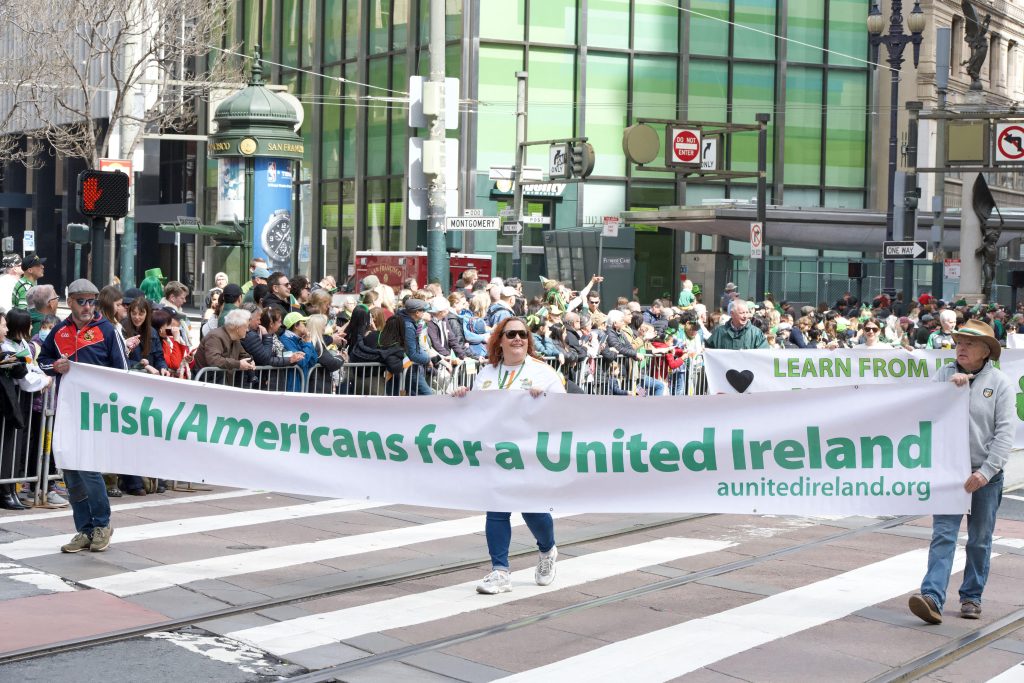
The truth is, for anyone willing to listen, Irish America supports Irish Unity. The President, unbeholden to the current British or Irish Government, stated the obvious: Ireland should be as one.
Over the past two years, I have crisscrossed the US speaking at Friends of Sinn Féin Unity Commissions and engaging with our diaspora. The message coming back has been clear and consistent—a pride in the US role in the Good Friday Agreement and the peace it has delivered.
There is a shared hope for a new and united Ireland and a recognition that we now have the opportunity to achieve it.
That Agreement, endorsed by the people of Ireland, North and South, includes the right to self-determination. It provides a peaceful and democratic pathway to Irish Unity; if the people agree to end division in referendums in the North and South, then our country will be united.
There is growing impatience that the Irish Government has not grasped this historic opportunity and continues to refuse to plan, prepare or advocate for Unity.
President Trump echoed what I have heard in Irish Centers, Labour Halls and meeting rooms across the US. That call is intergenerational and bipartisan. In a world where political division drives the discourse, Ireland, our peace process, and Unity remain among the few uncontested and shared platforms.
The British and Irish governments are denying that democratic right by refusing to hold unity referendums. Since signing the Agreement, the US has acted as a guarantor, insisting on its full implementation and keeping the process moving forward at times of great challenge. Unity referendums are the outstanding unimplemented section of the Agreement.
peace process and to discuss economic investment.
On a recent visit to Belfast, the British Prime Minister provocatively declared that Irish Unity was “off the table”. Political parties across Ireland reacted swiftly, and leading Democratic Representatives Neal and Boyle reminded the Prime Minister that an international agreement meant Unity was not his to deny. He later “clarified” that he supported the Agreement’s provisions and that it was not on his agenda that day. He might not have wanted to discuss it during his visit, but that did not stop Sinn Féin President Mary Lou McDonald from raising it when she led a delegation to meet him the same day.
It appears the British Prime Minister either does not understand or chooses to ignore his responsibilities under the Agreement. Recently, one of his spokespersons stated that the Prime Minister supported the Union between the North of Ireland and Britain. That may well be the case, but it has no bearing on a referendum. The Agreement is explicit that the Government with jurisdiction in the North must act with “rigorous impartiality”.
The British Government and the Taoiseach also maintain that the threshold for holding a referendum has not been met. Again, this deliberately misrepresents the Agreement’s provisions. There is no minimum threshold. The British can call a referendum at any time. Two court cases made that finding. The court even outlined when a referendum would be appropriate, including to “quieten” the matter or resolve the issue when the outcome could not be predicted.
The British setting a minimal threshold could be judged an “external impediment” to a referendum, which the Agreement explicitly bars.
A second provision sets out when the British MUST call a referendum, and this has been the focus of much discussion and calls for criteria. However, this approach assumes that the democratic right of the people to vote is to be resisted to the very end, and that it is an option of last resort.
The more immediate question is what grounds the British Government and the Taoiseach in denying the people’s democratic right to vote.
This is particularly unconscionable for an Irish Government with a constitutional obligation to promote Unity.
A British Government could call a referendum on a whim, with no concern for Ireland, as it did with the Brexit referendum, and the Irish Government would have no plan. That risk is real given the turmoil in British politics, and failing to plan for such a scenario is a dereliction of duty.
It is too early to tell the full impact of President Trump’s remarks. Some have dismissed them as “off the cuff” or “shooting from the hip”. However, he doubled down over the weekend and reportedly raised the issue in separate private meetings with the Taoiseach and President Connolly before responding to a question at the press conference.
Irish America is clear that it wants to move beyond words and the aspiration to Unity into action planning and preparation. I hope the President’s words will lead to renewed US focus on fully implementing our Agreements.
A policy which will realize the right to self-determination as agreed in the Good Friday Agreement, to support preparations for orderly, respectful and informed unity referendums and to ensure the British Government abides by its obligations to be “rigorously impartial.”
Irish America has always been on the right side of history when it comes to Ireland. We are all impatient to move beyond platitudes and being told now is not the time. The words of John Lewis always ring true: “If not us, then who? If not now, then when?”
Irish American reflects the diversity of American opinion, but on Unity it has a common platform, and its voice needs to be heard.
The US has a continuing role in ensuring the full implementation of our agreements; now it is time for Micheál Martin and the British Government to listen to and honor the people’s right to vote on their future.
Leave a Reply