
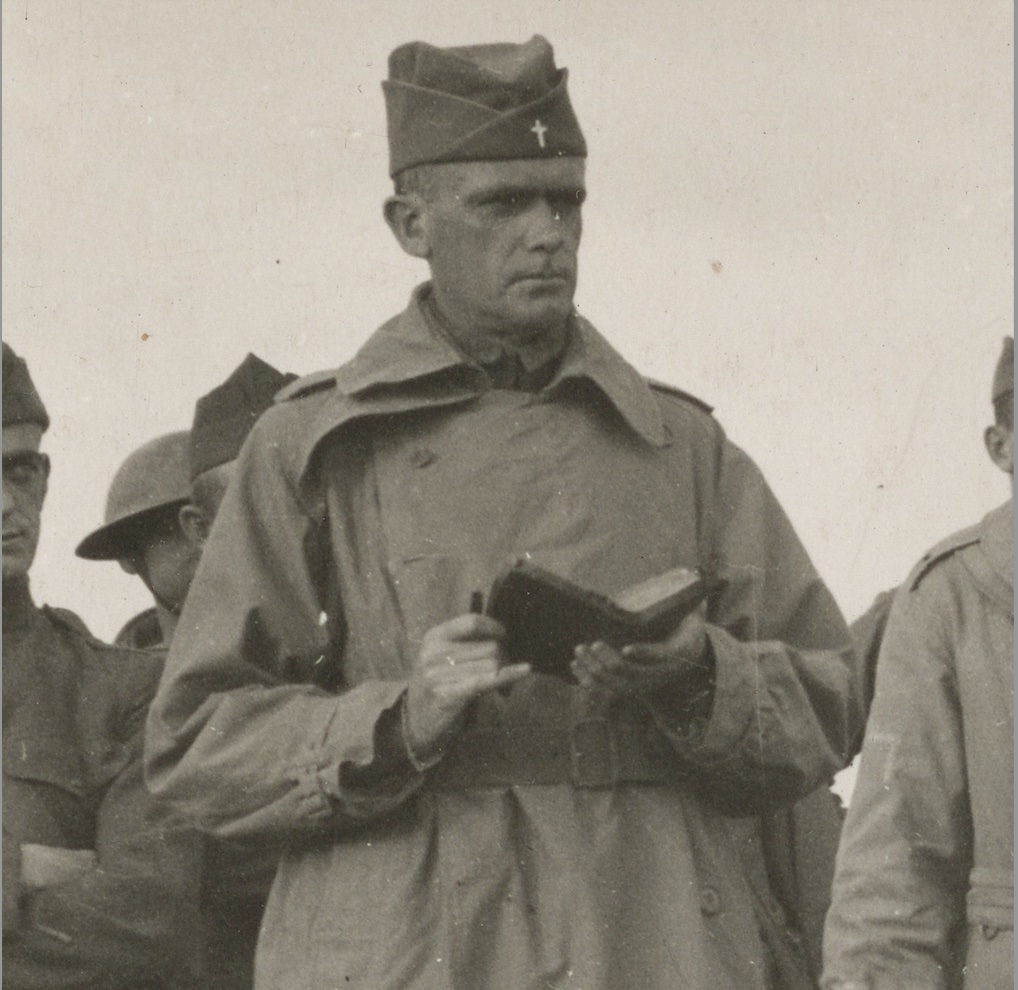
“If I’ve helped anyone become a better man and he loves me for it, that’s my Distinguished Service Cross.”
Beloved pastor and battlefield legend, the Reverend Francis Patrick Duffy, also known as “Fighting Father Duffy,” was truly a man of the people. From the rarefied world of academia to the trenches of World War I France to the mean streets of New York, Father Duffy moved effortlessly, earning the love and respect of all he encountered along the way.
Canadian by birth, Duffy moved to New York at the age of 22 to teach at St. Francis Xavier College, quitting shortly thereafter to join a Catholic seminary. He was ordained in 1896 and was assigned by his superiors to Catholic University for more graduate study. Two years later he was sent to Dunwoodie, the seminary in Yonkers, to teach psychology and logic.
While teaching, he also worked as founding editor for the New York Review, designed to acquaint readers with the new work of European and American theological and biblical scholars. He was sent to the Bronx in 1912 to develop a new parish, the Church of Our Savior. In the meantime, he also became chaplain for the “Fighting” 69th, the famed New York National Guard unit, part of the 165th Infantry. When the United States entered World War I in 1917, the 165th was sent to France and Father Duffy went with them. He was 46 years old.
During 180 days of combat that claimed the lives of 900 men, Father Duffy was on every battlefield. After every battle, he would walk the fields, collecting metal identification tags from bodies, hearing the last words of the dying, giving absolution and helping to bury the dead. One officer recalled seeing Duffy burst into tears as he bent over a dead soldier. When asked why, he replied, “I baptized him as a baby.”
Duffy’s bravery under fire prompted General Douglas MacArthur, the U.S. Chief of Staff, to consider promoting the chaplain to colonel and placing him in command of the division.
His bravery during the particularly bloody battle at the Oureq River won him a decoration, and his citation read, “Despite constant and severe bombardment with shells and aerial bombs, he continued to circulate in and about two aid stations and hospitals, creating an atmosphere of cheerfulness and confidence by his courageous and inspiring example.” He was also proposed for the Medal of Honor, the nation’s highest award for bravery, but he declined the honor.
When he returned to New York in 1919, Duffy was assigned as pastor of Holy Cross parish in Times Square where he became deeply involved in educational issues and fostering ecumenical dialogue and the discussion of church and state relations. Living in the heart of the theater district he befriended such theater luminaries as Spencer Tracy, John Barrymore and George M. Cohan.
When Father Duffy died in the summer of 1932, thousands of New Yorkers, both Protestant and Catholic, went to pray on the steps of Holy Cross Church. More than 20,000 filed past his coffin to pay their last respects. He was given a military funeral and the Mass was held at St. Patrick’s Cathedral instead of Holy Cross because the diocese believed he belonged to the whole city, not just Holy Cross parish.
Five years later, New York honored his memory by erecting his statue at 43rd Street and Broadway in a square beating his name.
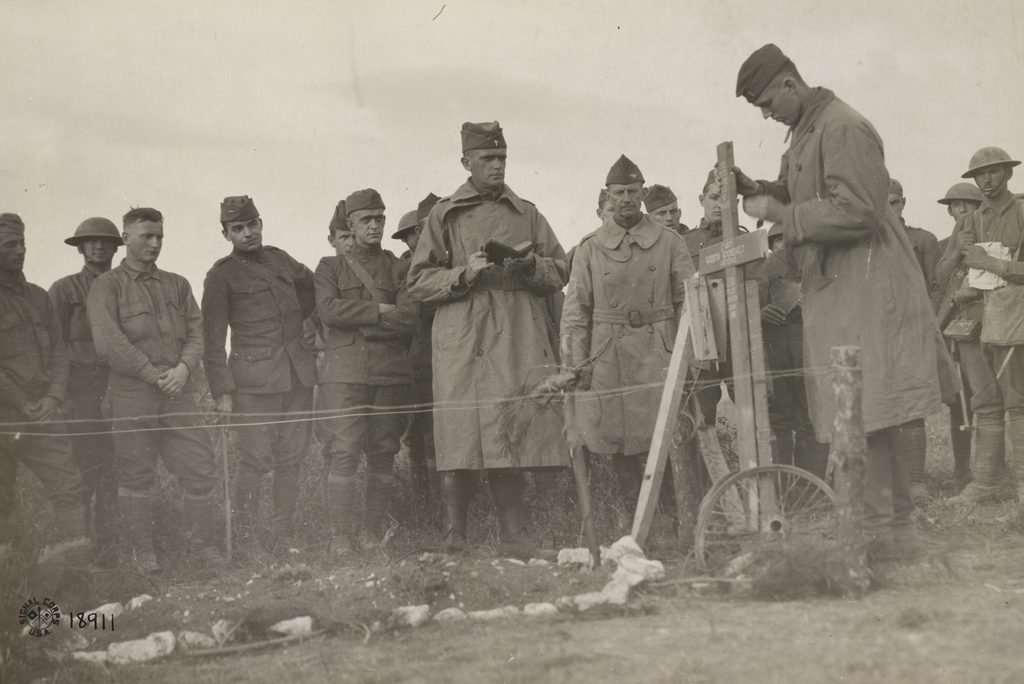
Chaplain Duffy conducts a funeral service over the grave of First Lieutenant Quentin Roosevelt, brought down by the Germans on July 14, 1918. Photos: Wikipedia
Leave a Reply