
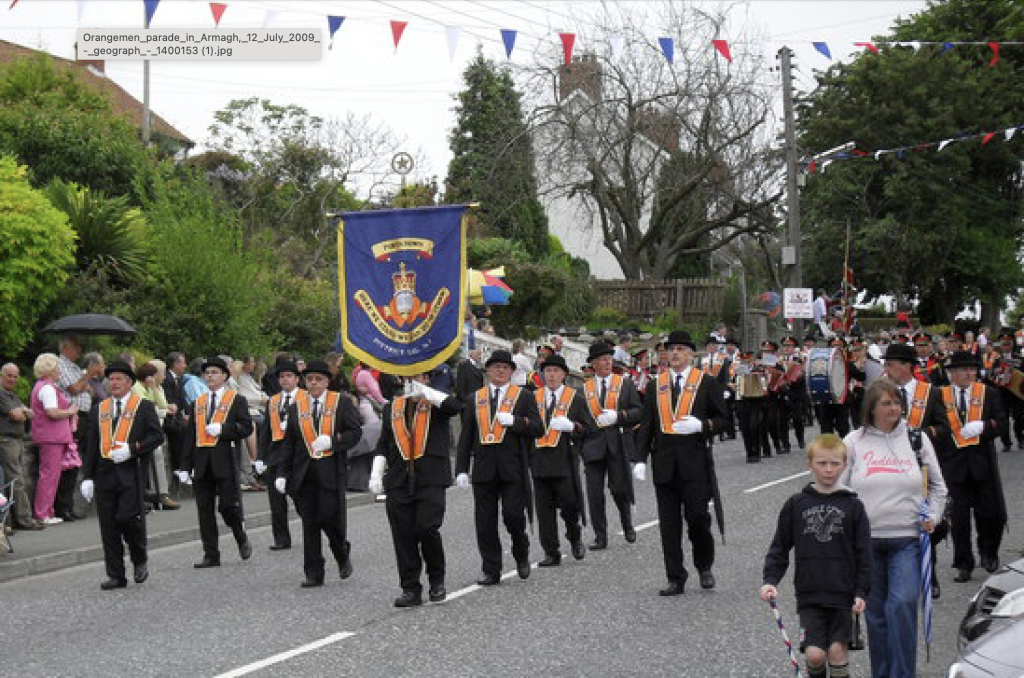
Why has this fiasco erupted in our faces? Over twenty years since the last violence at Drumcree and almost 30 years since the Good Friday Agreement, what caused this most bitter of disputes to re-ignite with potentially catastrophic consequences?
Simply put, events at Drumcree prove little reconciliation between the two communities has been achieved in the last 30 years, certainly in Portadown, putting it politely. Less politely, a visceral hatred and fear still lurks barely beneath the surface (and more of that later).
Another reason lies in the complex administrative procedures governing the work of the Parades Commission – procedures that must be followed to the letter to avoid legal challenge by some increasingly litigious out-players.
When both elements came together this month, a crisis was entirely predictable. Whatever the outcome, the after-shocks will be felt for months, if not years ahead. ‘Zombie Drumcree’ will not leave the stage quietly.
Way down the line, we may identify the person who first spotted the Parades Commission had not meticulously followed the correct procedures. If that person – with deliberate intent – informed the Orange Order in order to encourage legal action and subsequently chaos, it prevailed.
An embarrassed Commission reversed dozens of identical rulings, made over the past 20 years, allowing a parade to proceed, albeit limited to 35 members, without bands at 8am on 27 September.
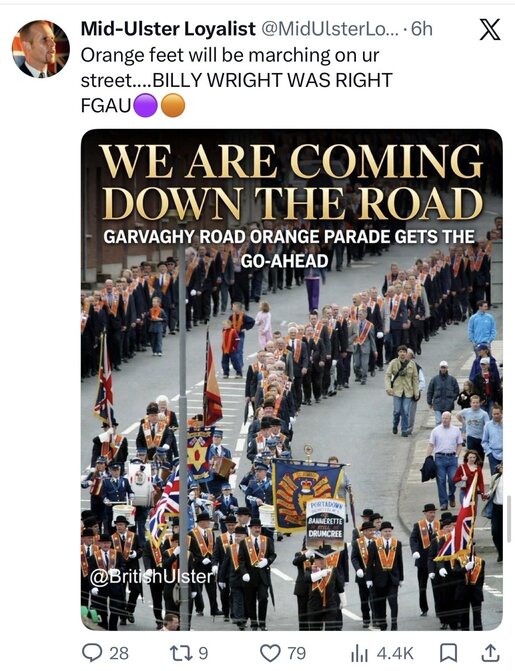
That inevitably led to today’s deadlock which will inflict untold damage, both to confidence in power-sharing and community cohesion, no matter who claims to have ‘won’ the day.
Many are pointing to loyalist activist and self-styled legal advisor to the Orange Order, Jamie Bryson, for alerting the Orange Order to the Commission’s legal error. If his intention was to resurrect old passions, he succeeded.
This could not have happened, had sufficient work been done in Portadown (and elsewhere, Portadown is not unique) to bring both communities together. But in a state whose health service is collapsing and whose schools are crumbling, cohesion between nationalist/republican and unionist/loyalist communities is not seen as high priority at Westminster.
So, the yawning gulf grows between unionists (who say a five-minute march by 35 Orangemen should not infuriate nationalists) and nationalists (who see Orange collarettes marching where they are unwelcome to symbol ‘croppies lie down’).
At the time of writing, the DUP are claiming republicans engineered the dispute after seeing their hopes dashed on the rebuilding of Casement Park, the upgrading of the dangerous A5 road (between Strabane and the border) and Derry still waiting for its promised 10,000 university places.
Sinn Fein and others, however, claim that the row over the Garvaghy Road gives unionists a useful distraction from the sex scandal rocking the DUP (former leader Jeffrey Donaldson languishes in jail awaiting sentencing on 18 child sex convictions including rape) and sniping from its increasingly buoyant right-wing rival, Jim Allister’s TUV.
Republicans also believe the cross-community vibe from this year’s Fleadh Cheoil na hÉireann in Belfast put loyalist noses out of joint while Sinn Fein leader Mary-Lou McDonald – standing in Cardiff beside her deputy, Michelle O’Neill; SNP leader, John Swinney, and the leader of Plaid Cymru, Rhun ap Iorwerth – sent a cold shiver down unionist spines.
Both sides at Stormont have one thing in common. They have so far failed to arm-wrestle London into providing sufficient funds allowing them to draw up a budget without swingeing public service cuts or tax-raising, both of which now seem inevitable and will be highly-unpopular.
So, it is no surprise that the collapse of power-sharing looms yet again, with unionists demanding immediate public order charges against their supposed partners in government, including Michelle O’Neill herself and Sinn Fein Policing Board member, Deirdre Hargey.
Aside from Bryson, key characters this week have been the local MP, Carla Lockhart of the DUP (referred to by Bryson as the ‘Queen of Ulster’), who in a rabble-rousing speech warned the Secretary of State, Sir Chris Bryant, and the PSNI chief constable, Jon Boutcher, that they risked “pushing Northern Ireland into the abyss.
Although unionists criticise Boutcher for not forcing the Orange parade, the nationalist jury is out which, for a police chief constable in Northern Ireland, is (so far) a positive result. He says that, while the parade is lawful, it is not so ‘at all costs’. Bryant, only recently appointed), has to date, been ineffective.
Garvaghy Road residents’ spokesman, veteran Breandán Mac Cionnaith (who maintains good relations with Sinn Fein despite leaving the party over endorsing the PSNI) is remembered in Tony Blair’s memoir for taking ‘unreasonableness to an art form. He conceded nothing, and I mean nothing’. Greyer now, the somewhat taciturn Mac Cionnaith is known for assiduously consulting his community base.
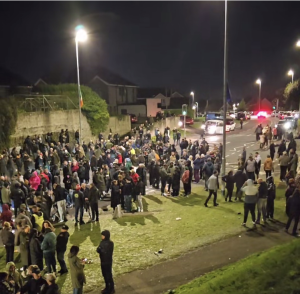
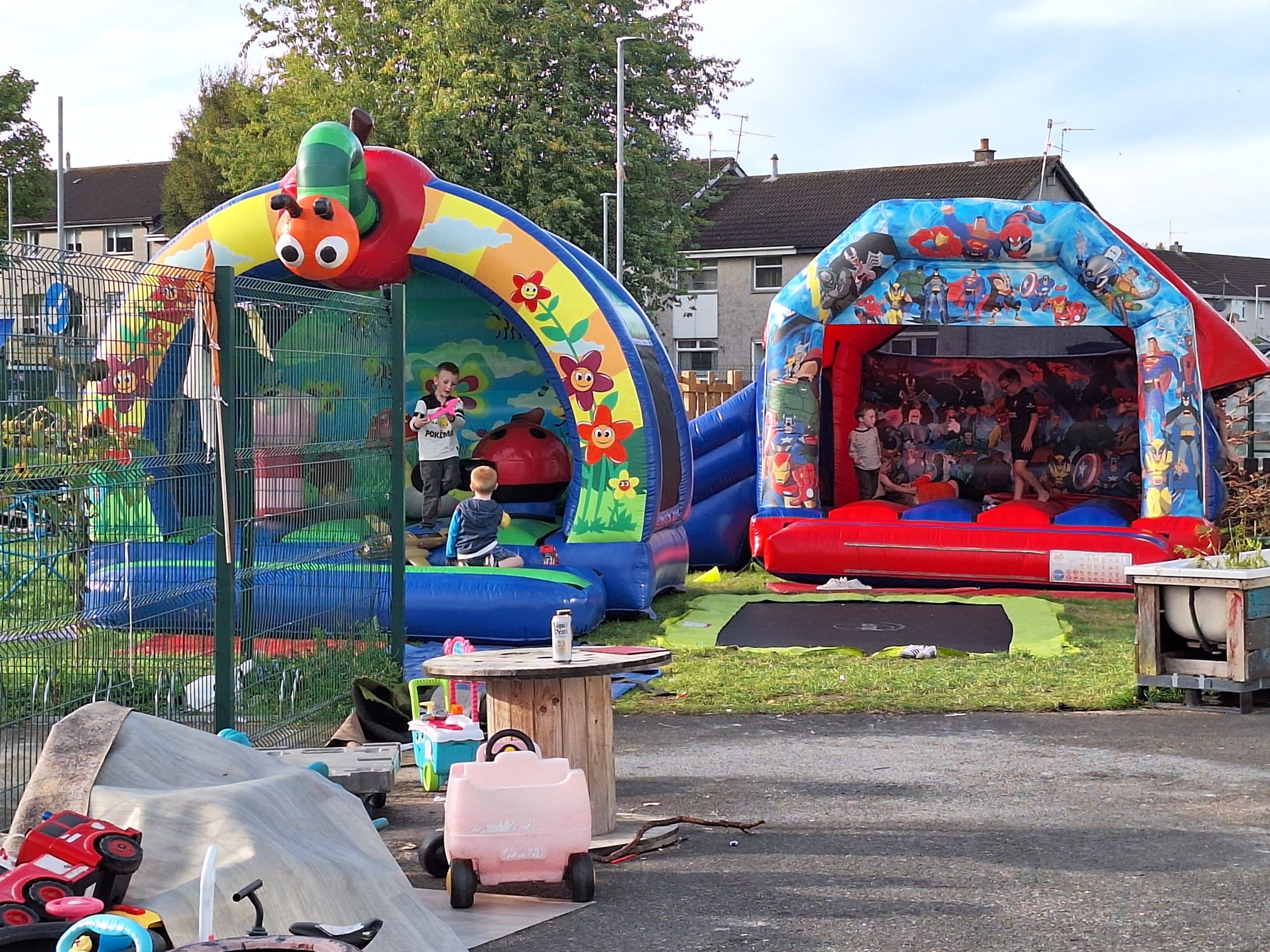
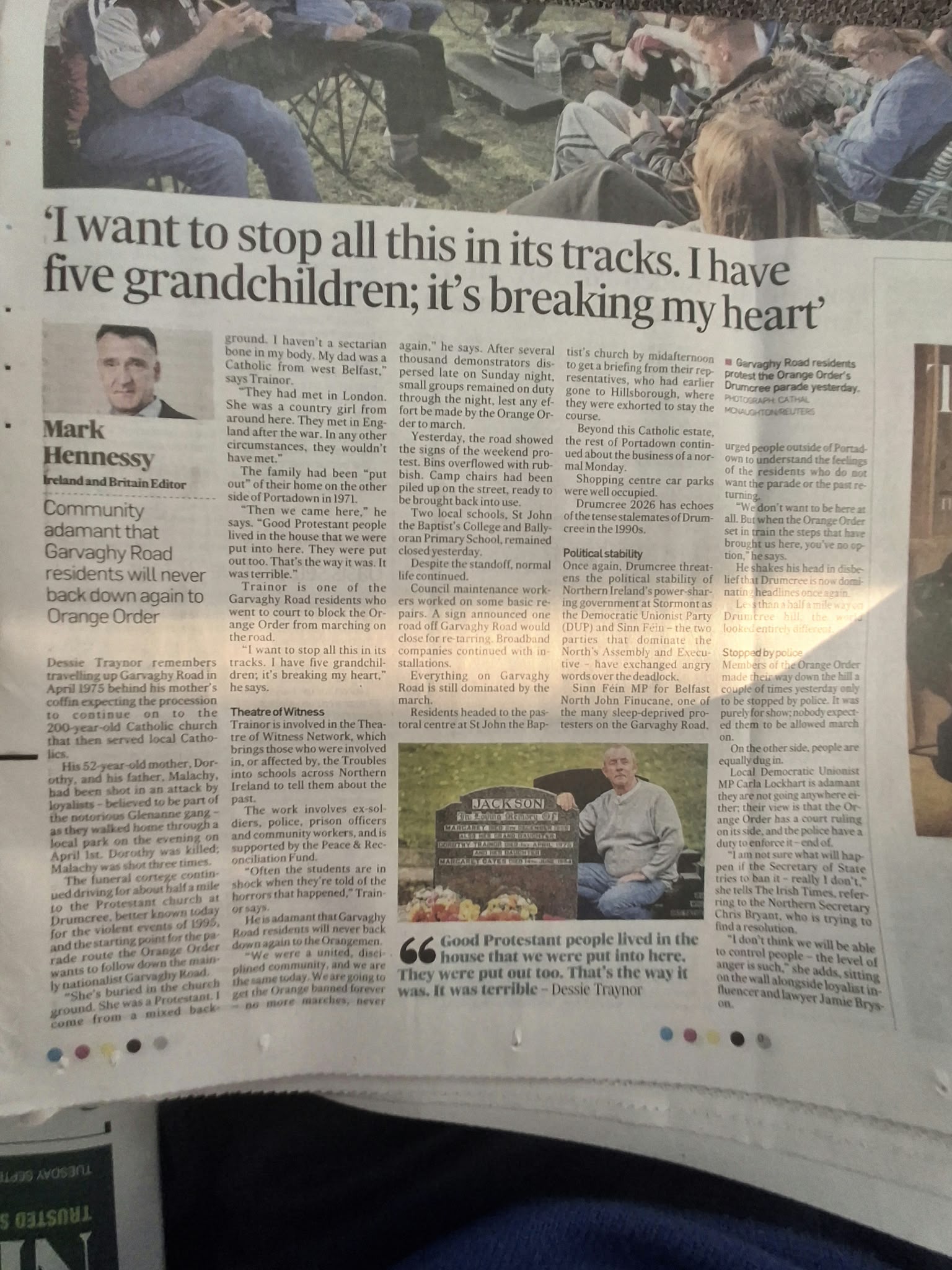
The mood in the crowds at Garvaghy Road this week was cheerful, with a sense of solidarity and resilience. Amongst those entertaining the crowd were the Mary Wallopers and Beoga (fresh from leaving the Ed Sheeran tour). Christy Moore sent a video message. Bouncy castles kept the children busy and tea, soup and sandwiches were available to all-comers.
The mood was also buoyed by a message of support from the bipartisan Friends of Ireland Caucus urging decisive action against allowing the Orange march to proceed. The letter was signed by House Representatives Richard Neal, Timothy Kennedy, Brendan Boyle, Lloyd Doggett, Stephen Lynch, John Larson, Joe Courtney, Mike Kelly, Bill Keating, Val Hoyle, Debbie Dingell, Jim McGovern, James Gallagher and Jimmy Gomez.
All the above partially sets out where we are today. It omits entirely, however, the fear, resentment, bitterness and animosity caused by the events of the 1990s which led, directly or indirectly, to the murders of 21 people including three young boys aged 9, 10 and 11.
So, what’s unique about Portadown? First, it’s not for nothing called ‘The Citadel of Orangism’ as the Order was founded in September 1795 to support the Protestant ascendancy in nearby Loughgall after the Battle of the Diamond, one of many violent sectarian conflicts.
For centuries, violence has always accompanied Orange parades in North Armagh. Two of the most prolific loyalist murderers in the entire conflict, Robin Jackson and Billy Wright, operated in the area but until 1972, there was a period of relative calm with no sectarian murders in Portadown.
That year, nationalists built barricades before a parade but the British Army removed them, using tear gas and rubber bullets. The soldiers then stood by and watched the parade being escorted by at least 50 UDA men in full paramilitary gear who saluted the Orangemen. There was no intervention from the troops or police.
Three men were killed within days and the genie was out of the bottle in Portadown. Mixed areas of the town became segregated, in both directions, as people sought the safety of their own co-religionists (for more on this, you are welcome to read my work Lethal Allies: British Collusion in Ireland, Mercier Press, 2013)
In the 1980s, there was frequent violence linked to Orange parades in the Obins Street area of town and parades were eventually re-routed but the focus merely shifted to the Garvaghy Road which, before houses were built, was the site of the world-renowned rose fields of Sam McCredy.
Its more recent history has been far from sweet-smelling.
In July 1995, around 10,000 Orangemen and supporters gathered at Drumcree demanding a parade. Nationalists protested but reached a compromise which they believed meant a silent, scaled-back march would be the last. Unionist leaders David Trimble and Ian Paisley, however, joined hands jubilantly aloft as the parade reached the centre of Portadown, presenting it as a unionist victory.
In 1996, the RUC banned the parade from the Garvaghy Road leading to 10,000 Orangemen and loyalist supporters gathering at Drumcree in a five-day standoff. It rapidly escalated into widespread rioting before the RUC U-turned, forcibly beating residents off the street to allow 1,000 Orangemen through.
This provoked fury in nationalist areas. Taxi driver, Michael McGoldrick (31), was murdered in Lurgan by loyalists and Dermot McShane (35) was crushed by a Saxon armoured personnel carrier during rioting in Derry.
In 1997, then Secretary of State, Mo Mowlam, pledged she would announce her decision on the parade in advance. Tensions rose, as before, with thousands of loyalists at Drumcree. Mowlam reneged and the RUC moved into the area, sealing the area off with armoured landrovers.
At dawn, they beat residents mercilessly off the street allowing the parade to pass. Later, there were claims the RUC had persuaded Mowlam that, otherwise, there wouldn’t be enough body bags for the Catholic dead. Priests held mass in a car park.
In 1998, the same scenario was developing – a massive stand-off with soldiers dug into the fields around Drumcree but an almost unthinkable tragedy took place in Ballymoney, over sixty miles away, when three young boys burnt to death in a petrol bomb attack on their home.
Jason (8), Mark (9), and Richard (10) Quinn lived with their Catholic mother in a predominantly Protestant housing estate. Other Catholics in the town were sent threatening messages in the days beforehand. Jason’s reported last words were ‘my feet are burning’ before his voice fell silent.
One man was convicted of murder after admitting driving the killers to the house, a conviction reduced to manslaughter on appeal. Although he named the alleged killers, they were never tried for lack of evidence.
These are accounts of the weeks of agony and anguish suffered by the people of Garvaghy, interspersed by murders and threats of murder. We reporters happily scooted home after each crisis, leaving the people behind to recover.
These days, they also have social media to contend with. Neither side holds back in using the most vile and intentionally hurtful language. It can even turn comical. A.I. facilitated one X-user to vastly increase the alleged size of a loyalist support crowd this week (even I was called a ‘loyalist whore’ and ‘an IRA mouthpiece’ in the space of a single hour).
So there you have it, A potted history of Orange marches in Portadown and a more up-to-the-moment explanation of why we are here. I’d like to end with a personal story or two.
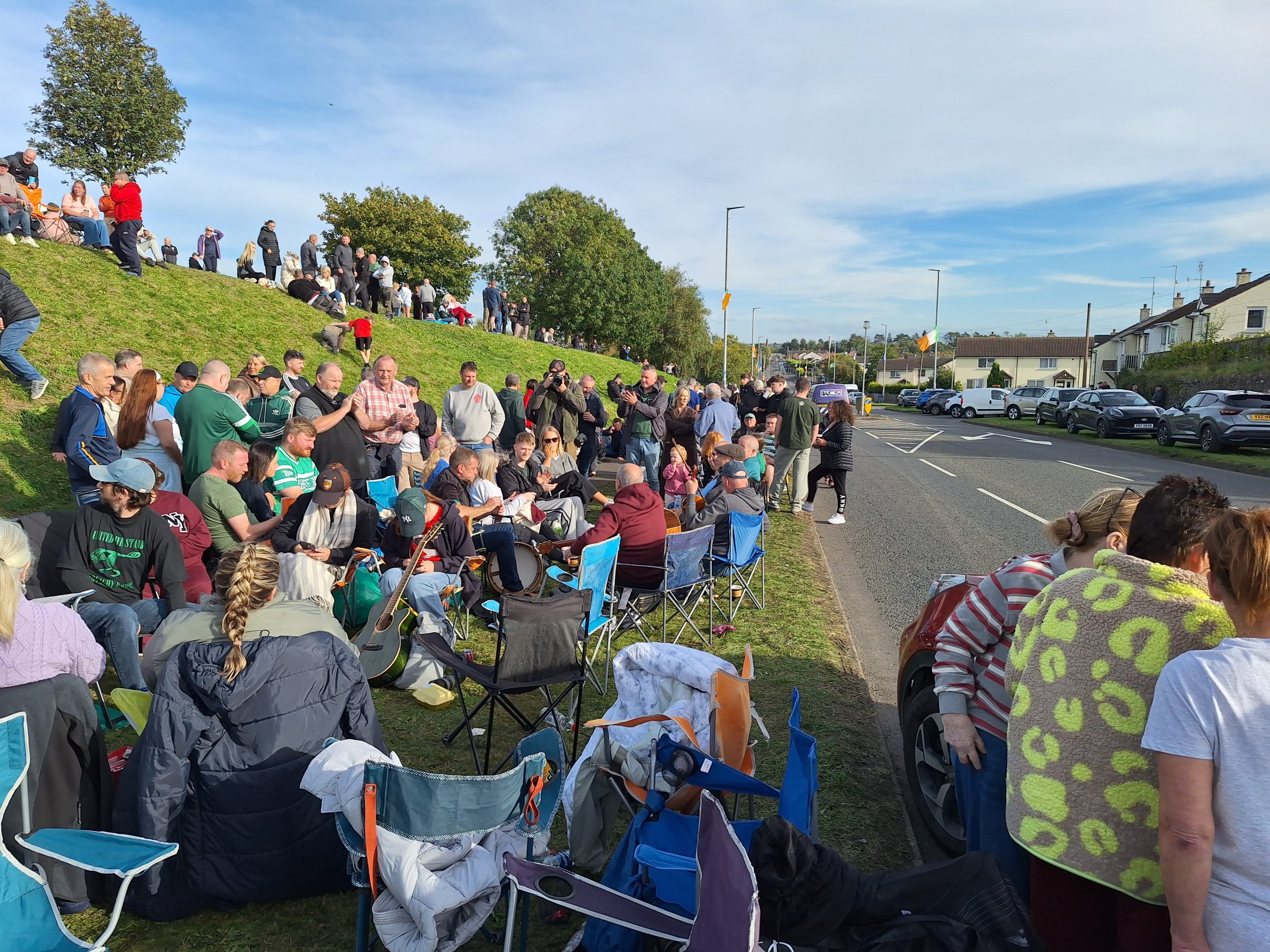
It’s 1997 and the streets in the centre of Portadown are deserted although not silent. The thumping of Lambeg drums – the drums of war – echo around the shops and houses, reminding everyone, as if required, that they are under siege.
For the last two weeks, tension has been building. The British Army has arrived and is digging troops into the countryside near the church and building field hospitals. It’s a set from a war-movie. Loops of unfurled razor-wire prevent thousands of loyalists and Orange supporters surging towards the Garvaghy Road.
Its residents have been glued to their radio sets for days. The then Secretary of State, Mo Mowlam, has promised to let them know in advance if she will allow the Orange parade to go ahead. Normal life has been suspended.
I expected to be there for a few days, staying with a local pensioner, Rosie McNally, who had kindly offered me a room. Days went by and I ran out of clean clothes, so sallied forth one morning to buy more at Dunnes Store in the centre of Portadown.
When I arrived, the staff seemed to be running around like headless chickens although I was the sole customer. Curious, I inquired why? The answer was one I could never have guessed.
The freezer cabinets and clothing racks were full of maggots – fishing bait that someone had bought and liberally distributed through the store earlier. The staff were running around trying to retrieve them from between the bags of frozen chicken and the racks of colourful dresses.
Nothing until then had brought home to me the sheer, visceral, personal hatred that loyalists in Portadown felt for their nationalist neighbours.
Dunnes, you see, is a company with its headquarters in Dublin – the ‘hostile foreign state’ as unionist leaders regularly called it.
Finally, I’d like to honour Rosemary Nelson, the Garvaghy Road residents’ solicitor – the kind, principled, courageous advocate and mother of two who told a US Congressional committee in September 1998 about ‘RUC officers questioning my professional integrity, making allegations that I am a member of a paramilitary group and, at their most serious, making threats against my personal safety, including death threats’.
‘This behaviour,’ she said, ‘has worsened during the last two years and particularly since I began to represent the residents of the Garvaghy Road.’
Six months later, she was dead, vilely murdered in a loyalist car bomb. For those of us who knew and respected Rosemary, her benevolent spirit still lingers in the community centre from where, during each annual Drumcree crisis, she dispensed excellent advice and gentle support for anyone in need.
Her son, Chris, has now told of how he used to ‘pray himself to sleep’ during successive crises at Drumcree and that he wants to prevent his own children from feeling the same tensions and fear.
It is all a crying shame.
Anne Cadwallader is a former BBC/RTÉ/Irish Press etc. journalist and author of Holy Cross: The Untold Story (The Brehon Press, 2004); Lethal Allies: British Collusion in Ireland (Mercier Press, 2013) and Crossing Over (Mercier Press, 2026).
Leave a Reply