
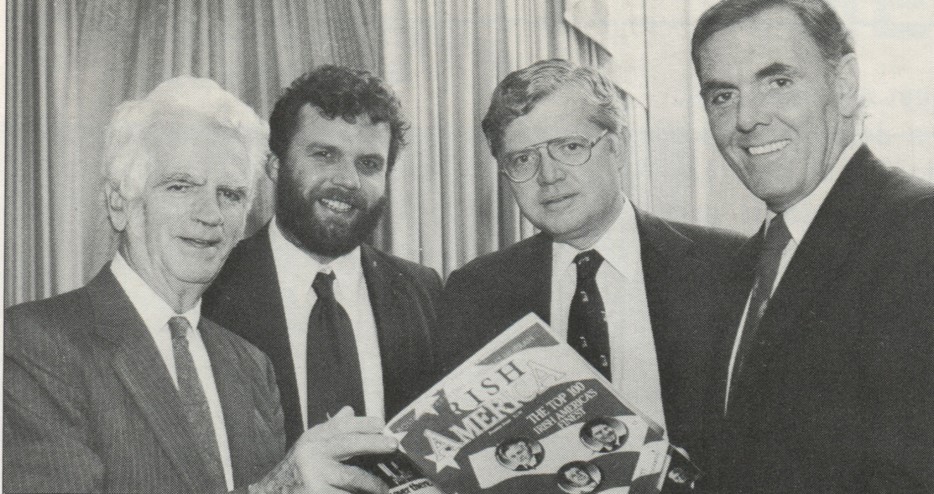
The gentle rolling hills that surround his ranch in Goshen, New York, about 60 miles north of Manhattan, remind Paul O’Dwyer of Ireland, and that’s good enough reason for him to live there.
He spends almost every weekend at the ranch. The New York Commissioner to the United Nations, now in his mid-eighties, catches the bus from Manhattan, then walks the almost three miles to the ranch, which is perched high on a hill with a spectacular view of the Hudson Valley.
Being O’Dwyer, though, he’s not completely removed from politics. Just over the brow of the nearby hill is the weekend home of Percy Sutton, the powerbroker of black politics in New York City, and the political mentor of the current New York mayor, David Dinkins. He and O’Dwyer have a lifetime friendship.
O’Dwyer is close to Dinkins, too. At a key down-time in the Mayor’s life, shortly after he had lost his job as a Deputy Mayor because of income tax irregularities, O’Dwyer, then City Council President, gave Dinkins a job as City Clerk. Dinkins never forgot the gesture.
Amid the sea of delighted Black officials and politicians on the victory rostrum when Dinkins became New York’s first black Mayor, was the silver mane of O’Dwyer, the man Dinkins respectfully calls “Uncle Paul.” A few months later, Dinkins repaid the debt by naming O’Dwyer to the prestigious post of New York Commissioner to the United Nations, in effect the Big Apple’s Ambassador to the United Nations.
Once a year, the picnic and fundraiser for the O’Dwyer Cheshire Home, the residence for physically and mentally handicapped patients that O’Dwyer has built singlehandedly in the heartland of his native County Mayo, is held at the Goshen ranch.
It’s a friendly affair, with the friends and acquaintances of a long lifetime turning up. There is an open-air barbecue, a huge marquee tent and lots of Irish songs and ballads from the old days. The children play with the Connemara ponies.
O’Dwyer is perhaps the closest the Irish will ever come to a benevolent godfather. People seek him out as he sits to the side of the main stage. There are whispered conversations, a pat on the shoulder, a promise perhaps to do something about a problem. There is always a waiting line.
Later in the evening, after most of the guests have gone, and the only sound is the far away tolling of a church bell in nearby Goshen, O’Dwyer takes stock, looking out over his ranch, seeing all the way to his native Mayo. “The impact that the money raised here can have on an Irish village is extraordinary, ” he says. “Any effort towards self-help can make a huge difference.”
He knows that impact. The O’Dwyer Cheshire Home in Mayo is dear to his heart. Mental and physical health facilities in rural Ireland are rudimentary by U.S. standards. The O’Dwyer Cheshire Home, located on the old family homestead near Bohola, is the exception.
Disabled young men and women who would likely be forced into faceless institutions far from their homes and families can instead reside close by in a family atmosphere. Much needed employment is created by the facility, and the home is a source of great pride to the locals. American money provides much of the funding.
The old Irish concept of the “Meitheal,” is closest to O’Dwyer’s thinking. The word is almost untranslatable. It means the coming together of friends and neighbors for the common good.
If a farmer was ill, for instance, his neighbors would rally round and do his work for him.
O’Dwyer has propagated that concept all his political life, rallying around causes, many of them so obscure and unpopular that he himself admitted to some surprise that he won so many elections.
Yet he has been an inspiration.
Pete Hamill, columnist with the New York Post, remarked recently that young Irish Americans in the 1960s who were looking for an idealistic, dynamic political leader to follow were most surprised when he arrived speaking with the brogue of their fathers. O’Dwyer’s idealism had a profound impact on writers such as Hamill, Pulitzer Prize winner Jimmy Breslin and a host of political officeholders.
These days he is still fighting the good fight, whether it is for Irish unification or the downtrodden and the little guy in society. At the U.N. he is busier than ever. He is the lion in winter, sage of counsel, but with still enough teeth to bite back. He wouldn’t have it any other way.
Editor’s Note: This article was originally published in the March 1991 issue of Irish America. ♦
Leave a Reply