

It is a Manhattan Irish bar late at night. Chris O’Donoghue of WWOR Channel 9 wheels into the bar with a group of friends. Heads swivel, as one of the best-known faces in the New York area passes. He knows it is only a matter of time. And it is. A large man, the map of Ireland on his face, comes lumbering down the bar. “Chrisss,” he slurs, assuming familiarity with the face he has seen so often on screen.
What follows is a twenty minute discourse on his life, as the unfailingly polite O’Donoghue sits and listens. Eventually a friend in the party, none too kindly, leads the man away.
Such encounters happen to O’Donoghue all the time. Being in a wheelchair, he can hardly sidle off when he sees them coming. But if there is one thing he has learned in his life, it is patience, a virtue born of a quite remarkable and successful struggle against adversity.
In 1965, at the age of 21, he left his native Limerick to seek fame and fortune as a soccer player in the United States. Chris O’Donoghue was a gifted footballer, who hoped to make his name in what was then the fastest-growing sport in the U.S.
Within three weeks, however, his career and his life lay in ruins. A severe pain in his lower back turned out to be a hemorrhaged blood vessel in his spine and he was left paralyzed. The illness was a hereditary one and doctors warned him he would never walk again.
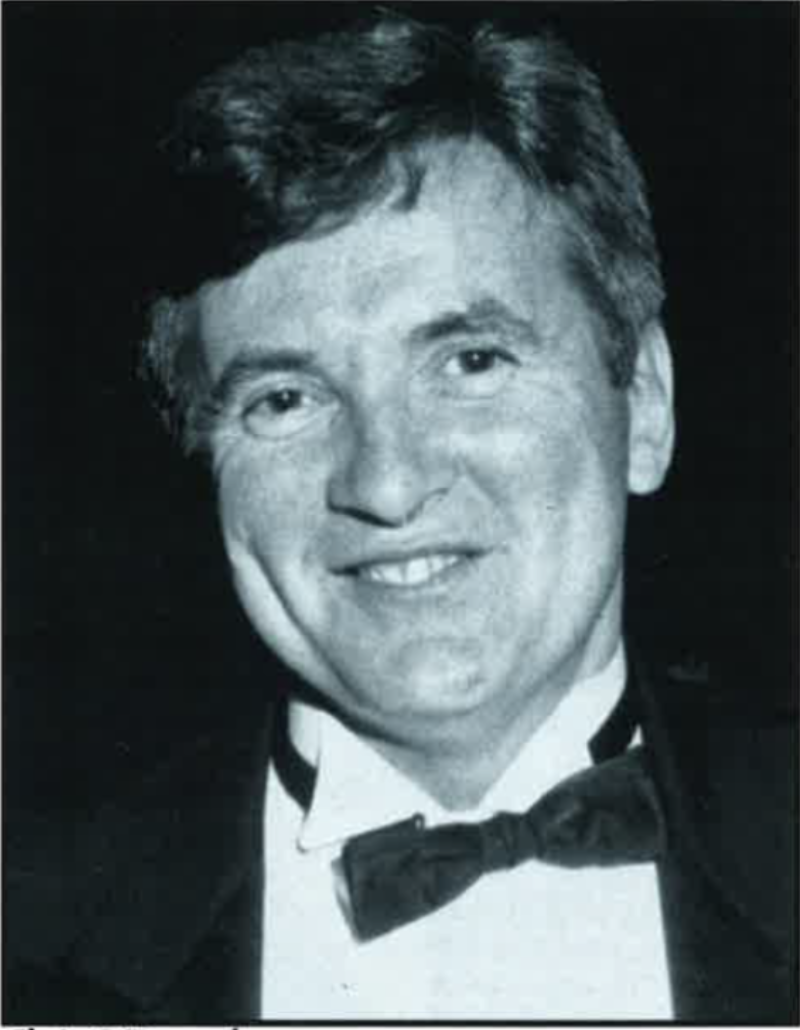
He remembers the dark night of his soul, lying awake in a hospital bed struggling with the horrible uncertainty of his future. Going back to Ireland was an obvious option, but he had not come so far to let his dream of life in America die. He decided to stay and fight the disease.
Against the odds he struggled back to his feet, and initially, with the aid of leg braces, began walking again. He remembers this as a time of living on the edge, waiting for the next attack to come-and it did, not once, but three times. By 1976 nerve damage to his spine had left him confined to a wheelchair.
“I became very upset and depressed,” he says now. “I had really thought I had a chance of beating the disease. I very quickly withdrew into myself.” After a period of deep depression, with the support of friends, Chris rallied and decided to get on with life.
Before his illness he had worked in the insurance business. In typical fashion he now put his disability to work. He began working as a counsellor to young schizophrenics. “It helped me to develop a totally different perspective on my own problems,” he remembers.
He also took a master’s degree in rehabilitative physiotherapy and began working as a consultant on the problems of rehabilitating victims of auto accidents or industrial mishaps. He was doing very well in his new field when fate intervened again.
On an overnight flight to Ireland on New Year’s Day, 1983, O’Donoghue sat beside Larry Fraiberg, president of the Westinghouse Cable and TV network. Fraiberg was clearly impressed with the resilience and never-say-die attitude of the young man beside him. He asked him if would he like to work in television. O’Donoghue said “sure,” but thought little more of it.
A few weeks later Fraiberg personally called and asked O’Donoghue if he would take a job as a sportscaster in the Westinghouse Baltimore affiliate.
O’Donoghue accepted.
“It was language that was totally foreign to me,” he says. “Sound bites, heads, VO’s. It was all just crazy.” He not only survived but prospered in his new job and soon asked for an assignment as a general reporter.
He remembers his first days on news as the toughest of his career.
Not only had he to prove himself as a newcomer in a very competitive business, but also as a handicapped person. “Fires, tornados, murders don’t wait for a handicapped person, You have to be there with everyone else.”
So well did he do, that in 1987 WWOR-TV offered him an opportunity to come back to the New York area, which he considered home. Sentiment aside it is also the toughest T.V. market in America.
But O’Donoghue has done extraordinarily well. In 1987 he received the prestigious Edward
R. Murrow Award for his report on a topic close to his heart—the young Irish living illegally in the U.S. Entitled “Destination America.” The story was a standout. An Emmy nomination followed in 1988.
Nowadays, he is one of the best-known reporters in the United States. His story has appeared in several national magazines and he has become a champion of the disabled. He himself lives the kind of active life that belies any disability. “If you can’t stand up, stand out,” is how he once characterized his drive and zest for life.
He stands out, all right.
Editor’s Note: This article was originally published in the March 1991 issue of Irish America. ♦
Leave a Reply