
On February 24 the Sunday Independent newspaper in Ireland published an article which asked the question, “1916: How should we mark the 75th anniversary?…” That was leaving it late, wasn’t it? The latest word from Ireland is that the Rising will be marked by a reading of the 1916 Proclamation from the steps of the General Post Office (main site of the fighting) by Prime Minister Charles Haughey.
In the Independent article the question was answered by Des O’Malley the leader of the Progressive Democrats, junior partners in the coalition government. He wrote: “Consideration of this inevitably emotive topic should be undertaken in a mature, informed and dispassionate fashion. Here indeed is a minefield issue where many angels would fear to tread.
Nevertheless, whether we can or cannot have a rational and responsible debate of the 1916 Rising is in itself a useful barometer of the level of maturity which we have, or have not, attained.”
Mr. O’Malley concluded the Rising should be commemorated, not celebrated, given the stain across the land of Northern bloodshed which the Independent described as “palpably rooted in the ‘unfinished business of 1916 and given the Sinn Fein/IRA claim to be inheritors of the mantle of the 1916 rebels.” The solution – Charlie reading the Proclamation – is about as anodyne as could be found, and thus most appropriate. So we’ll do our little bit on the day and continue to let the IRA set the Republican agenda for that “unfinished business” in the North of Ireland.
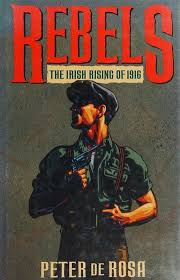
Far better to have a reading at the GPO of Rebels: The Irish Rising of 1916, the story of the Rising as told by Englishman Peter De Rosa and just published on this side of the water by Doubleday. Why? Because it rings true with the drama and emotion and wildness of Easter Week seventy-five years ago, and because it doesn’t deify or demonize.
It puts flesh on James Connolly, Padraig Pearse, Thomas MacDonagh and the rest of the leaders in a way that strips them of the mummy cloths of Irish Republicanism (whether it be the bloody version of the IRA, or the cant-driven versions of the country’s main political parties.) It conveys the bursting bravery of the small group of men and women involved, yet it also conveys the foolhardiness of the venture, and the duplicity of its leaders in forging ahead with a completely unrepresentative action. And, yes, it conveys the blind and bloody rush to vengeance of the British masters whose execution of the Rising’s leaders managed to turn a martial victory into a political defeat.
(What lesson here for war bosses whose only sure measure of conquest is in gallons of enemy blood?)
The 1916 Rising was organized by a handful of Irish Republican Brotherhood members, despite the fact that the – suicidal – venture had been countermanded by General Eoin MacNeill, their commander-in-chief. It went ahead amid confusion and was doomed to failure. It took place in a country whose people were clearly not supportive of it: when Padraig Pearse read the Proclamation in Dublin on Easter Monday he was jeered in the street. But Pearse, drawn here as a character of Messianic drive and of a blood lust that seems almost vampirish was sure that their march to doom would pay off in martyrdom. He was right. Or, at least, that conclusion was assured by the British top dogs of war whose savage repression of the Rising turned the tide of sympathy in the country to the rebels. And the rest is, er, history.
Peter de Rosa’s book reads almost like despatches from the front (uncensored despatches). Its fast swing-shift back and forth between different characters and scenes means that it is not a narrative of particular elegance.
But it makes up for this in excitement and an absolute command of detail.
In a note to the reader, Peter de Rosa claims, “Rebels is not faction, still less is it fiction. This is a true story but so extraordinary that it is only believable because it happened. With Talleyrand I say, ‘Je ne blame, ni n’approuve: je raconte;’ I blame not, I approve not: I merely tell a tale.”
One can quibble with this declaration since, though he is a writer of great skill, he is hardly a mind-reader. The book contains the private musings of several leading characters and though the research for this book has clearly been prodigious – and has made for a fresh understanding of the Rising – it is hardly fair to conclude that Mr. de Rosa could look into his own heart and know the minds of other people.
Surely only de Valera could do that…?
Dev of course, is in Rebels, brave but stiff. Roger Casement is there, horrified that the Rising will go ahead when it is bound to fail, and tortured with the consequences that exposure of his homosexuality will bring. Countess Markievicz is there, of course, strutting in her army gear and brave beyond belief.
One of the triumphs of Rebels is the life put into a number of characters who are not central to the action but whose attitudes and actions illuminate the story and give a feeling for Ireland, 1916. For example, the depiction of Francis Sheehy-Skeffington, a pacifist who was murdered by a mad officer, manage – though briefly – to pay tribute to a tremendous man. A couple of British political masters, who saw the folly of the victors’ vengeance, are painted with sympathy and authenticity. Most, however, did not realize that what a brave, but foolhardy rebellion could not do, death at the hands of British vengeance would that is, make heroes of the rebels.
Peter de Rosa, a former priest, has been professor of mathematics and ethics at Westminster Seminary, professor of metaphysics at St. Edmund’s College and dean of theology of Corpus Christi. He has worked as a producer with the BBC in London and his first success as a writer was with the comic series, Bless Me, Father which he wrote under the pseudonym Neil Boyd. He has written a number of theological works and the best-seller Vicars of Christ: The Dark Side of The Рарасу. He lives in Ireland.
All in all, it now seems perfectly obvious that Peter de Rosa was suited better than most to take on the Rising – a sacred but weary old cow at this stage (see Des O’Malley’s remarks) – and write of it afresh.
It is surely a remarkable feat that Rebels allows for a consideration of patriotism without the danger of either deifying the patriots or demeaning their sacrifice.
Editor’s Note: This article was originally published in the April 1991 issue of Irish America. ♦
Leave a Reply