
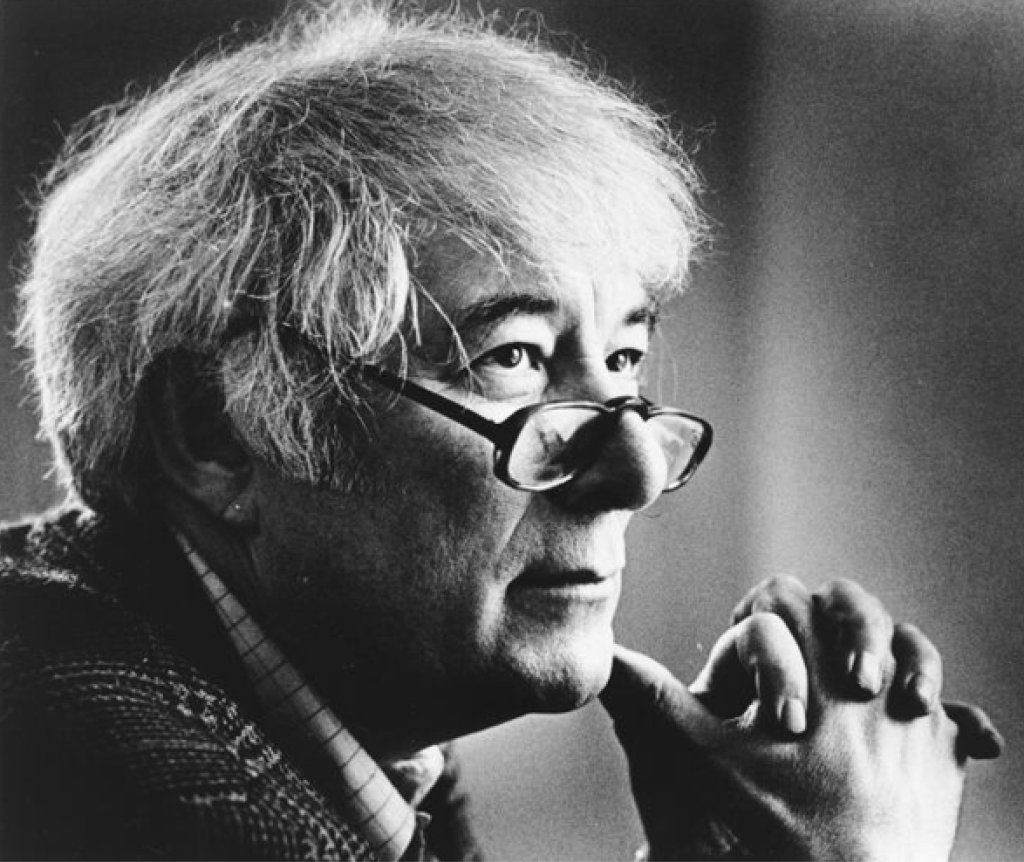
Seamus Heaney of County Derry holds the professorships of poetry at both Harvard and Oxford Universities. In the big kitchen of his house in Sandymount, Dublin, Heaney stood very straight, feet planted well apart, as we talked about the genesis and production of his first play, The Cure at Troy, his poetic and imaginative reworking of Sophocles’ Philoctetes.
He talked about growing up in a Catholic, rural family in the 1940s. “There was nothing else except death, loss, funerals, not of this world, another world, valley of tears…I sort of bought it.” Coming from a family of farmers where books were not part of the scenery Heaney feels it “almost a duty to part the veil. I always wanted to say, don’t be scared, it’s all right. It can be enjoyable.”
Success came early for Heaney “from the first time I put pen to paper.” His first book was published by Faber when he was only twenty-five.
He writes to fill “an inner emptiness, which is appeased by the achievement of the work. Whether a big work or small work, it’s the sense of something finished and done and a little area pegged out…. What distinguishes one kind of writer from another is the inner set of demands and imperatives and obstacles that have to be got over to get to that state of finishing. I think that the psychological state that the writer can have at the end is the same whether the writer is Shakespeare or the man contributing to Your Boys.
“I didn’t begin with any notion of storming any citadels. There was tension and intensity about the work, but it was happening out of lived-through experience. There was something earned about it, whatever the steps were….There is a certain type of writer who thrives on self-consciousness and doubletake and irony. I am not that type of writer. The calling of people in literature is to say this is what we are all like.”
Another high of writing for Heaney is discovering “the joys of unsuspected supply” the sudden appearances on the page of something thought forgotten, not significant at the time of experience. For the novelist or playwright it happens when the characters start taking a hand in their own destinies. This comes from the “pre-reflective lived experience.
“One of the blessings about getting older, thanks be to God,” he continues, “is that you don’t suffer in the same way as children. You suffer genuine agonies of reality but not the terrible fears and sorrows.
“One of the worst sorrows I felt was homesickness at boarding school. Damn it all, I was just another farmer’s son who got an exam and went to boarding school. We all got through it.
“There is something children are spared of nowadays, that whole confession – sex – fear. It is so well documented that you think it is a literary cliche. But it was pure terror. I was more unhappy between the ages of nine and nineteen than I ever needed to be or want to be again.
“I’ve been very lucky that for better or worse I don’t feel too alienated. With both parents dead, the family of eight siblings still assembles. There’s a great deal of laughter and mockery and… whatever freedom I have is somehow involved in a very fond and eye-level relationship with that life. That’s one thing they can’t knock from under me. I don’t mean anything as sentimental as love of a particular place. I mean the sense of having some kind of love that’s trustworthy.”
Why has he turned to the theater?
“A gloomy side of life for the full-time poet is that it is impossible to make a decent living and feed a family. Some poets supplement income from their books by going on the reading circuit. That’s deadly I went once on a three-week reading tour and it nearly killed me – not physically but it takes the mystery and pleasure out of your own work. If you read your work out twenty times in twenty days, it loses whatever strangeness it may have have….
“I chose to adapt Philoctetes, a play by Sophocles, one of the greatest playwrights ever. Philoctetes is a character mentioned in book two of Homer’s Iliad: The ten-year siege of Troy was the central event of Greek legend. An alliance of Greek clans and kings sailed to besiége the city after Helen, wife of the Greek warrior Menelaus, had been taken there by her Trojan lover, Paris.
“The Greek warrior Philoctetes is caught in a terrible predicament. He is marooned on the island of Lemnos after being bitten by a snake. The festering wound and its smell and his yells of pain made him repugnant to his comrades, who abandoned him and sailed on to the war, but, years later, the memory of Philoctetes’ invincible bow persuades the Greeks to return to Lemnos and sue for his support in their fight against the Trojans.
“Philoctetes (played by Des McAleer) suffers a division within himself between a sense of personal grievance and an inner command-which he keeps repressing, to comprehend his own experience, however painful, in the light of more a noble and less self-centered vision.
“Neoptolemus (Sean Rocks), son of Achilles, is sent by the contriving Odysseus (Seamus Moran) to trade with him his legendary bows and arrows, but Philoctetes at first is little inclined to listen to arguments that call upon duty and loyalty. Relentless arguments that rage form the main thrust of the action.
In the original play Sophocles depends on a deus ex machina to resolve the conflict, but Heaney writing in verse to preserve something of the formal, ritualistic quality of the Greek theatrical experience, arrives at a conclusion that is the inevitable culmination of a spiritual and psychological crisis.
In Sophocles we see people whose natures have been poisoned by narrow fanatical hatred. Philoctetes is a man obsessed by a grievance which, thanks to an agonizing physical ailment, he cannot forget. For Sophocles his pain and hatred have a dignity and it is by no means plain to him that Odysseus, who is lying and stealing for the sake of Greece, necessarily deserves to prevail over the animus of the stricken Philoctetes.
Philoctetes could refuse to submit to Odysseus’s request that he serve his own people. Heaney gets him over the gulf not by the intervention of a God-like creature. but by Neoptolemus, who is perfectly human and treats Philoctetes not as a monster but simply as another man whose sufferings elicit his sympathy and whose courage and pride he admires.
Heaney’s play culminates in a lyrical song of unexpected hope from a blood-red clad female chorus.
“I’ve given each character a natural way of speaking, and have felt free to compose a number of new lines for the chorus.”
Editor’s Note: This article was originally published in the April 1991 issue of Irish America. ♦
Leave a Reply