
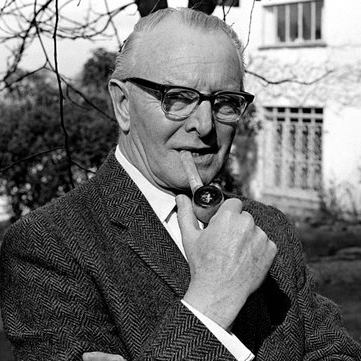
On April 20, Sean O’Faolain, one of Ireland’s finest writers, died in a Dublin nursing home after a long illness. Bom in Cork in 1900, he left unfinished the second part of his autobiography, Vive Moi.
But he also left behind a golden store of novels, plays, biographies and literary criticism, as well as several collections of short stories, of which he was a true master. In this personal reminiscence,
Antoinette O’Ceallaigh writes about the great writer who was also a great neighbor.
One cold November evening in 1971, shortly after our return from Africa, we prepared to move into our first home in Ireland. We had hired a sander for the weekend to sand our wood floors, and were determined to have all the floors ready to varnish by Sunday evening even if it meant staying at it all day and all night. Mishap followed mishap and there it was already Saturday night with very little progress made. The last calamity resulted in the bag attached to the sander spewing the sawdust everywhere. Refusing to be defeated we looked out of the house and out the back-there wasn’t a sign of human habitation not a light to be seen. Happily we opened all windows to disperse the dust and sanded valiantly on until 2:30 a.m.
Next morning, feeling much the worse for wear, we began again. I was vacuuming downstairs while my husband tried to sand one of the bedrooms. Over the rasping noise of the sander I heard a persistent banging. I let it continue for some time, then I thought maybe he had been cornered by the sander and was calling for help. You can see that delirium was setting in fast! I bent down to turn off the vacuum cleaner and as I raised my head I saw this tall man in a dark navy Crombie coat with a black trilby pulled over one eye framed in the doorway—the dreaded bogeyman of my childhood dreams!!! I let out a bloodcurdling scream. The dark clothed stranger continued to knock on the door frame to show me he was not about to strangle me with a vacuum cord!
“Would it be possible for you to stop making this racket at some reasonable hour in future?” he asked. “We live behind those trees, my wife is ill and we couldn’t sleep until 2:30 this morning.” I cringed with shame, my apologies were profuse: “we had no idea… of course we wouldn’t disturb again.” Seeing my discomfort he relented slightly. Were we subcontractors, he asked.
“We’re trying to buy the house,” I almost sobbed-the exhaustion of the past few days really hitting me now. “Oh,” he grinned, “as we’re going to be neighbors, we’re starting off in traditional fashion with a good row! !” I insisted on bringing my bewildered husband down to apologize, his head still covered in a nylon stocking so as not to inhale too much sawdust—he looked as if he’d just left the scene of a bank robbery. We exchanged names and bid a cordial good-bye.
The next day we sent flowers and an apology and then that evening received our first invitation to afternoon tea on Sunday with Sean and Eileen O’Faolain.
We were stunned. It had never crossed our minds that the Mr. O’Faolain we had kept awake until the wee small hours was – THE O’FAOLAIN – obviously we had spent a little too long in Africa!
Sean and Eileen came into our lives that Sunday in Knockaderry, their home, and continued to enrich us with their friendship for the next twenty years. Both of us were teachers of Irish in high-school at the time. We were full of our recent experience of teaching in the bush in Africa, full of enthusiasm for our new jobs, and sure we had all the answers to Ireland’s and the world’s problems. Undaunted by the greatness of the man, all of this tumbled out of us—he delighted in our naivete and youth. Such was his nature, he enjoyed new perspectives and experiences no matter from how inconsequential a source. Sean engaged us with his enthusiasm for the new
Ireland he saw emerging in the carly seventies. Over tea and rich cake, he and Eileen often recounted their early years in the republican movement, their vision of a free Ireland, and exasperation at what was being done in the name of that movement to the people of the North.
His accounts of his years as editor of the Bell and his dealings with censorship were highly amusing. He seemed untouched by bitterness, one got the impression that he had enjoyed the fray!
Sean spent a number of years in this country —first in Harvard as a graduate student and junior lecturer and in the early 60s as a professor in Princeton.
Academia, on a permanent basis, was not for him but he admired this country for its great and vast beauty and creativeness.
In his book on the short story, Sean wrote that in order to write fiction one first had to live life. This he certainly did but more than all the events he had lived through and the stale and narrow-visioned attitudes he challenged, his excitement with new and original thoughts and ideas was the very basis of the man and the writer. Nothing was more thrilling to us over those years than to get an invitation from them, for in their home we were to meet many literary figures, but above all we were to be excited by and catch some of his joie de vivre, some of his gaiety and exuberance. Many’s the time as we left their house, my head seething with their lore, I felt that nothing was too great a challenge; I could write, I could change the face of Ireland and indeed the world, so great had their enthusiasm for life influenced and stimulated me.
Now and again we are fortunate to cross paths with someone who profoundly affects one’s whole life and mind. I feel so privileged to have known and loved Sean O’Faolain. Go raibh maith agat a Sheain, ar deis De go raibh d’anam.
Editor’s Note: This article was originally published in the June 1991 issue of Irish America. ♦
Leave a Reply