
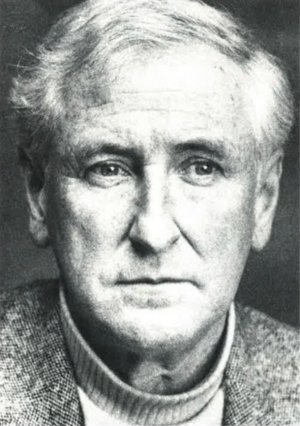
One hundred years ago this month, Dr. Douglas Hyde [An Craoibhin Aoibhinn] visited the United States for the first time.
He was in Boston and New York from June 3 to June 25 on his way home to Ireland from the University of New Brunswick in Canada where he had spent nine months as an interim professor of French, German and English literature. On the night of June 16 in New York he delivered a lecture that would spark the Gaelic revival.
The poet, scholar and storyteller was 31 years of age, “tall, dark-haired, broad-chested, and attractive, with eyes that sparkled with an intense intellectual curiosity and a demeanor that bespoke energy, enthusiasm, and a genuine liking for people,” write the authors of Douglas Hyde-A Maker of Modern Ireland, the thoroughly-researched and detailed biography of the man whose ideas created the Gaelic League, which set in motion a cultural and political revolution in Ireland. It was a defining moment in Irish history. What Hyde defined was Irish nationality.
Hyde’s host in Boston was James Jeffrey Roche, John Boyle O’Reilly’s successor as editor of the Pilot. O Reilly had published one of An Craoibhin Aoibhinn’s Irish poems and paid him two pounds for it. They corresponded briefly but never met. O’Reilly was dead when Hyde reached Boston.
He took the trolley to Cambridge, visited Harvard where everybody was friendly, was shown a copy of his book Beside the Fire and urged to read it. The one who pressed his own book on him did not know that Dr. Hyde, the scholar, was An Craoibhin Aoibhinn, folklorist, poet and author of the book.
On June 9, Hyde took the train to Fall River, boarded a steamer for New York, booked into a hotel in Union Square, visited the Statue of Liberty, Central Park and the Gaelic Society’s rooms on 28th Street, where he expected to meet the famous Fenian Jeremiah O’Donovan Rossa. He found him in his lodgings instead and after a few drinks they went together to the office of the Irish World, where Patrick Ford, the journal’s founder and editor – and U.S. advocate of the Land League – was enthusiastic about Ireland’s politics, but showed little interest in reviving Ireland’s national language.
“Hyde and O’Donovan Rossa tried to convince him of its strong political implications without success,” the authors write.
In New York it was 95 degrees in the shade and rose to 100 degrees during Hyde’s visit. Having spent the winter and spring in the harsh weather of Canada, he prided himself on his endurance. New York in June was another matter.
A storm broke the heat wave as Hyde delivered his seminal lecture on the revival of Irish to the Gaelic Society. It was a preview of his historic address, “The Necessity for DeAnglicizing Ireland,” to the Irish National Literary Society in Dublin on November 25, 1892, from which grew the Gaelic League.
In New York on June 16, 1891, Hyde spoke in Irish and English to a bilingual audience of Irish and Irish-Americans. He deplored the decline of the Irish language, which, he assured them, “stands upon an equal footing with Greek, Latin and Sanscrit.” It was the key to a literature which “has not only never been equalled but never been approached either in age, variety, or value by any vernacular language in Europe.” And he praised the Gaels of America for keeping it alive by speaking it. John Devoy, the leader of the Clan-na-Gael, published every word of Hyde’s address 11 days later in his Gaelic American and newspapers in Ireland printed excerpts from his report. It was read with great excitement in Ireland.
Among those who read the excerpts from the Gaelic American, according to the authors, were John-later Eoin-MacNeill, then 24; John Dillon who was in Galway Gaol; Lady Gregory and William Butler Yeats, then 26; Patrick Pearse, aged 12, and Edward – later Eamon de Valera, aged nine.
Hyde’s New York lecture coincided with Parnell’s fall. An era had ended and Home Rule was lost. But another era was about to begin with the foundation of the Gaelic League, as Hyde would tell an audience in New York in November, 1905.
“Twelve years ago, we found our country becoming a province, no, not a province but a mean little outpost of England. Today we are making it a nation,” he said.
The Irish, according to Giuseppe Mazzini, the doctrinaire Italian patriot and democrat, had lost their “notes of nationality” – their identity as a people. They had grievances, but they were “philosophically and politically wrong.” Hyde in his lecture explained: “I wish to show you that in Anglicizing ourselves wholesale we have thrown away with a light heart the best claim which we have upon the world’s recognition of us as a separate nationality. What did Mazzini say?”
His auditors considered it a “sensational” address, as W.P. Ryan, father of Desmond, the historian of the Easter Rising, put it.
Ryan believed the lecture had gone “lo the heart of a national evil which was preying on Irish life like a cancer.” W.B Yeats heard someone say as he left the hall that it was “the most important ulterance of its kind since ’48.”
For the Dunleavys it was “the most important speech of his career. ” Its seed is in the New York address, whose arguments, Eoin MacNeill said, led to his own proposal, in July 1893, to found the Gaelic League. The League’s mission was to “maintain and promote the use of Gaelic as a spoken language in Ireland.” It was non-political and non-sectarian. The priest and the parson could join. Hyde was its first president.
During his 1905-06 American fundraising tour, Hyde was a missionary for the Gaelic League. He roused Irish-Americans to such fervor for the language that they contributed sufficient money to keep the organization going for several years.
The “Playboy” riots during the Abbey’s U.S. tour of 1911-12 split Gaelic League supporters and alienated John Quinn, Hyde’s New York patron.
Dissension grew within the League at home.
P.H. Pearse wrote that the Gaelic / League was “the beginning of the Irish Revolution.” And added: “Let our generation not shirk its deed, which is to accomplish the revolution.” This was politics. At the 1915 Ard Fheis in Dundalk there was a motion making it an objective of the League to free Ireland from foreign rule. The motion went against Hyde’s “non-political and non-sectarian” credo and he re-signed. He left the hall without anyone noticing after 22 years of devoted service.
For a man with strong claims to the title “father of the Irish cultural revolution,” Douglas Hyde is rarely mentioned today.
This biography should change that. The authors, professors of English at the University of Wisconsin, had access to Hyde’s journals, diaries, letters and family papers – he seems to have committed his thoughts to paper from age 14.
Douglas Hyde grew up in two worlds.
As the third son of the Church of Ireland rector in Frenchpark, County Roscommon, he belonged to the Ascendancy class.
But his friends were local boys-Johnny Lavin, father of Mary Lavin, the writer, and Seamus Hart, Irish speakers and Fenian sympathizers.
He learned Irish talking to the old people.
And he learned about landlordism, the hidden history of Ireland and why Parnell was a hero. Around the Ascendancy table he learned about agrarian crime and why Parnell was a traitor to his class. There was no doubt on which side he stood. Although of Unionist background, he never was a Unionist.
An outstanding scholar, Hyde failed to get academic appointments because he was considered a nationalist. Edward Dowden, Trinity College’s renowned professor of English literature, recommended him as “one of our most brilliant and distinguished scholars of recent years.” Vice Provost John Mahaffy did not help, but contrary to Hyde’s own suspicions did not hinder him either, the Dunleavy evidence suggests.
The biography covers Hyde’s 89 years in almost day-by-day detail. He was professor of Irish at University College Dublin until 1932, and did not take himself too seriously, which annoyed some people.
He was a member of the Irish Senate but was not re-elected. In 1937, de Valera persuaded him to serve as first President under the “New Constitution,” which he did until 1945. He died in 1949.
This is an important book. It took many years to compile. It is a sympathetic study.
There are a few minor errors, such as describing Charles Gavan Duffy as prime minister of Australia: he was of course prime minister of Victoria from 1871 to 1873. It does justice to “the enigma” that was Douglas Hyde, or to give him his Gaelic name, Douglas de h-Ide.
Editor’s Note: This article was originally published in the June 1991 issue of Irish America. ♦
Leave a Reply