
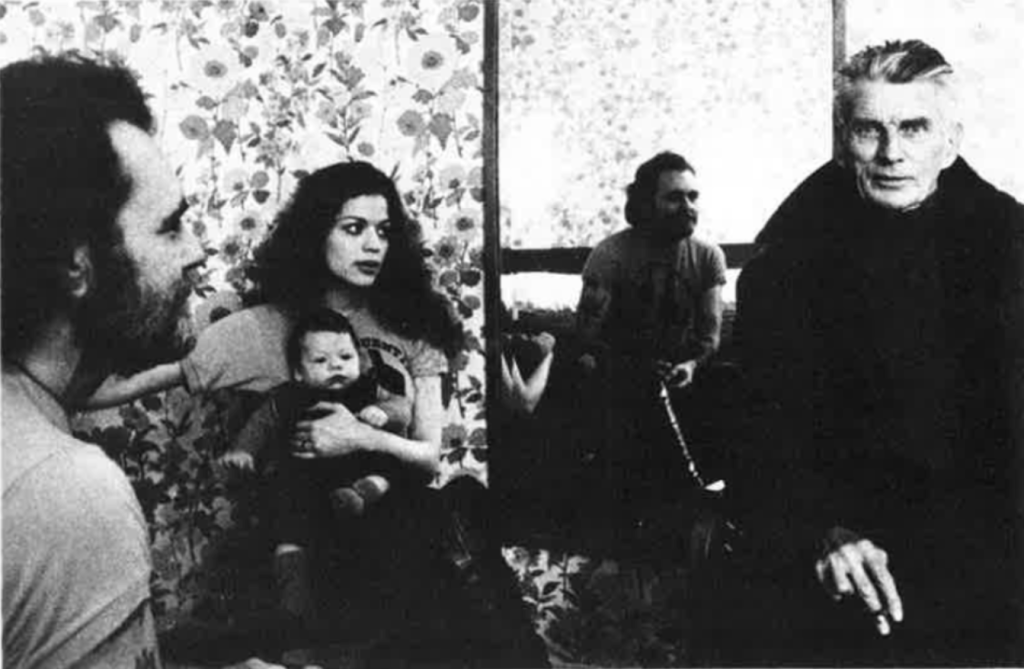
In the 1890’s, Sarah Bernhart did a one-act play in San Quentin Prison’s lower yard. That was it for showbiz until Waiting for Godot arrived in 1957, via the San Francisco Actors’ Workshop. The captive audience included Rick Cluchey, who’d “never been in a theater, not even to rob one.” Many acts later, he became the first non-Italian actor ever to win the Italian Drama Critics’ Award, after a long co-conspiracy with friend and mentor Samuel Beckett that most actors would commit mayhem for. His whereabouts has been traced to the Washington D.C. area, where he is quietly casing theaters, plotting his next audience heist. But if a prosecutor had succeeded, the only notices we’d have read of Rick Cluchey would’ve been his execution.
Cluchey made some bad career moves. His acting apprenticeship is not recommended. He quit the ninth grade to join the army with a forged birth certificate, shooting for Korea. His mom ratted to his commanding officer, who pulled him off the boat shortly before his entire unit was overrun. As soon as he was legal, he joined again.
Luck soured on the Ides of March, 1955 as the twenty-one year old cast himself in a real-life film noir.
Fresh out of the army, broke, jobless, with a wife and two tots, he listened as a friend described a no-one-gets-hurt-big-bucks plan to rob a payroll courier in L.A.
It was bad enough to miss the payroll by a day, but while the automobile kept moving, the gun accidently discharged, sending a bullet into a car seat where it ricocheted off a spring and emerged to give the courier a minor flesh wound. “The gunshot shocked me, and I’d ruled out a life of crime long before I was nabbed in Chicago six months later, when my former partner turned me in.”
Too late. In a darkly laughable marriage of circumstance and legal technicality, the crime added up to “bodily harm while being moved under duress during an armed robbery.” California’s “little Lindbergh” law qualified Cluchey for gas. The prosecutor, a politically ambitious sort who’d condemned Caryl Chessman and Barbara Graham, wanted a perfect death-penalty record. For fifteen months Cluchey sweated it out between brawls in county jail, awaiting doom. The judge refused to condemn and looked for a way out that was fair, but the legal trade-off forced him to hammer Cluchey with life without parole for the $850 robbery.
That’s about as bleak as life gets. “With the predictability of a system that’s designed to keep you, my life should have been over,” says Cluchey, “then I saw myself on that stage, amid the two tramps commenting, and the baronial character hauling another guy with a rope around his neck.” Alan Mandell, the former managerial director at Lincoln Center who is now consulting director at the Los Angeles Theater Center, acted in the first arrival of Godot in San Quentin and later co-founded the San Quentin Drama Workshop (SQDW) with Cluchey in 1957. He observed, “It was as though a light had gone on, and Rick suddenly found the key to open the door to his life.” But it was several years before Cluchey could perform with his troupe. A man with nothing to lose by going over the wall – and Cluchey admits “he often thought of it” – was considered too big a risk to let out at night. Meanwhile, prison life hit new lows during the explosive period when mess halls and lines were suddenly desegregated and racial hate became a deadly one-on-one affair. Cluchey navigated the minefield with a growing sports reputation as a middleweight boxer who dropped his opponents without regard to race, creed or color. He befriended prison classmate Eldridge Cleaver and doomed “Soledad Brother” George Jackson-the latter used his position in audio-visual to show the drama films Cluchey requested.
To make a buck and escape the “pressure cooker,” Cluchey sold all the blood he could drain and volunteered for “totally irresponsible mad scientist chemical-behavioral experiments.”
A spirituality took hold, helping him cope with the negatives of prison, and he worked with the chaplain, counseling inmates. Already in courtyard favor as a purveyor of theatrical escape, Cluchey drove up his survival stock by distributing one of prison’s rare perks, Christmas cards for the inmates’ mothers. “After that, I could’ve run for office.”
In 1965, Cluchey wrote his prison drama, The Cage. The warden said, “I don’t want it about my prison,” so Cluchey called it Le Cage and gave the characters French names. When he saw it, the warden’s sole comment was, “I didn’t know things were so bad in France.”
In a reversal of fortune, Governor Pat Brown, on his last day of office, allowed the parole board to consider life parole. “I often speculate on my chances under Reagan – pretty grim, pretty grim.” After “eleven years, nine months and fourteen days in prison, and ten years of civil death parole: twenty-two years in a system designed to keep you,” Governor Jerry Brown (son of Pat Brown) gave a full pardon.
Cluchey never disputed that “you should do the time if you do the crime,” but says, “punishment should fit the crime. It didn’t. Still doesn’t. It wasn’t a time for rehabilitation, but for revenge, with a down economy, and the blinders went up. They’re going up again.”
Though prison-trained as a dental technician, Cluchey left prison to work with Bill Sands for the Seven Steps Foundation, helping ex-cons stay outside the walls.
When theater recaptured Cluchey, Sands helped him reform the SQDW by joining former warden Clinton Duffy in busting down the bureaucratic gates that prohibited ex-cons from getting together. Cluchey fielded a troupe that could stay out of jail. In 1969, he performed The Cage on Broadway, after breaking box office records at Washington’s Arena Stage.
Cluchey might conjure an image of James Cagney in White Heat, but there is a world-weary gentleness buffering a face that hints of a round trip to hell. He is writing an autobiography, and the psychology of keepers and captives is apt to surface. He vows to stick closer to the stark facts than Weeds, the Nick Nolte film that was “very loosely based” on Cluchey.
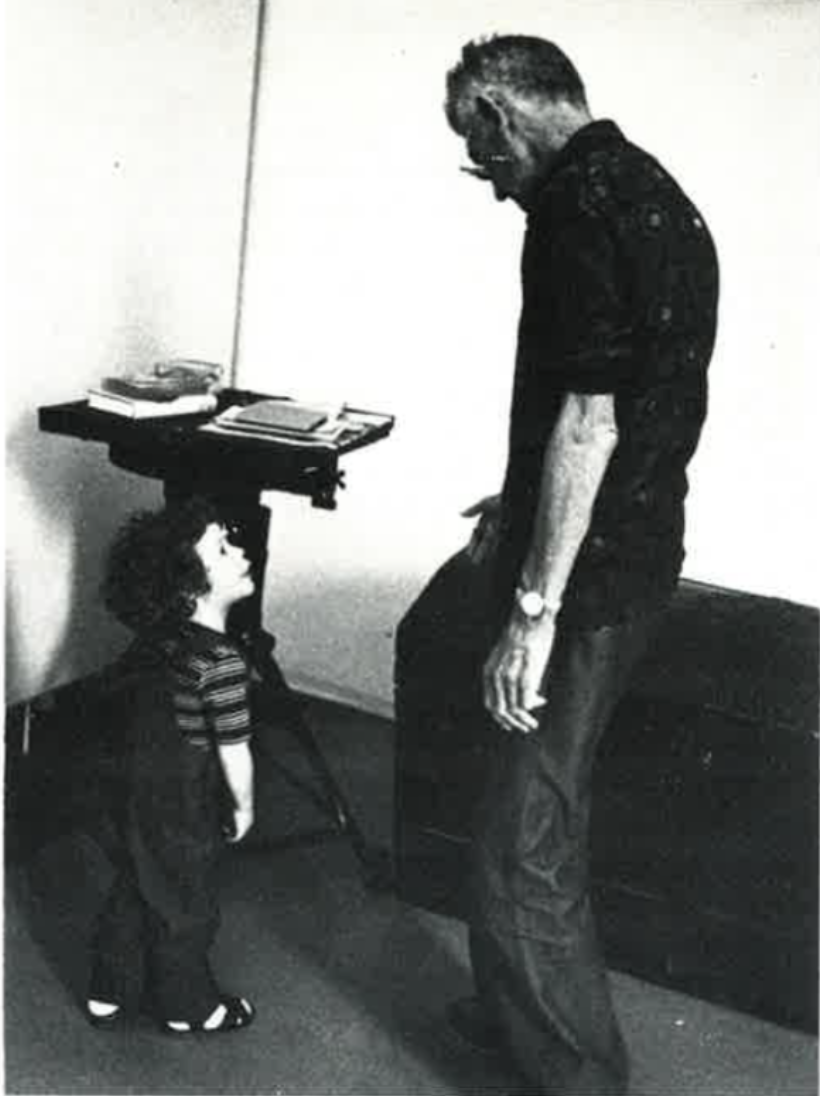
“The parts about Beckett are the toughest to get right.”
“Getting it right” is what the artist in Cluchey is all about. Encouraged by colleagues who knew Beckett, he corresponded with the playwright while working in Scotland, eventually working closely with him from 1977-84, the SQDW becoming Beckett’s preferred group. “Beckett was hit by a lot of labels, and was greatly misunderstood. He was a spiritual man with an Irish sense of humor who carried deep pain from his identification with the harsher events in the world. He was not a nihilist, but a minimalist, his poetic vision distilled is to the last drop.
Beckett lived above a French prison, watching inmates signal him with mirrors. He was fascinated by prisons, mental hospitals, all the so-called bleeding meat of society. When he got the Nobel Prize, it was for demonstrating to humanity its pain in a way it could be understood.” Robert McNamara, a Washington director of European plays, produced last summer’s critically acclaimed Beckett Festival, a collaboration between SQDW and SCENA Theater. He says, “Rick can interpret and animate Beckett’s vision in a way that can’t be found in the commercial American or British theater, or in academia. His international reputation places him with Irish greats like Jackie MacGowran and Pat Magee. We’re facing a dearth in the future of doing Beckett and great playwriters of that ilk, and Rick is one of the very, very few people capable of doing the roles well.”
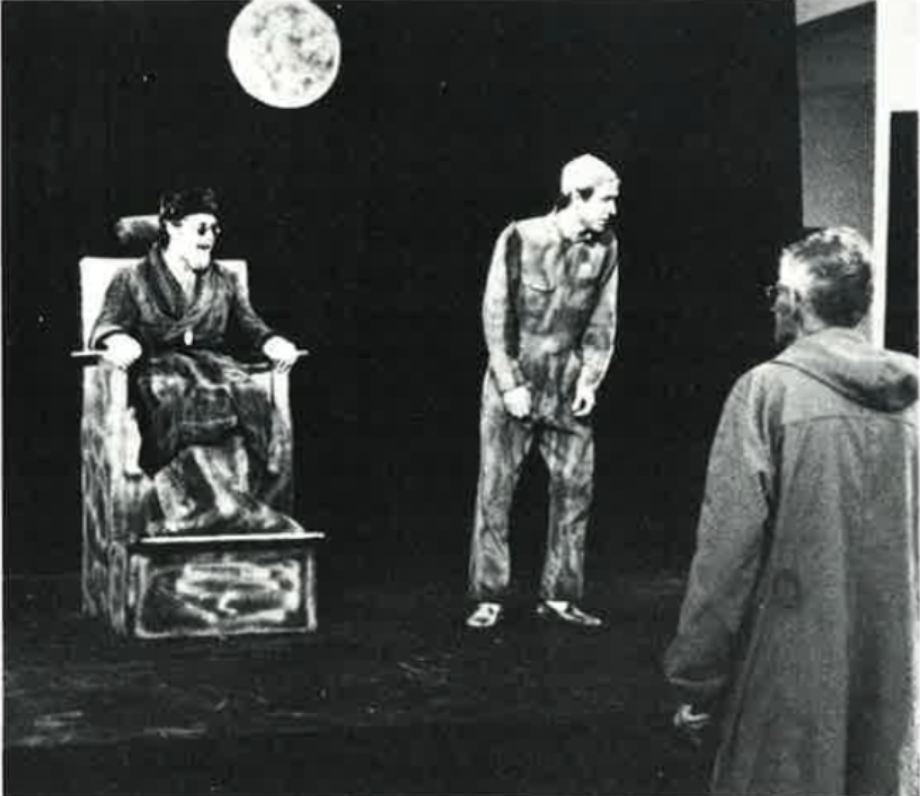
Cluchey was guest artist for the festival. In Eh Joe, he sat for fourteen minutes in elegant pajamas and robe in an easy chair, his only movements a change in his eyes or a clench of his hand, with not a word to say, the audience listening to the voice-over of a women’s mocking voice. A cinch? But Beckett wrote it for camera, giving Cluchey sole permission to perform it on stage. A quarter-hour camera close-up is tough, but Cluchey must project from the stage the feeling of guilt that never leaves, and he does it with an intimate intensity that makes the audience loosen its collar. “I feel close to Joe, but two performances a night are hell. It takes a pound of flesh and leaves a head-ache.” On stage, Cluchey still sells blood.
Last summer, Cluchey could also be seen on PBS in Beckett Directs Beckett, appearing in Waiting for Godot and Krapp’s Last Tape Cluchey’s Krapp’s Last Tape is regarded as defini-tive. The programs were originally shown on European television, with English and French versions filmed concurrently in Paris under Beckett’s supervision.
In Godot, Cluchey went full circle, playing Pazzo, the character who keeps a rope around Lucky (Alan Mandell). Roman Polanski was in the French version.
Cluchey has performed or directed all over the U.S., and in Paris, Rome, Sydney, Berlin, Zurich, Edinburgh, London, and Amsterdam. The foreign performances, including many in prisons, are often before audiences who do not speak English or who miss the street idioms. In a luxury of training, the SQDW found ways to stretch communication, offering symbols in exchange for language. Cluchey strives for fresh interpretations, even cutting the pictures out of play books so they do not influence his approach.
Besides the Italian award, life’s booty includes an ’83 Obie for David Mamet’s Edmond, 1987 Los Angeles Dramalogue Critic’s Awards for writing, directing and acting, and being honored as an Exxon Distinguished Scholar.
Like Mandell, McNamara regards Cluchey’s integrity on the stage as an inspiration. “Rick sees the theater as a family.
He’ll let people in who may not yet be at a certain level, and develop them. If he has a fault, it is his generosity. A natural teacher, he’s a great man for believing in work in progress, and in what can be achieved in the present moment.”
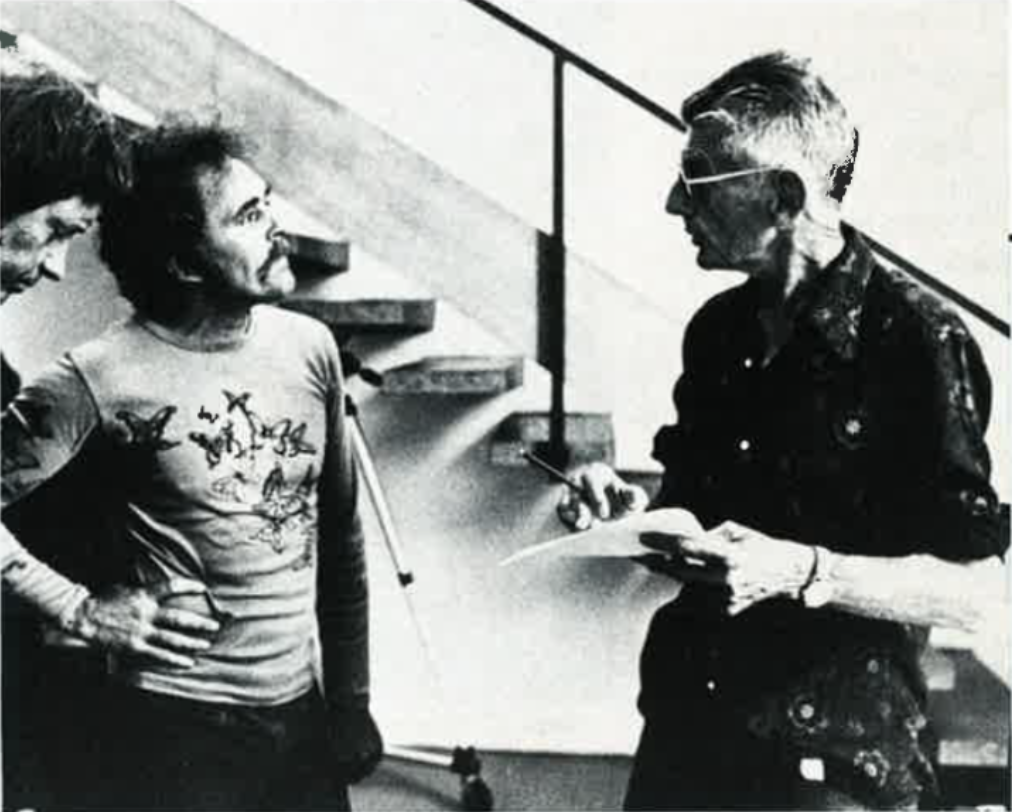
The actor made up for many of the slings and arrows of outrageous fortune when he remarried. Teresita Garcia-Suro, a talented, attractive actress and costume designer, joined the San Quentin Drama Workshop in 1973 for the London and Edinburgh Festival runs of Cluchey’s The Cage and The Wall is Mama. Their teenagers, Luis Beckett, who has played Boy in Godot and Maya, who made her stage debut last year at Publick Playhouse in The Death of the Bishop of Brindisi, were born while the parents worked with Beckett.
Last October, Garcia-Suro played the mistress of Cluchey’s Professor Nettles in Largo Desolato. The work was written by Czechoslovakia’s Václav Havel, who is now that country’s president.
Cluchey directed the absurdist allegory for the American Showcase Theater in Alexandria, Virginia, bringing insights from a play Beckett wrote to honor Havel while he was in prison. Donna Rice, no stranger to absurdist political dramas with historical impact, made a respectable first shot at the stage.
Cluchey is proud of the effect The Cage had in 1987 after the 20th-anniversary performance was updated to address the health issue. The California Department of Corrections, taking note of the powerful public response to the play’s three-month run in Los Angeles, now screens everyone coming into prison for AIDS.
“There are tough questions on privacy rights, but prison is an incubator for death sentences both in and outside. If anything good comes of this tragedy, it may be a hard look at practical penal objectives, and a move for reform,” says Cluchey.
He is also concerned with “the whittling of freedom reflected both in the content of our arts and the diminishing support for them. I sense the gates are closing. With its power to change and capacity to enlighten, real art is frightening. When it provides courage and a sense of direction, it is even more frightening. No wonder that for guys like Helms, demagoguery becomes their ‘set piece,’ as we say in the biz.” Whatever lockdown occurs on the arts, the gates will not close on Cluchey.
Meanwhile, after over two decades, The Cage continues to undergo change. “That’s why we call ourselves the San Quentin Drama Workshop, because we ‘never’ let go, we keep working on the pieces. That was true of Beckett, and that’s why he decided to line up with us.” Currently, Cluchey is working on The Sheperd’s Song, an original, no-holds-barred play on crack and AIDs, targeting young people, including those already in the penal system.
Editor’s Note: This article was originally published in the June 1991 issue of Irish America. ♦
Leave a Reply