
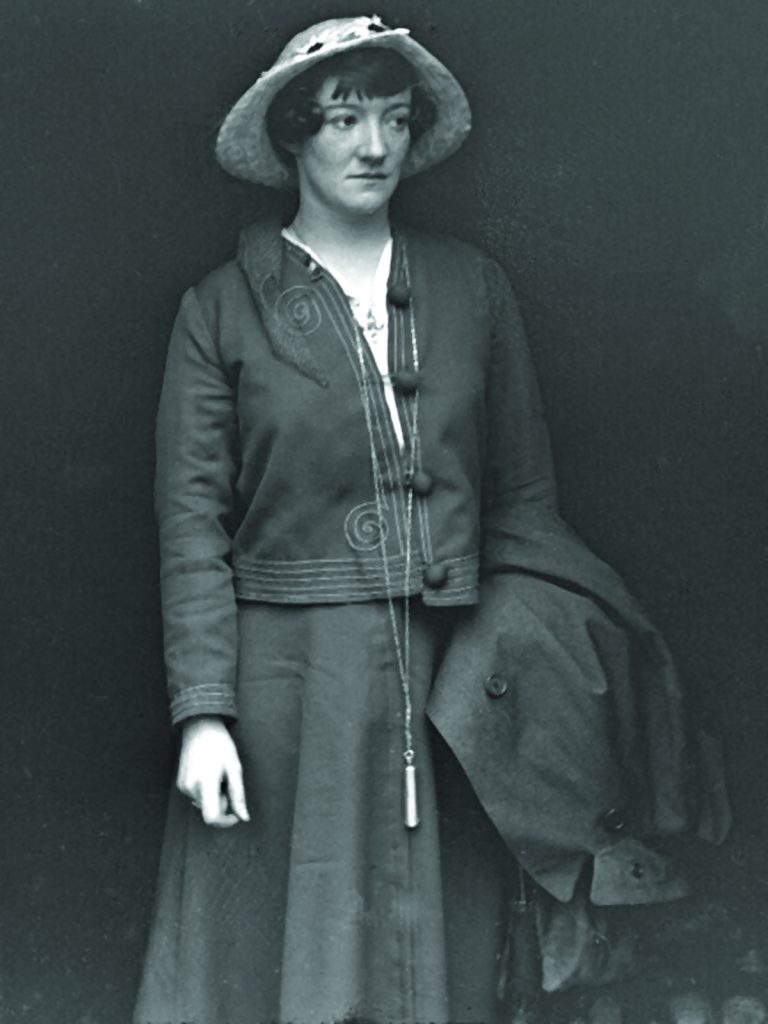
GRACE
“Now as the dawn is breaking, sure my heart is breaking, too.
/ As they lead me out to die, my thoughts will be of you.”
Rosemary Rogers profiles Grace Gifford (1888–1955), an Irish artist, political cartoonist, and republican activist best known for marrying Easter Rising leader Joseph “Joe” Plunkett in a jail cell hours before his execution.
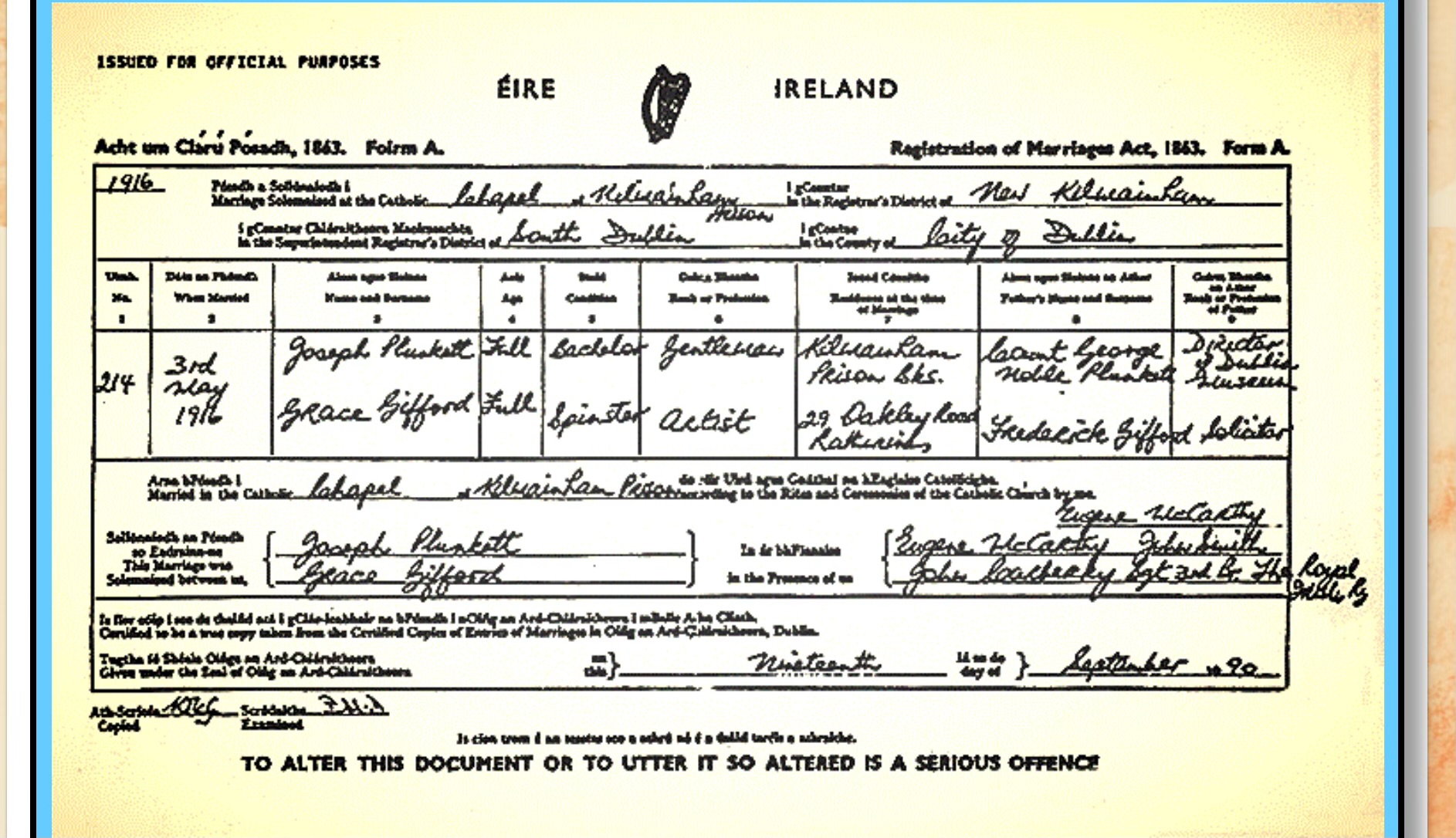
It was a drama worthy of Shakespeare, this wedding between an artist and a poet inside a prison. Grace Gifford, the determined bride, had stopped off at a jewelry store to buy her ring, then convinced British Authorities to allow the marriage. She waited at the altar until soldiers brought in the groom, Joseph Mary Plunkett, and unlocked his handcuffs. Grace and Joe were deeply in love with each other and deeply committed to the fight for Ireland’s freedom. Joe was due to face a firing squad within a few hours, although, in truth, he was already dying of tuberculosis. He had been condemned to death both for his part in the 1916 Easter Rising and for signing the Poblacht na hÉireann, or Declaration of the Republic.
The ceremony took place in the prison’s chapel; the only light was two dying candles, and the only witnesses were a priest, and two British sergeants from the 3rd Battalion of the Royal Iniskillen Fusiliers holding fixed bayonets. The couple was not allowed to speak or touch each other. Still, the marriage, its legendary romanticism, gave the ill-starred lovers a kind of immortality. In 1985, Frank and Sean O’Meara composed a beautiful ballad, “Grace,” about Grace, which many artists covered, including The High Kings and Rod Stewart.
Grace was ordered to leave after the ceremony ended. But soon after she arrived at her lodgings, she received word that Joe would be shot by a firing squad within two hours. She rushed back to Kilmainham. As she later recalled, “we had ten minutes to say good-bye that night; and a man stood there with his watch counting down every minute.”
Grace Evelyn Gifford was born into a prosperous Dublin family that was sharply divided by political loyalty and religion. Her mother was Protestant, her father a Catholic, and five of the six Gifford daughters were fierce Fenians while the six sons sided with British Loyalists.
Grace found her escape in art. She attended Dublin Metropolitan School of Art, where she was considered its most gifted student, especially noted for her talent for caricature; she later continued her studies in London. On returning to Dublin, she joined her sisters, Muriel, Sidney and Nellie in their vibrant and independent social life. The young Gifford women, all rejected their Loyalist backgrounds, became passionate advocates for Ireland’s independence from Britain, joining Inghinidhe na hÉireann (Daughters of Ireland), the women’s movement led by Maud Gonne. Feminists and suffragettes, the Gifford sisters worked with Countess Constance Markievicz in Dublin slums, feeding the city’s poor and introducing its children to Irish culture.
Joseph Mary Plunkett, as his name suggests, came from a devoutly Catholic family; the martyred St. Oliver Plunkett was a relative. His father, Count George Noble Plunkett, was a papal count, an honorific bestowed on him by Pope Leo XIII. Joe was a brilliant child, but had suffered from poor health throughout his life, a victim of glandular tuberculosis. The illness required him to study abroad, in warmer climates, which afforded him an education of extraordinary breadth: Joe spoke several languages, studied philosophy, journalism, aeronautics, Orientalism, Catholic mysticism and, prophetically, military strategy. He was mysterious and eccentric, and like most of his Easter Rising comrades, a published poet.
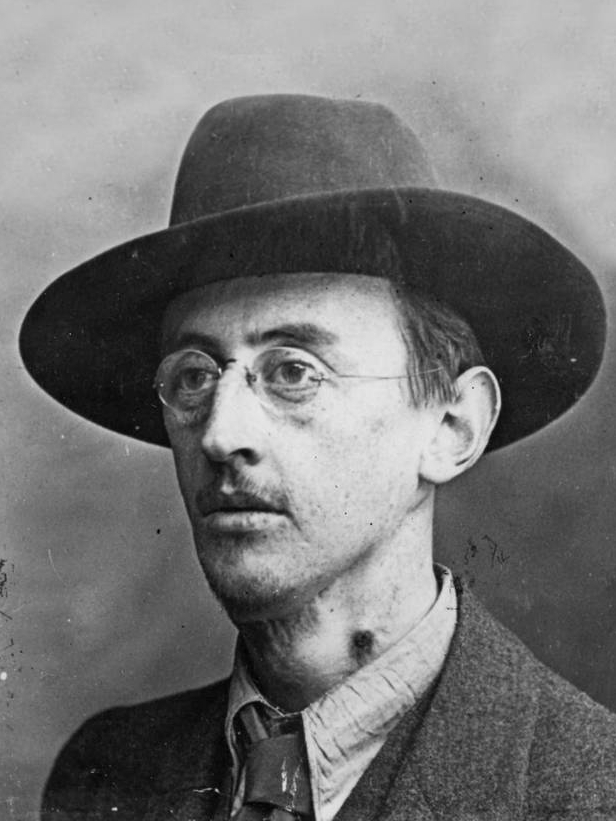
In 1912, the Gifford sisters began visiting St. Enda’s (or Scoil Éanna), the progressive Irish-language school founded by the leader of the 1916 Rising, Pádraig Pearse. It was there that Muriel Gifford met St Enda teacher, dramatist, and poet Thomas MacDonagh, who in turn introduced Grace to Joe Plunkett. Both men and Pearse were on the secret Irish Republican Brotherhood (IRB) Military Committee, and it was Plunkett, a strategist, who planned much of the 1916 Easter Rising. It was he who decided the insurrection should be concentrated in Dublin, with the seizure of large city-center buildings. And, in 1918, Plunkett persuaded James Connolly and his Irish Citizen Army to join the IRB conspirators.
In time, the sisters converted to Catholicism. Muriel Gifford and Thomas MacDonagh married in 1912, and by December 1915, Joe and Grace were engaged. It was all too much for their parents, especially Grace’s choice of a tuberculosis-ridden husband, a calamity the mother ascribed to her daughter being “always so headstrong.” Grace was told never to show up at home again.
As Plunkett and MacDonagh worked during 1915 and 1916 in the oath-bound IRB, they could reveal nothing of the rebellion to Grace or Muriel. The first hint Grace had was on Easter Sunday, the day before the Rising, when Joe wrote Grace that he had completed his will and left everything to her. In another separate (and very prescient) letter, he asked her to fight for her inheritance. He also sent her a gun.
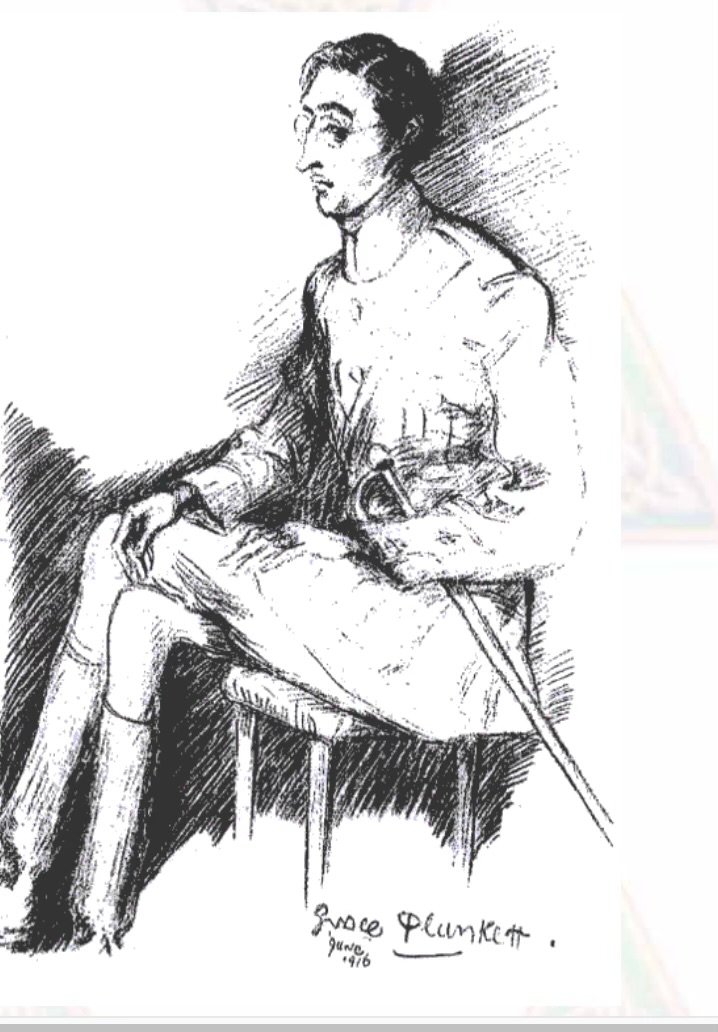
Only days earlier, Joe was operated on to remove tubercular glands in his neck. Yet on April 24, 1916, he took his place in the GPO, swathed in bandages and eccentric military gear, carrying a saber within his jeweled fingers. One witness said he “looked like death” while another recalled, “Pearse was flagging, Connolly gravely wounded, but Joe moved amongst us all the time with his eloquent comforting words.” His aide-de-camp was the then 25-year-old Michael Collins.
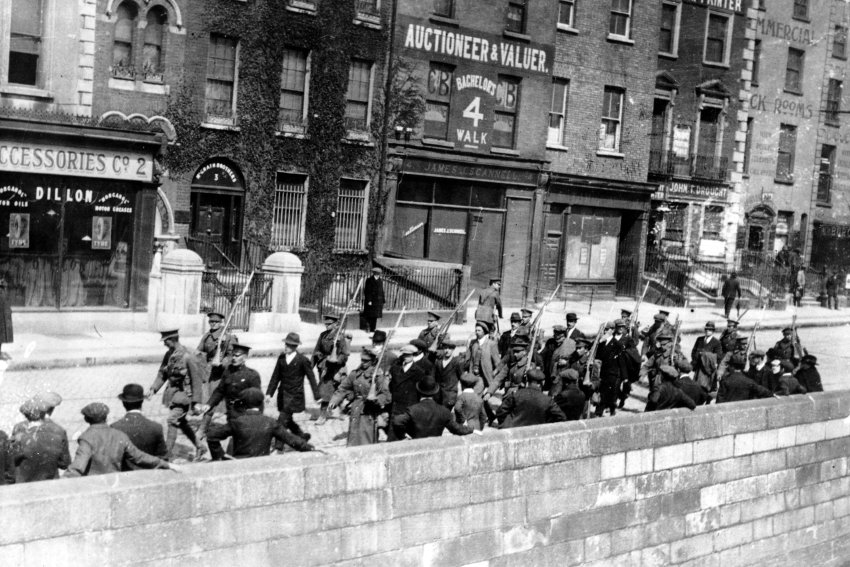
Pearse surrendered after 6 days. General Sir John Grenfell Maxwell (aka “Bloody Maxwell”), commander-in-chief of British forces in Ireland, issued an ominous warning, “I am going to ensure that there will be no treason whispered for 100 years.” To that end, between May 3 and May 12, 1916, fourteen of the leaders were executed by firing squad in the prison yard.
The population of Ireland originally didn’t support the Rising, but after the executions, the rebels were seen as martyrs. Public opinion turned rabidly anti-British, proving Pearse’s strategy: A blood sacrifice can convert national apathy into passion. Sinn Féin swept the Irish Parliamentary Party in the upcoming election.
For a time following Joe’s execution, Grace stayed at Larkfield, the Plunkett family home, even as the parents were deported because they supported the rebellion. Grace found herself living with a difficult sister-in-law, Geraldine, who had been deeply attached to Joe and resented Grace’s place as his widow. Grace’s biographer, Marie O’Neill, read Geraldine’s unpublished memoirs and said its tone was openly hostile towards Grace. Geraldine claimed Grace had a miscarriage and even questioned if Joe was the father. O’Neill acknowledged that Joe and Grace’s letters hinted at sexual intimacy but dismissed the sister-in-law’s claims as “the malicious gossip” of a disturbed woman.
Grace’s in-law problems continued. Months after his son’s death, the Papal Count declared Joe’s will invalid because it was written before they were married and there was only one, not two, witnesses. In doing so, the Count ignored his son’s last request: Take care of Grace. She left their home never to return. In 1917, more tragedy. Her closest sister, Muriel, died of heart failure while swimming, leaving the two children of Muriel and Tom MacDonagh orphaned. She shared the care of the children with her sisters and the MacDonagh family.
By 1918, she received several commissions as an artist and used her talent for political commentary to create topical satirical cartoons. Grace had three books published; her cartoons and caricatures, with their incisive and often snarky wit, appeared in many publications including Punch. Yeats chose her to illustrate a book of his poetry.
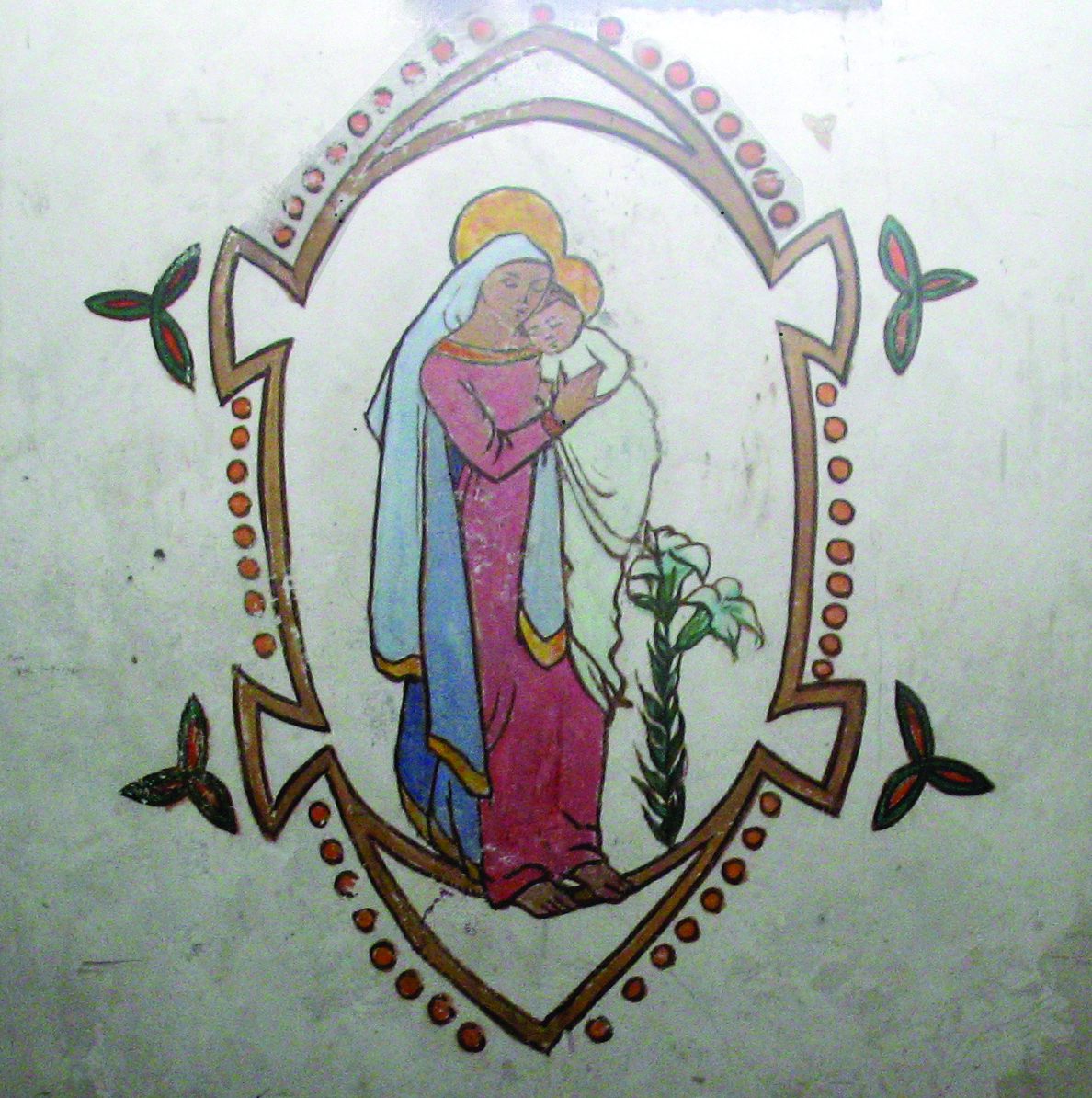
Grace threw herself into republican politics and was elected to the Executive at the Sinn Féin convention in Dublin. She opposed the Anglo-Irish Treaty and, during the Civil War, was arrested, along with other republicans including Maud Gonne, and imprisoned in, of all places, Kilmainham Prison. There, she painted her famous Madonna and Child on the wall of her cell, which visitors can see on tours of Kilmainham Prison.
After the Civil War, she struggled to find work because of her Anti-Treaty position and moved between rented rooms. Grace attracted many admirers but wasn’t interested in any of them, always signing her name as “Mrs. Joe Plunkett.” In 1932, she began to receive a pension established for 1916 widows, which greatly improved her financial circumstances. Finally, in 1934, Grace sued Count Plunkett for her share of her husband’s estate and received an out-of-court settlement of £700.
But in the remaining decades, her health declined; she was unable to work, and Grace died alone in her Dublin flat in 1955. Ireland’s president, Sean O’Kelly, attended her funeral; she was buried with full military honors near Joe’s grave in the republican plot of Glasnevin Cemetery.
Leave a Reply