
In the vast collection of traditional Irish music, there exists a tune called the Ballinasloe Fair which celebrates what was in its heyday one of the most famous horse fairs in Western Europe and which is still regarded as the biggest and most popular fair in modern Ireland.
The week-long fair opens on October 3 each year and follows an old recognized pattern of Irish country fairs beginning with animal trading and ending with general fair-going.
Ballinasloe (Beal Ata an Slu-aidh – the ford mouth of the gathering crowd) is a bridge town on the River Suck in East Galway and both its name and location suggest its use over a long period of time as a gathering place. The town is situated on an esker (an ice-age gravel deposit) which stretches from Galway Bay in the west to Dublin on the Irish Sea and these eskers would have provided dry footing for animal droving across the boggy central plain during a period before the introduction of modern transport. The fair assumed its present form in the 18th century when contacts were made with markets and animal buyers in England and Continental Europe, and at its height during Famine times (c. 1850), numbers such as 100,000 sheep and 6,000 horses being offered for sale were not uncommon.
Gatherings at fairs and assemblies have a long history in Ireland and a visit to Ballinasloe in this first week in October sees the town transformed into a general hustle and bustle of excitement with a festive atmosphere prevailing all around. Every sort of individual can be met with from local country folk attracted by the colorful trappings to horse dealers and potential buyers looking for a bargain. A quick ramble through the fair-green soon brings out the daring adventurer in the curious visitor, particularly when having to side-step and almost wrestle with anything from ponies, jennets, foals, donkeys, and horses to cattle, sheep, goats and picbald Gypsy horses. A familiar sight in the middle of the hullabaloo is an owner trying to knock manners into a seemingly stubborn animal, reminding one of an old Irish proverb which proclaims that the three most bothersome things in the world are: a thorn in the foot a woman and a goat going to the fair that will go any way but the way you want it!
“I’ve been coming to the fair now for the past twenty years or so,” one gentleman related, “and that’s the way with most country folk around here.” They seem to have no regard for calendar dates as most of their daily routines and activities throughout the year revolve around the Ballinasloe Fair, demonstrating its general popularity.
Besides the fair proper, a number of official events occur which include an agricultural show and horse-jumping activities, the staid organization of which contrasts sharply with the excitement and noise in the fair-green. The stately appearance of animals and judges alike, with every wag of the tail under control, creates a positively somber atmosphere, a wide cross section of unusual breeds of farm animals (and garden vegetables on display) however helping to excite the inquisitive mind.
The open green on the other hand seems to promote the principal life-energy of the fair. An activity which becomes immediately apparent to the visitor is the age-old ritual of buying and selling of animals.
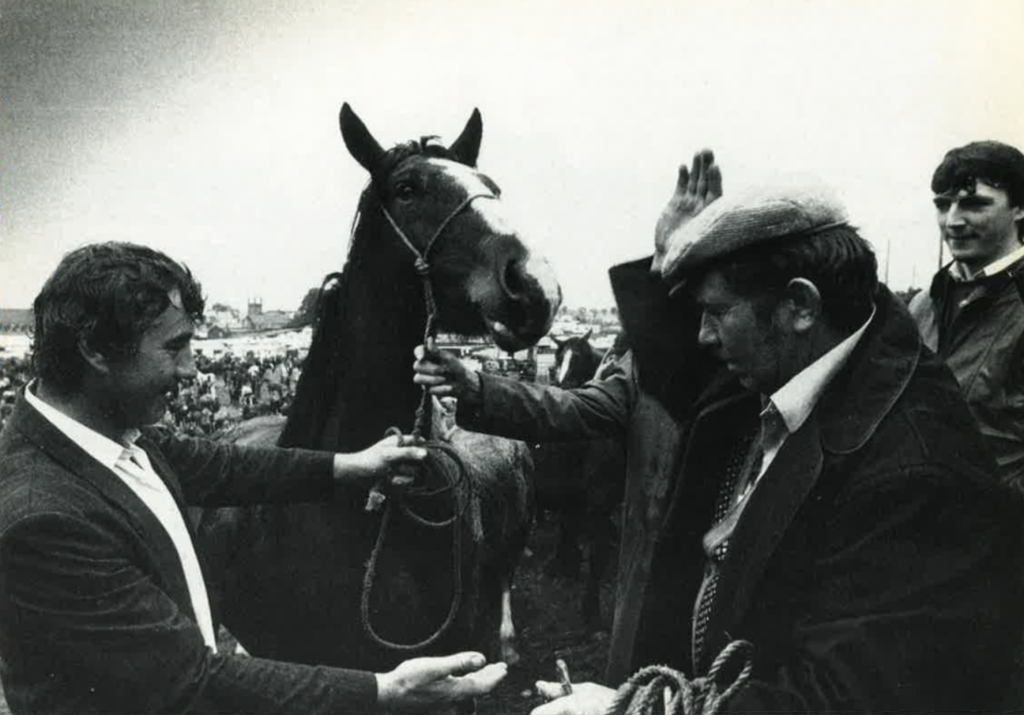
“I’ll give you two hundred,” offers the buyer. “I’ll not take less than three. I could be getting that over yonder,” challenges the seller. During the haggling an intermediary known as a tangler intervenes to keep the process in order, attempting to bring the hands of the buyer and seller together. On concluding the bargain both individuals spit and slap hands (a practice which is believed to derive from days when different languages were spoken at the fair) and the seller is obliged to hand back a pound or two in “luck money” to the purchaser of the animal. Bargaining can last for hours at a time providing an abundance of excitement and craic and is still the preferred buying-selling method of large numbers of country people.
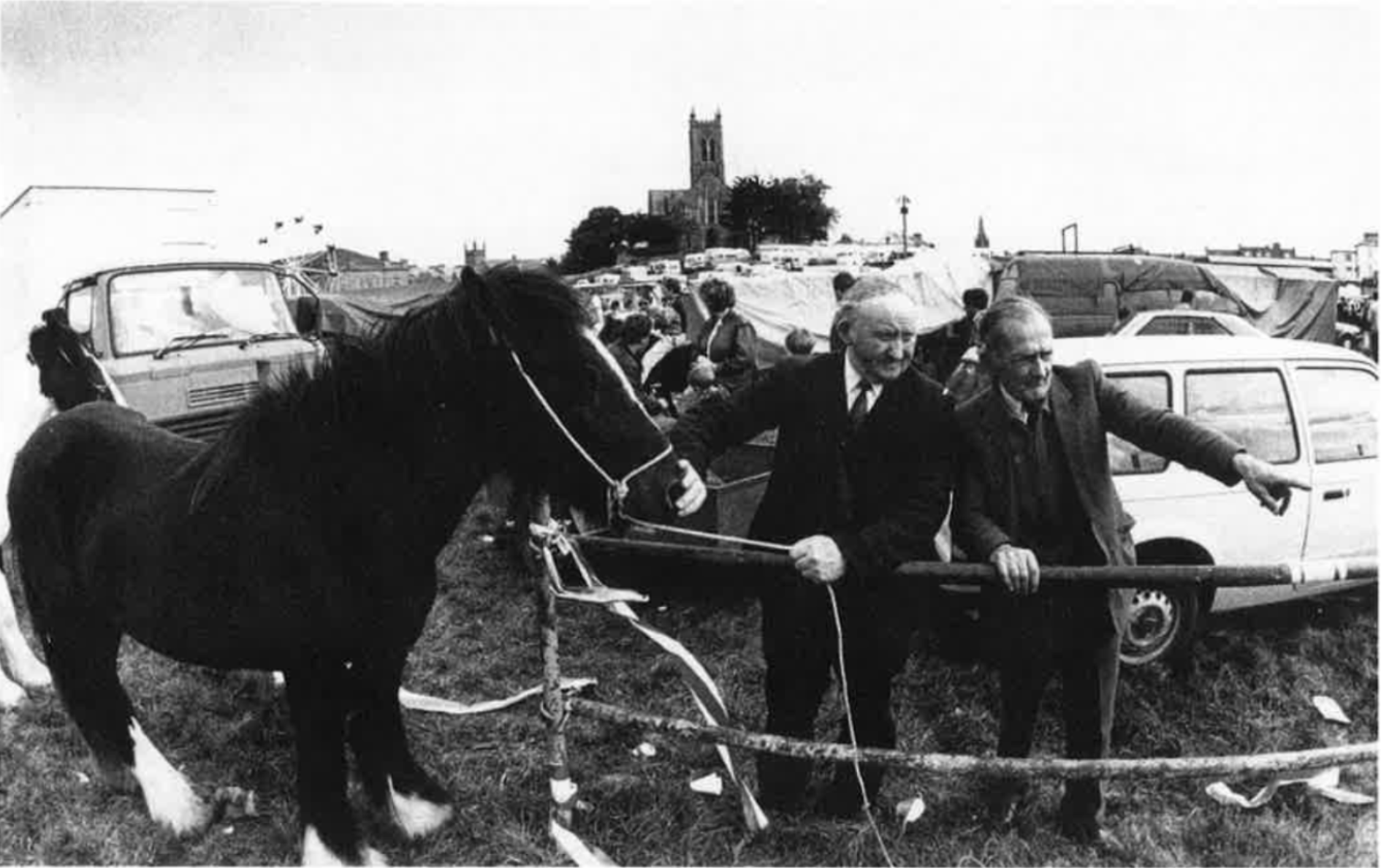
At Ballinasloe the principal preoccupation has undoubtedly to do with the exchange of horses, and the cross section of equine breeds present is bewildering — Clydesdales, skewbalds, piebalds, and Connemara ponies being bought as general farm animals and for cart-pulling while Irish draughts and other pedigree varieties and breeds may be put to work as show-jumpers and for racing and hunting.
A special fcature of the fair where people give themselves up to uproarious fun is the presence of travelling-showmen, jesters, gleemen and trick-performers, the trick o’ the loop merchants and three-card tricksters being most popular.
“The same ol’ race
For the same ol’ chase That I don’t get caught
For twenty, forty, sixty, eighty…
Punters to the front and lookers behind,” shouts the trickster as he skillfully maneuvers the playing cards and calls for bets to be offered. Many an innocent bystander has been caught with this trick, having to retire home in the evening, to the amusement of his friends, with empty pockets.
A stroll through the canvas-covered stalls sometimes offers an element of surprise for the fair-goer. Here a variety of knickknacks are being peddled — antique farm implements, horse tackle and tools of every description — where one can soon discover some long-sought-after article. Off to one side of the green the carnival dangles lures of thrill rides, prizes for shooting and throwing skills and games of chance for the fair’s children, while hungrier ones indulge in fish and chips and freshly baked sugared-doughnuts. On a sloping hillock travellers and barrel-topped wagon owners set up camp where for one whole week the center of the world is Ballinasloe.
On approaching the fair green from the western entrance one is enticed towards a main focal point of the fair — a 150 meter long, fenced track used by the travellers to display and show off the trotting and racing abilities of their ponies. Here, from hundreds of piebalds and skewbalds huddled together, a single animal is chosen, hitched to a chariot-like cart known as a “gig” and raced on the track to the wild yelps of onlookers, the entire scene being reminiscent of chariot racing in the first three centuries after Christ as documented in the old Irish Romances. Animals are also ridden bareback on the track with great skill (the ancient Irish never used saddles), some of the riders being no more than fourteen years old. It seems little wonder that the Irish are in such demand for their skill in handling horses when one observes the horsemanship naturally displayed here.
Depending on the energy and speed of the trotters, very high prices can be fetched.
However, as with travellers and Romany Gypsies everywhere, trickery is sometimes used to excite the horses, the application of ginger and mustard to the hindquarters being a common procedure. The ultimate in trickery at the fair can be gleaned from a story I heard from a farmer friend of mine concerning “an old man who went to the fair once with a tired decrepit nag which he wished to trade for a younger smarter animal. The travellers who bought the horse had her dispatched to a nearby field, where she was quickly transformed into a sprightly mare, being doctored, trimmed, washed, shampooed and having her hoofs polished: whereupon she was sold back to the delighted old man who couldn’t for the life of him understand how his ‘new’ horse could know every twist and tur on the road home!”
Gatherings like that at Ballinasloe seem to be triggered by a spirit-renewing urge passed from one generation to another to create a festival of togetherness for local country families, old and new acquaintances and especially for lovers of horses and ponies. At the nearby smaller horse-fair of Spancil Hill, Ireland’s sons and daughters and friends congregate each year on June 23 for a similar celebration.
Thankfully, the recent introduction of modern cooperative marts hasn’t hastened the extinction of the traditional fair and at the end of the day one can still hear the loud clap of one hand into another, signifying the conclusion of another bargain.
Editor’s Note: This article was originally published in the September 1992 issue of Irish America. ♦
Leave a Reply