
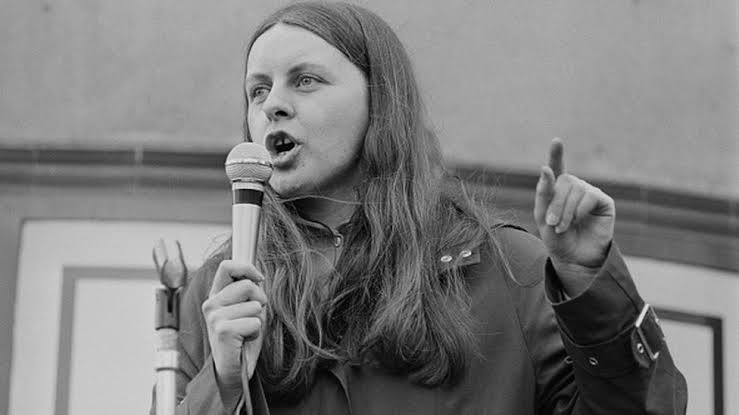
In 1970, at the age of 22, Bernadette ‘Devlin’ McAliskey was elected to represent the constituency of Mid-Ulster, which includes her home area of East Tyrone. Although she is no longer a Member of Parliament, and her international profile has receded, this radical Republican activist is still a kind of people’s tribune in her own embattled nationalist community. Nowadays McAliskey spends a lot of her time documenting the increasing catalogue of killings by the British security forces and the Loyalist gangs that seem to operate with impunity in Northern Ireland.
The stories she tells are told from the point of view of this Republican community, a community increasingly ignored and shunned both inside Ireland and out.
They tell of the sinister collaboration of the British security forces with Loyalist death squads and the dirty war that is waged outside the rule of law. They are also tales of a people that refuse to buckle under, tales of another generation being thrown into a deadly conflict. On a recent visit to New York, McAliskey told these stories to Patrick Farrelly.
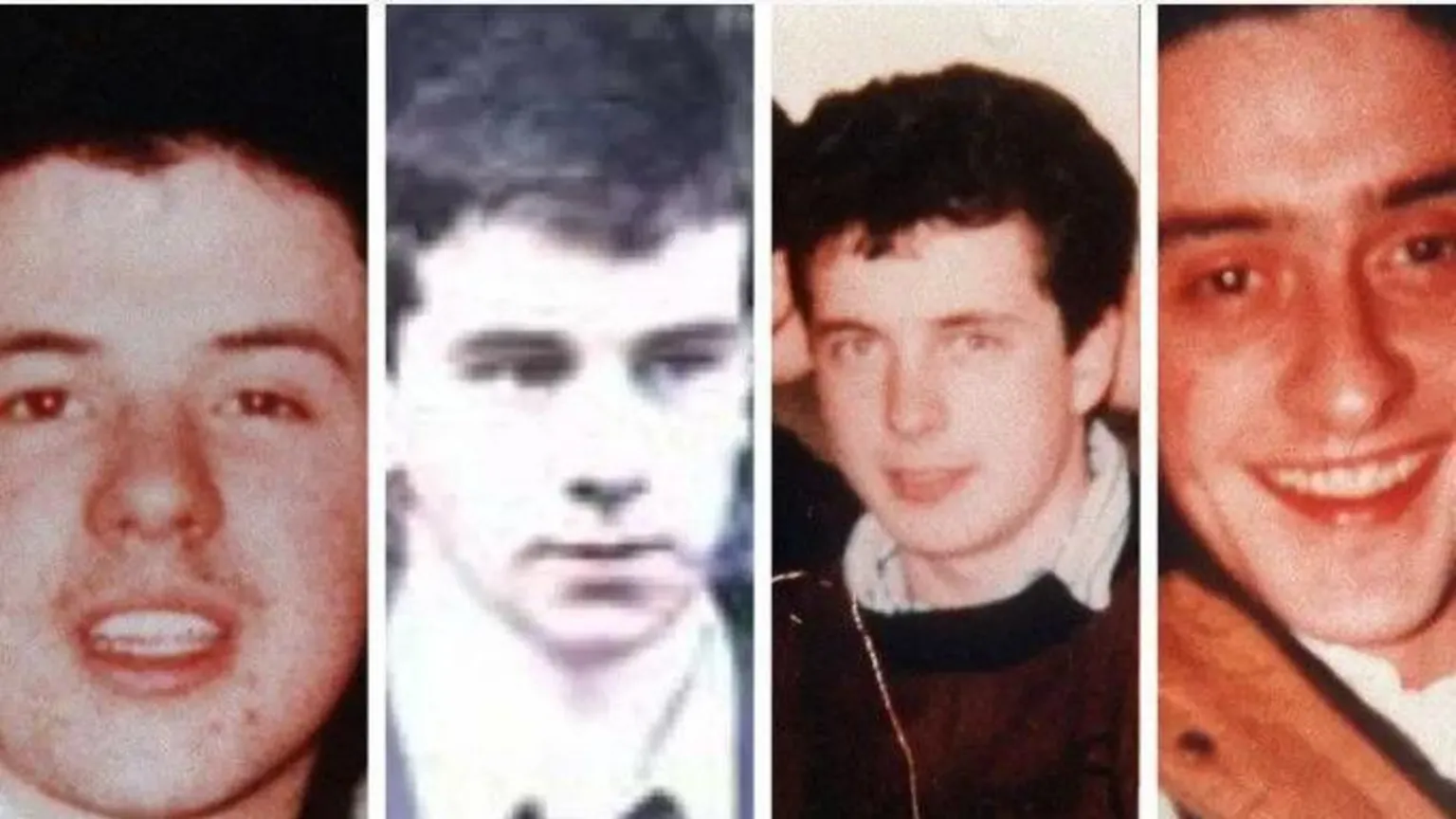
Bernadette McAliskey becomes solemn and a note of sad resignation enters her voice when she talks about February 16, last, the night Barry O’Donnell, Seán O’Farrell, Paddy Vincent, and Peter Clancy were killed.
“We’re still not clear what really happened,” she says in her soft Tyrone lilt. It was just after eleven at night and she was at home in her Coalisland housing estate. “The sound was like nothing I had ever heard before and it was so loud we got down on the floor because we thought the house was under fire. The roar of that machine gun was deafening and it was being fired almost a mile-and-a-halfaway.” A short time later a different sound of gunfire would tell the story. To the outside world it would be a tale of four young men who had gone to attack a police barracks, being themselves ambushed and killed.
Although the British government denies it, there is an undeclared war going on in Northern Ireland. To the participants on the ground, and indeed to the security and intelligence chiefs who direct them, there has never been any pretense about it.
Nowhere has this war been more obvious than in East Tyrone — a place as different from the tough streets of Belfast as rural Pennsylvania is from West Philadelphia. Unlike the economically blighted neighborhoods of Belfast, in which the hardline Republican politics of Sinn Féin hold sway, the nationalist farms and villages of East Tyrone are not home to oppressive levels of unemployment and social deprivation.
“The British,” says Bernadette ‘Devlin’ McAliskey, who was raised in Cookstown but now lives in Coalisland, “look on us as a people who really have no excuses. In West Belfast people have been voting for Sinn Féin since the 1970s. In East Tyrone people have been doing that since 1918. It could be said that the population’s roots are more deeply Republican than Sinn Féin is,” she said. One consequence of that deeply felt Republicanism is the hard and wrenching battle which the Irish Republican Army has been fighting with the regular British Army, the locally recruited British regiment, the Ulster Defense Regiment (UDR), and the Royal Ulster Constabulary (RUC), for more than a decade.
It is McAliskey’s contention — and indeed that of many nationalists – that the undeclared war in East Tyrone now manifests itself not only in the illegal killings of Sinn Féin and IRA activists by the official, uniformed security forces, but that those forces also collaborate with Loyalist death squads in terrorizing the nationalist community. McAliskey estimates that in the last four years or so, more than 30 Nationalists have been killed in such disputed circumstances in East Tyrone.
In the early morning of January 16, 1981, McAliskey and her husband Michael miraculously survived when they were riddled with bullets by Ulster Defense Association gunmen at their home.
She was shot eight times as she tried to protect her two-year-old son, Fintan.
Their would-be assassins were arrested as they left the house by British Army paratroopers that had been dug in beside the McAliskey home. Afterwards one of the soldiers told her ominously that they were under orders to arrest any gunmen coming out of her house.
In the following years many more homes in this area have been visited by assassins.
While those who take up arms for the IRA face long jail sentences or an early grave, no member of the security forces in this area has ever been convicted of murder.
McAliskey has sought to document the eyewitness accounts of local people to these acts of terror. It is a task that is ignored by the media in Ireland and England who have bought into the notion that this is an outlaw community.
The “collaboration” between the security forces and Loyalist gangs – apart from the now well-documented leaking of security files – takes different forms, McAliskey claims. “In some killings the RUC were seen to convey the killers to the scene. Other times the normally heavy military surveillance seemed to disappear, at just the right moment, indicating that the people doing the killing were getting very clear and precise information about lapses, about periods of change-over – sometimes no longer than 30 minutes. The killers’ information was sufficiently accurate for it to be ‘inside information.’” McAliskey is adamant that she is not referring to some all-encompassing conspiracy.
“We have always tried to make the most conservative estimate of these incidents. But at minimum it requires a tight group of people in the RUC and UDR, having access to information about patrols, and sufficient authority to be out in official vehicles themselves without alerting suspicion.
“In almost all the cases we have looked at the military were operating out of Cookstown RUC and UDR station. The killings fell into three categories: deliberate killing of Sinn Féin activists, and Sinn Féin elected representatives; the killing of active IRA members; and outright terrorizing of the nationalist community.”
The events surrounding the deaths of the four young local IRA men last February was to stun the town of Coalisland.
Who the victims were tells us a great deal about the nature of this community, and their killing and the conduct of their funerals was to be a watershed event for the area, and in particular, for the young people.
Death in the Town
Once the deafening sound of the heavy machine gun stopped, the McAliskey family, like all their neighbors, went outside. “After that there was a lull, and then a sustained burst of gunfire, further on, from the Clone area (a couple of miles away). It was British Army weaponry, and it was not returned. It was followed by three single shots.” The people standing outside their houses, in the darkness and sudden quiet, had a good idea what had happened. The last sustained burst of gunfire said everything.
“When you’re listening you can hear cross-fire, it’s like the difference between two conversations and one,” McAliskey explains.
“All the adults knew they had heard an IRA operation followed by a British Army slaughter. At that moment, any parent who couldn’t put a hand on a grown-up son was worried sick.”
The following is now known about that night: A large truck with ten young men and a U.S. Army-issue general purpose machine gun drove up to the fortress-like R.U.C. barracks in Coalisland. There, the machine gun was fired at the building — without any response from its occupants. The truck then proceeded back through the town and out via Annagher Hill to the church car park in Clonoe, a prearranged dispersal point. A distance of nearly four miles.
The dispersal point was a traditional meeting place, a cross-roads adjacent to the church car park – a place courting couples go, and people wait for rides to town.
When the truck pulled up in the car park it was fired on from all sides. A British Army Special Air Services unit (SAS) had been lying in wait. The SAS is an undercover regiment with a fearsome reputation as a killing machine that takes no prisoners — They were responsible for the killing of three unarmed IRA members in Gibraltar, Spain in March 1988.
The IRA group did not have an opportunity to return fire. The gunfire directed at them was so intense the nearby church caught fire. “Of the ten men involved in the operation, four were killed and six escaped, three of whom were injured. The injured were carried away by those who weren’t,” McAliskey says.
Two other men, who were not part of the IRA operation, were shot and remained injured at the scene. One of those had met Barry O’Donnell earlier in the day, and O’Donnell told him he would meet him there and give him a lift to a disco. He ran when the shooting started, but was shot breaking through an outer circle of SAS soldiers.
“The other fella was shot in the car park because Paddy Vincent tried to escape in his direction, and the shots that hit Paddy Vincent also hit him. A young courting couple in another car escaped injury,” McAliskey adds.
“Clearly the SAS knew in advance of the IRA operation, had the dispersal point staked out, and knew their targets. There was an unmistakable impression that the two injured bystanders would have been killed too, if the SAS believed they were involved,” McAliskey says.
The four dead were aged between 20 and 22 years old.
Why did the IRA attack an almost impregnable fortress? “I think the attack on the barracks was supposed to have been the beginning of something — a secondary operation perhaps. Maybe the attack on the RUC station was to draw out the troops for some other attack. I don’t know. Something clearly went wrong. Obviously the British knew in advance exactly what was to happen.”
Two Sides of a Coin
The four dead were all from the locality and accurately mirrored the place they came from. Barry O’Donnell had been in college in England, and while there was caught in possession of weapons. After a short prison sentence he returned to County Tyrone,
A marked man at home his first thought was to emigrate to America, but he was turned down for a visa. He then moved south to the Irish Republic, but the gardai (Irish police) gave him a hard time. He came back to Tyrone.
“When Barry O’Donnell came back he was stopped by the security forces an average of ten times a day. I think he decided then that if that was going to be the quality of his life he might as well be right in there. They had boxed him off, driven him from the fringes to the center. Although he was quite willing to be driven.” Barry had joined the war. “Barry O’Donnell knew, and the whole town knew, there would come a time when he was going to run out of road.”
O’Donnell’s family had been part of Republican Tyrone for generations. They were also a family of Irish-speaking enthusiasts. He was a charismatic young man with a number of camp followers — young women who, according to McAliskey, “would follow him to Cork and back.”
O’Donnell’s best friend, Seán O’Farrell, died with him in Clonoe church car park. “They were like two sides of a coin. Scan was a very serious, quiet man,” McAliskey remembers.
“Sean had a twin brother, Austin, with multiple sclerosis, who was nicknamed Gandhi by them. It was a measure of these kids and their outlook on life that Gandhi and his wheelchair were taken everywhere by Barry and Seán. Indeed people would not have been surprised if Gandhi had been on the back of the lorry.
“This trio were the life and soul of the town. When one of them got dragged out of the car by the military, the others would tell him not to squeal, and then shout the name of some very respectable member of the local community as being responsible for whatever the latest IRA illegality had been. They were at the heart of the resistance of the young people in the area.”
Peter Clancy had been injured in a previous encounter with the British Army.
After that his family went to great lengths to persuade him to go to America or anywhere else to get offside. His father, Leo, was a school teacher, a very solid member of the community. But he wouldn’t go.
“Then there was young Paddy Vincent. People were just incredulous that he was involved. His parents had no inkling their son had any sympathy for Republicanism, never mind an involvement with the IRA. The family really had no opinion about the state of the world at all. They were greyhound people – Paddy’s mother wouldn’t hold a view that would annoy her Protestant neighbors. Mrs. Vincent could not acknowledge that her son had died in an IRA ambush or that he had been a member of the IRA, which was very tragic. She had a child to bury, but she couldn’t admit to the circumstances in which he had died. So she didn’t want any Sinn Féin people at the funeral, which everyone understood. Unfortunately the clergy intervened and encouraged her to believe that Paddy had been forced to drive the lorry. They shouldn’t have done that,” McAliskey says.
The Funerals
Paddy Vincent was buried where his people came from, in Edendark between Coalisland and Dungannon. It was to be a quiet funeral and the RUC said they would keep a low profile. “The low profile meant that the funeral cortege was led — and we counted them – by 36 armore police cars, and followed by a further 24 armored cars, with policemen lining the funeral cortege and marching in front and behind it,” McAliskey says.
At Peter Clancy’s funeral in Clone there were so many RUC men in the graveyard they had to edge back a foot at a time to let the mourners in. Once the immediate family were in the graveyard they closed ranks again. Most of the mourners saw nothing of the actual funeral.
“When we got to Clone we could just see the sun glinting off their helmets, a sea of black where they occupied the cemetery,” McAliskey remembers.
But the most dramatic thing around the cemetery was this other sea, of school uniforms. “My kids were not at school, they were there in civilian clothes, with us. But the children in uniform had been sent to school that morning by their parents. Instead they were at the cemetery in their hundreds, dressed in school uniforms. It was an act of defiance. Clcarly these kids were burying their own generation.” The following morning the town of Coalisland divided in two. “Half of us went to the O’Donnell house and half went to the O’Farrells. We were to meet at the church gate with the funeral corteges and go in together, ” McAliskey says.
“You had to run a gauntlet of abuse from the police to get to the house: sniggering cops standing on the door step of the bereaved household; cops rapping on the windows, knocking on the door and asking. ‘Is Seán in?’ It’s all an effort to corage people.”
It took almost two hours to get Séan O’Farrell’s cortege from his house to the chapel, a five minute walk away. “The first thing the RUC did was try to cut off the coffin from the mourners. So no one would move. We had to negotiate with the RUC to move back and allow the funeral to continue as a single unit.”
“Once we got out of the housing estate, the police would not allow the cortege to proceed with the traditional beret and gloves on the coffin. The mood the people were in they just wouldn’t take them off. The police would say ‘you can’t proceed,’ and the family would reply ‘well that’s all right.’ It went on like that for almost two hours.”
On the other side of Coalisland, the same thing was happening with Barry O’Donnell’s funeral cortege. “His brothers walked alongside the cortege wearing their leather jackets and their shirts and ties. The police said the leather jackets looked like a paramilitary uniform and stopped the funeral. The local kids exchanged clothes till a combination of clothing could be found so that the police would permit the funeral to proceed. My daughter Roisin gave her jacket to one of Barry’s brothers so that he could walk by his brother’s coffin.” A ritual has been established, at the insistence of the Catholic Church, for Republican funerals, whereby before the coffins go through the church gate, the beret and gloves are removed with the flag remaining. But the priest will then refuse admission to the church while the coffin remains draped by the Irish flag.
When the two coffins reached the church door, the O’Donnell and O’Farrell families would not allow the flags to be removed.
Jim O’Donnell knew the parish priest, Fr. McEntaggert, very well because they were both Irish language enthusiasts. Fr. McEntaggert told the two fathers, Jim O”Donnell and Tom O’Farrell, they were putting him in a very embarrassing position. He asked the two men to accompany him to the sacristy. The scene outside the church was extraordinary, as 4,000 mourners stood behind the two coffins. Behind them were about 2,000 RUC men.
“The family positions were clear,” McAliskey remembers. “They pointed out that Catholic RUC men are carried into the church with the Union Jack on their coffins. The priest said there was an agreement. The two men acknowledged that might very well be, but not with them. They said their sons had died for that flag. They told McEntaggert to go ahead and say the Mass and they’d leave both the coffins and the flags outside.”
Finally O’Donnell and O’Farrell came out and called the pall-bearers forward to lift the coffins and move them directly to the cemetery for burial. At that point Fr. McEntaggert relented, and the coffins were placed in front of the altar with the tricolors on them – the first time it had happened since the 1981 hunger strikes.
The church was packed with the crowd spilling out the door. Then came the sermon.
“It was extraordinary,” McAliskey says. “The priest got only half of his first sentence out. It was, ‘Those who have sent these young men to their deaths…’ At that point all the youth walked out.”
McAliskey remembers looking up to see Austin “Gandhi” O’Donnell being moved quickly down the aisle in his wheelchair. Finally at four o’clock in the afternoon they were buried, seven hours after the caskets had left the houses.
The Tyrone Mentality
Bernadette McAliskey does not pretend to be an objective analyst of her own people. But her assessment, personalized as it is, has a ring of truth to it: “They are rural people who really like being rural. Indeed it is arguable that there is a Tyrone mentality which has its roots in peasant radicalism and which has produced the tough independence of mind you find in island people.” The area known as East Tyrone takes in the area west of the Blackwater River that borders Armagh, north to the village of Ardboe on Lough Neagh and west across the mountain to Carrickmore and Pomeroy. To the north it takes in Cookstown and to the south the town of Dungannon.
The area consists of patchwork pockets of Protestants and Catholics, with Catholics in the majority. They’re not intermingled. “There really are no mixed communities in Tyrone, until you get into an urban area like Dungannon,” McAliskey says, “Although the boundaries are invisible to the stranger.” Even in the center of Dungannon, the Catholics shop, on Irish Street where almost all the stores are owned by Catholics. “That’s where you’ll find the British soldiers.” she adds. Close by are Scotch and Perry Streets where Protestants shop and where almost every store is owned by Protestants. In the countryside, farm size differs little between the two communities but that in itself is deceptive. In the nationalist areas, say from Ardboe to Clone, there’s nothing much growing because the land is too wet – essentially it’s subsistence farming.
The good land is a Protestant belt that runs from Cookstown through Tullyhogue out towards the mountain.
“The good quality arable land, where the fields are larger and hold dairy cattle, is almost exclusively owned by Protestants. There are some poor Protestants on small holdings.”
Emigration is another important factor, though it has a different dynamic in Tyrone. “We have more migration,” McAliskey says. “Our people tend to see America as a source of income rather than a final destination. They work hard, save money, send it home. Then they come home.”
“Most of them contribute to the standard of living at home. You can recognize the families with sons and daughters in America. They may have a car where before they didn’t and so on. The emigrants buy a plot of land beside their mother and build on it. And they go back and forth to America.
“Many of these people have been all over America but have never been in Dublin or Derry or shopped in Belfast. But they always come home to Tyrone. It’s as if emigration, as apart from travel, was a sign of defeat. They refuse to be driven out and they keep coming home to put their markers down.”
McAliskey says that “Tyrone people are misplaced persons in the sense that they don’t belong to the state (Northern Ireland). It accounts for a strong unity of purpose between people at home and abroad. Their roots are very much in Tyrone.”
Visiting the Mulgrews
THE consequences of political and military involvement can be catastrophic in Northern Ireland, and not just for the individuals themselves. The Mulgrew family found that out with a vengeance. Mark Mulgrew and another young man broke into a soldier’s house in September 1988. The man they had come to kill was a member of the Ulster Defense Regiment — a regiment locally recruited from the area’s unionist population. The two men were members of East Tyrone Brigade of the Irish Republican Army. After breaking the door down Mulgrew found his victim and prepared to carry out his mission.
Then something happened which, if it does happen often in this kind of war, little mention is made of it, by either side. Mark Mulgrew couldn’t kill the soldier, and neither could his companion.
Afterwards the UDR man would testify in court that Mulgrew wasn’t man enough to kill him. Ironically, the soldier’s comments, and also perhaps the fact the UDR man proceeded to shoot and injure Mulgrew, may have resulted in the court finding him guilty of membership of the IRA and possession of a weapon, but not guilty of attempted murder.
Among Mulgrew’s neighbors around the East Tyrone village of Kildress there was a different take on the affair. They would say it was typical of the basic decency of the Mulgrews. Others would later point to the incident as a factor in a tangled web that would bring death and destruction to the Mulgrews’ doorstep.
Mark Mulgrew’s father, Tony, came from a large family of boys that grew up in the hills near Cookstown, Most of them went to England where they spent their time tunneling. It was said that the crews they made up with Donegal people were the best tunnelers in England and they worked on many of the big construction projects like the Channel Tunnel to France.
Eventually Tony met and married a Welsh woman, Eyrle, and came home to raise a family of five boys and two girls. The Mulgrew house was a popular gathering point. Tony Mulgrew had two fine looking daughters, “Bernadette McAliskey says.
“All the kids were in their teens and early 20’s, so young people in the neighborbood were always tuming up.”
The house also attracted other kinds of attention. With Mark Mulgrew in jail, the authorities designated it an IRA house. “It was a Republican area and the Mulgrews were a Republican family. And it had all the ingredients of an IRA house: a lad in prison; they voted Sinn Féin; and young men congregated there, notably Seán Anderson who was the fiancé of one of the daughters, Stephanie,” McAliskey says.
Anderson had spent some time in jail but was not believed to be a member of the IRA. But what was important was that the British security forces thought he was a member of the IRA. Seán Anderson normally visited the Mulgrews at a particular time, but one evening in October 1990, he had taken advantage of a cheap holiday scheme and left at 24 hours notice for a week’s vacation in Spain.
“Poor Tommy Casey happened to drive up that lane at the wrong time,” McAliskey remembers. “It should have been Seán Anderson. I think they knew who he was, but they killed him anyway because he was a member of Sinn Féin.” The Ulster Volunteer Force (UVF) said they had killed him.
After Tommy Casey, 50, was killed some people in the locality came to Tony Mulgrew and told him of disturbing things they had seen in the area in the time leading up to the killing. Mulgrew told the police he had the names of a number of witnesses who saw two police cars escort another car — one in front, one behind —with no registration plates, up to the area fifteen minutes before the killing. He asked them to look into it. They never got back to him or the witnesses.
Twelve days later masked men came to Tony Mulgrew’s house while he was away.
His wife Eyrle and Seán Anderson’s fiancé, Stephanie, were taken out of the house and held at gunpoint while their house was torched.
That was not the end of Mulgrew’s problems. Tony and his brother had a small construction business. They were visited by the taxmen and hit with tax bills that put them out of business. According to McAliskey, “The Mulgrews’ real crime against society was not being ashamed of being part of the Republican community, and being successful in business.”
One year after Tommy Casey was killed – on the anniversary in fact — Seán Anderson was walking down the lane away from his own house in Pomeroy when two men walked up to him and shot him dead.
The UVF claimed responsibility for his killing.
“Getting” Martin McCaughey
Many Sinn Féin elected representatives have been killed, and those who have survived assassination attempts have come under strong family pressure not to stand for election again. “They try to prevent people from coming forward to stand for election,” McAliskey says.
In November 1988 Phelim McNally was shot dead by Loyalists who mistook him for his brother, Francic, who was a Sinn Féin councillor. The case of Martin McCaughey is a lot more complex.
A member of the IRA, McCaughey reluctantly became a Sinn Féin councillor because other suitable candidates were afraid of the physical consequences of getting elected.
After a certain time, McCaughey no longer appeared at council meetings in Dungannon and everyone in the area around his native Cappagh knew why.
“It has been a British military policy to set up targets for the IRA and when the IRA move in, they ambush and slaughter them,” McAliskey explains. “In Cappagh the military discreetly let it be known that they were laying on a stake-out of a house in Cappagh. Then of course the IRA was supposed to ambush the stake-out. Instead the IRA set up their own operation to draw out the SAS, who the IRA then surrounded and killed.” Officially, the British denied that any of their men had died — a policy this shadowy regiment sometimes adopts— but locals saw two bodies being removed.
McCaughey was involved and injured in that operation, hence his absence from council meetings. “Afterwards it was common for people to be stopped at road blocks and for the military to ask, ‘Any sign of young McCaughey? If you see him tell him we’re waiting for him.”
On the night of October 9, 1990, McCaughey was shot dead by the SAS in an ambush. “Even if you believe,” says McAliskey, “that Martin McCaughey had no business running around the country with an AK-47 shooting at SAS men, the acceptable solution is not to kill him (There is no death penalty in Britain or Northern Ireland). The unspoken reality for the military is that it’s of no consequence how you shoot McCaughey because he is a member of the IRA.”
McCaughey died alongside Dessie Grew, whose brother Seamus was killed in 1982 by the RUC in one of the shoot-to-kill incidents investigated by British policeman John Stalker. The British said that they were on their way to an arms dump and claimed to have found rifles nearby. There was no shoot-out. They also said Grew was a wanted man, responsible for killing British soldiers in Europe. But Dessie Grew had been living openly at home and signing on once a week at the local labor exchange.
“Dessie Grew was killed because he was a member of the IRA,” McAliskey says. “He could have been arrested at any time, and charged under the law with membershipof the IRA. But that would be the law and this is, after all, a war where there really is no law.” Other witnesses have brought accounts to McAliskey of security force involvement in killings that were claimed by Loyalist groups.
Liam Ryan, who had lived in the New York area for years, was assassinated in November 1989. Ryan, who had become active in the IRA, was shot dead alongside one of his customers on the doorstep of his family’s bar on the shores of Lough Neagh. Ryan’s security file had been leaked to the Loyalists.
The killing of three young men in Cappagh in March 1991 when they arrived at a local pub as Loyalists were attacking it, was also connected to the movement of security forces in the area. In a recent British television documentary, a hooded UVF man hinted at collusion by the security forces in Cappagh in an interview in which he spoke of incidents in which the Army and police had transported Loyalists to and from killing missions in Nationalist areas.
Postscript
The Third Parachute Regiment arrived in Coalisland in April, and McAliskey says, beat people “indiscriminately” at checkpoints. “Indiscriminate means they were beating people who were not Republicans,” she says, “and this caused respectable local politicians to protest.” The attacks, which normally go unnoticed, became headline news in Ireland when, a couple of hours after one of their comrades lost his legs in an IRA explosion, in Cappagh on May 12, the paratroopers rampaged through Coalisland beating everyone they met and smashing up pubs. In the aftermath, local SDLP councillors said they had a commitment that the paras would be withdrawn.
The following Sunday a fist fight in Coalisland between a group of youths and a patrol of King’s Own Highlanders Regiment resulted in the patrol’s General Purpose Machine Gun and an automatic rifle being stolen, and the soldiers fleeing to their barracks. A couple of hours later the paras sealed off the town and went on the rampage again.
This time they shot and seriously wounded three locals and beat numerous others. One of those was Barry O’Donnell’s brother, Fergus, who was dragged around the main street and beaten as he lay on the ground. The next day a protest called by McAliskey drew over 2,000 of the community’s 6,000 residents to the police station. On Friday, May 22 it was announced that the Third Para’s commander, Brigadier Tom Longland, had been relieved of his command. Since then the regiment has kept a low profile.
“The machine gun has not been returned and naturally the young people see the irony in that,” McAliskey says, adding, “but God knows how many more Barry O’Donnells and Seán O’Farrels have been created in the process.”
Editor’s Note: This article was originally published in the June 1992 issue of Irish America. ♦
Leave a Reply