
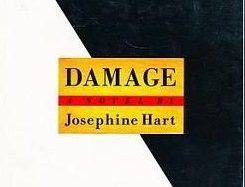
One of the most auspicious debuts in published fiction this year is Josephine Hart’s brisk novel, Damage. Critical plaudits and advance publicity have lifted the slim volume into various top-selling lists.
Indeed, the almost indecent haste of its arrival has been pejoratively associated with the author’s marriage to London public relations doyen Maurice Saatchi, to whom the book is dedicated.
However, most readers will find the association irrelevant. Damage stands quite assuredly, thank you, on its own merits.
Certainly, Carol Devine Carson’s cover design is enough to prompt book store browsers to pluck Damage off the shelf.
A detailed footnote also points out that Bembo type, “sturdy, well-balanced and finely proportioned” was selected for the text but if you think the reference meaningless, it does emphasize Ms. Hart’s attention to style and underlines her unitary approach to form and content.
Written in the first person and set in London, the author assumes the anonymous narrative role of a relatively successful politician. He has a socially approved marriage with a beautiful wife, Ingrid, one enterprising son, Martyn and one attractive daughter, Sally. He is happy, or thinks he is. But in middle age he begins to regret a lack of passion in his life. Despite material gains he wonders whether he has truly lived.
His musings cease when he meets Anna Barton. In Anna he finds his soul mate.
They share instant empathy, which immediately and explosively yields to a sexual and consuming passion. The only problem is that Anna is Martyn’s girlfriend.
The narrator’s desire for Anna is unquenchable. For Anna, he fills a part of her life, as does Martyn – to whom she becomes engaged – and a previous lover, Peter.
Her murky childhood has, she claims, left her damaged. “And damaged people are dangerous,” she wars.
And so Damage weaves an intriguing web of deceit, of rivalry between father and son, of delusion between private and public lives. It constructs a view of the world from the perspective of a mind beset by passion, where passion is a destructive, obsessive, if not addictive force.
Significantly, the psychological voyage in Damage is convincing enough to overcome any initial distraction the reader has in knowing the male narrator was created by a female author.
Ms. Hart’s style, particularly her usage of the first person, is reminiscent of John Banville’s Booker-nominated The Book of Evidence, the humor a little less quirky perhaps, but with provocative insights freshly revealed. Sentences are short and direct, chapters seldom go beyond three pages. It reads quickly, easily. You are encouraged to turn the page.
On occasion, however, the dialogue does convey a clunky philosophy out of sorts with the book’s naturalistic tone. For instance, “I have no children,” said Wilbur.
“Maybe that’s why I’m always examining them in my writing. And what obsesses you, Martyn? A writer is always obsessed by something.”
“I’m obsessed by the subject we have just been discussing. Truth. I’m obsessed by the question of whether it exists as an absolute. Can a liar be giving the most accurate description of someone else’s reality? That’s why I love journalism. It’s the perfect training for what I want to explore as a writer.”
Martyn’s voice continued, but I was unable to absorb his words. Stunned by admiration and jealousy, I realized that my son, cloaked in his own reality of beauty and intelligence, had become at last and most dangerously my rival.
The only disappointment in an otherwise beautifully crafted story is a melodramatic turn that arrives with the thud of a deus ex machina landing onstage. Elsewhere, however, there are passing gems that, for their economy, recall Edmund Burke or Wilde. She writes, “I did not die in my fiftieth year. There are few, who know me now, who do not regard that as a tragedy.”
With a first novel like Damage there is little question that the author from Mullingar, County Westmeath, is a major new voice on the literary scene. Ms. Hart, who has achieved notable successes in theatrical production and publishing, makes her point in 198 pages.
The book is now being adapted for film by celebrated French director Louis Malle, with Oscar-winning British actor Jeremy Irons tipped to land the central role. Shooting begins in London in October and Ms. Hart has already discussed the adaptation with Malle. “It was so wonderful to learn more about my characters from him, to examine even further what the book was about,” she said
Her next work will be awaited with anticipation by her newfound admirers.
Editor’s Note: This article was originally published in the July/August 1991 issue of Irish America. ♦
Leave a Reply