
Sometimes it all just works. Or as Shannery O’Connor wrote, quoting Teilhard de Chardin, “Everything that rises must converge.”
It did— rise and converge that is—at about 1:35 p.m. during the lunch held at New York University on May 20 to announce the establishment of Ireland House, the University’s new center for Irish studies, made possible by a grant from Lewis L. Glucksman and his wife Lorretta Brennan Glucksman. The moment came as the Taoiseach (Irish Prime Minister) Charles J. Haughey concluded his speech celebrating “the opening of a bright new chapter in the history of cultural and academic links between Ireland and this great city of New York.”
That afternoon high above Washington Square Park, satisfied by Irish salmon and good white wine, there was a sense of barriers transcended.
The family of immigrants cast in bronze by Eamonn O’Doherty of Derry and presented by the Taoiseach as a gift from the people of Ireland served to bend time. No one there with forebears from Ireland could not but think of them and feel their presence. The survivors of the famine ships, the bright lads who came over and ended up fighting in the Civil War or riding the plains in the cavalry, the maids and the railroad workers. The men who dug the canals or farmed in obscure parts of the United States all were there too, All listened to the Taoiseach of Ireland speaking to their children’s children.
After he had said all that was in the prepared text, the Taoiseach recited a poem from the 9th century written by a monk in an isolated monastery about his only companion Pangur Ban, his cat. I and Pangur Ban, my cat/Tis a like task we are at;/Hunting mice is his delight/Hunting words I sit all night. The Taoiseach recited the poem in old Irish and then in English.
Better far than praise of men/ Tis to sit with book and pen/Pangur bears me no ill-will/ He too plies his simple skill. Practice makes “Pangur perfect in his trade” While the monk gets, Wisdom day and night/Turning darkness into light.
What mysterious Providence ensured that the jottings of a scholar of Carinthia’s monastery would be recited in New York in 1991?
Darkness does get turned into light, the spiritual and material meet and mingle.
The Taoiseach said he added the poem because he felt it spoke to the “sincere and genuine interest in Irish culture in the United States on a level and at a depth that is gratifying and in some ways surprising.” After all many Irish Americans are a long time gone and many champions of things Irish have ties that do not depend on blood.
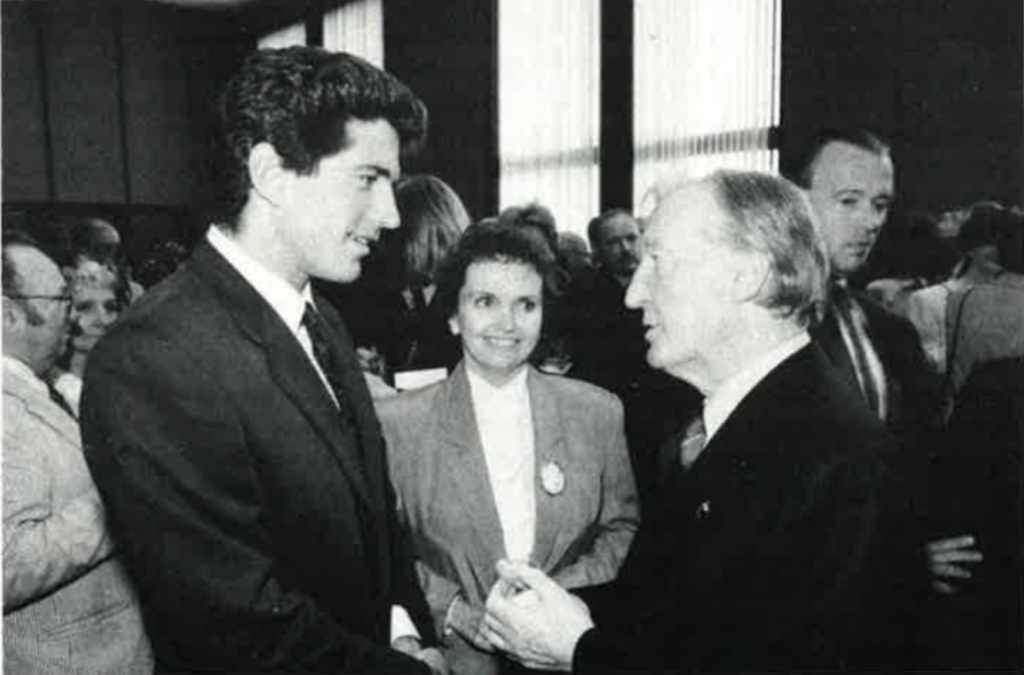
What brought people together that afternoon mattered less than what happened there. When John F. Kennedy, Jr. and the Taoiseach smiled at each other and shook hands it seemed separations were measured only in moments. It was their first meeting but it recalled one other encounter. When President John F. Kennedy met President Eamon de Valera he remarked that if the Irish President had remained in the Brooklyn of his birth and Patrick Kennedy had stayed in the Wexford of his, perhaps their positions would be reversed.
Perhaps Ireland House will be a place to ponder such things.
“The creation of Ireland house will be a wonderful academic and cultural addition to NYU, “John Kennedy, Jr. said quietly as he left.
Commissioner Carol O’Cleireacain summed up the occasion simply. “I found it incredibly moving.” Robert Kennedy’s daughter Courtney agreed, “It was a wonderful Irish moment.” And so there are days when the sun dives out the clouds and the joys and sorrows of the past are transformed and made present. “All that rises must converge.” Maybe such knowledge would hearten those who left Ireland sadly and will encourage those who remain. If physics and theology say the barriers between the spiritual and the material can be abolished surely a mere ocean is no obstacle at all.
Maybe in some counter-universe Pangur Ban still hunts his mouse, the monk his words and both will somehow be here at Ireland House turning darkness into light.
Loretta Brennan Glucksman
“Of course my father would have been very pleased to see this day but really it’s my husband Lew who has pursued the dream of Ireland House,” Loretta Brennan Gluckman told the N.Y.U. luncheon guests. The woman whose name will adorn Ireland House traces her family’s roots to Donegal and Leitrim. Born in Allentown, Pennsylvania she became a documentary filmmaker who worked with the Public Broadcasting System at WNET Channel 13. Presently she is president of Westlands Associates, a governmental and public relations firm and serves on the Arts and Science Board of Overseers at NYU. Her husband is vice chairman of Smith Barney, Harris Upham and Company. An NYU alumnus of the Graduate School of Business Administration he is a trustee of NYU and a member of the faculty. But in Ireland he is often taken for a native.
“Put a cap on Lew, give him a pipe and people think he is Irish. We were in a pub in Ireland,” Mrs. Glucksman said, “the locals asked me where my people came from. I told them Leitrim and Donegal. Then they asked Lew what county he was from. ‘County Jerusalem,’ he said. ‘And why not?’ was the reply.”
L.J. Oliva, Chancellor and President-elect of N.Y.U.
Chancellor and President-elect Jay Oliva of NYU, in his introductory speech, tried to explain the deep fascination Ireland held for members of the NYU community. Some saw in the history and culture of Ireland “special keys to the human condition.” Others “were caught up with the Irish way with words and language and entered through Irish letters into the human spirit,” and “there are some,” Chancellor Oliva continued, “myself strongly among them whose involvement comes through family and who entered therefore, through the human heart.”
When Jay Oliva was growing up in Ulster county New York, his mother gave him a choice. He could learn step dancing or the bagpipes. “I chose the pipes,” he said. It’s probably going too far to attribute his recent appointment as President of New York University to bagpipes but NYU does have a new corps of Pipers who played at commencement this year and they opened the celebration of the announcement of the Loretta Brennan Glucksman Ireland House.
Family did figure directly in Dr. Oliva’s active support of the Ireland House, both his mother and his wife are of Irish descent as he told the luncheon group in Irish.
Is la mor speisialta an la seo domsa mar b’as iarthar na h’Eireann mo mhathair agus b’as ceatharlach muintir mo mhna cheile, Mary Ellen.
“My mother’s family are from the Gaeltacht in Galway,” he told Irish America.
“There’s also a connection with Stokestown in County Roscommon.” And my wife’s grandfather was an Irish lumberjack in the Adirondacks.
In addition to Irish, Dr. Oliva leamed a love of traditional music from his mother.
“For years I sang in a trio called The Men of the West. We performed in pubs in New York at Flannagans and the Glocamorra. And this was while I was a professor and then a dean at N.Y.U. But we got so interested in Irish language singing that we became more of a concert group performing at colleges.”
Dr. Oliva did not grow up in a particularly Irish area. His mother’s father, Richard Rooney settled near Kingston New York in Ulster County and took up blacksmithing. His mother’s mother, Julia Feeney Rooney, was appointed by Calvin College to be the first female postmistress in the United States. His grandfather ultimately became a justice of the peace. His father’s family came from Genoa.
“There has always been a story in my family that we are descended from Spanish map makers who scattered to various coastal towns to pursue their trade. I was somewhat skeptical but recently I saw a history of 15th century maps and they were marked ‘Oliva.’”
Map makers. Genoa. Did they help Columbus perhaps? “Maybe.” Dr. Oliva said. “But I was told in Ireland that Columbus came there to study manuscripts that mentioned St. Brendan’s voyage. I believe that there is a note to that effect in the archives of University College Cork.”
Dr. Oliva’s own voyage began at Manhattan College. He graduated in 1955 and received a graduate fellowship at Syracuse University. “I intended to study French history,” he said, “but I was the first Catholic to reach this fellowship. I was not welcome in all quarters. I was directed to Warren Walsh, who was of Irish descent although not a Catholic. He took me into the Russian Department. So I became a professor of Slavic studies. In such ways are our lives shaped by prejudice.” After studying at the University of Paris, Dr. Oliva joined the faculty of NYU in1960. When he was named president-elect it was the first time a president of the university had come from faculty ranks.
Dr. Oliva says that Duncan Rice, dean of the faculty of arts and science, is someone whose direction, “now and in our future involverent in international affairs and especially in the new Europe will be a hallmark of this university.” The programs are scheduled to begin in October but Ireland House itself will not open until next spring. So Chancellor-President-elect Oliva still has time to practice his step-dancing.
Editor’s Note: This article was originally published in the July/August 1991 issue of Irish America. ♦
Leave a Reply