
October 6, marks the 100th anniversary of the death of Charles Stewart Parnell-the uncrowned king of Ireland. Born in County Wicklow in 1846, son an Anglo-Irish landowner and an American mother he might easily have led a life typical of his class – instead he gallantly tried to improve the lot of his fellow Irishmen. He was elected to parliament in 1875, where his obstructionist tactics forced attention to Irish affairs. In 1879, he became leader of the Land League and in 1880 the head of the Irish parliamentary party. By 1885, Parnell’s party held a balance of power at Westminster and Home Rule for Ireland seemed inevitable. In 1889, however Parnell was cited in a divorce action by the MP husband of Kitty O’Shea. His supporters split over the scandal. The sanctimonious prime minister Gladstone called for his resignation, and the Catholic church waged an all-out war against him. In 1890, Parnell was voted out of leadership. It was the end of Parnell and the end of Home Rule for Ireland. In the following feature, writer Sean Cronin uses a long-forgotten diary plus a newly released novel to chronicle the events which led to the fall of the great Irish leader.
The Bishops and the Party
That tragic story made,
A husband that had sold his wife
And after that betrayed;
But stories that live longest
Are sung above the glass,
And Parnell loved his country,
And Parnell loved his lass.
-William Butler Yeats
The death of a hero is the subject of drama. In Greek tragedy the hero’s fall is caused by a flaw in his character. The drama ends in the hero’s defeat and ritual slaying.
Charles Stewart Parnell died at the age of forty-five within sight of his goal-an all-Ireland Parliament. As leader of the Irish nation, Parnell was irreplaceable. His last battle began on December 6, 1890, when the Irish Party split, and ended on October 6, 1891, with his death.
The Irish leader’s nemesis, William E. Gladstone, the leader of the British Liberal Party, confessed to Barry O’Brien, Parnell’s first biographer, in 1897: “Parnell was the most remarkable man I ever met…. Ah! had Parnell lived, had there been no divorce proceedings, I do solemnly believe there would be a Parliament in Ireland now. Oh! It was a terrible tragedy…. What was my position? After the verdict in the divorce case I received letters from my colleagues, received letters from Liberals in the House of Commons and in the country, and all told the same tale: Parnell must go…a marvellous man, a terrible fall.”
Did “the bishops and the party” destroy Parnell to appease Gladstone? That sanctimonious statesman was concerned about his Nonconformist constituency – “the backbone of the Liberal Party.” The bishops were worried about their loss of political power in Irish politics, plus the O’Shea divorce case.
The late F.S.L. Lyons, the historian-biographer of Parnell, quotes the Methodist Times of November 20, 1890, thus: We do not hesitate to say that if the Irish race deliberately select as their recognized representative an adulterer of Mr. Parnell’s type they are as incapable of self-government as their bitterest enemies have asserted. So obscene a race as in those circumstances they would prove themselves to be, would obviously be unfit for anything except a military despotism.” [Parnell, p. 487].
On November 25, 1890, the Irish Party re-elected Parnell as chairman by acclamation. The next day, Gladstone’s letter demanding Parnell’s resignation appeared in the press. A key passage said Parnell’s continuance at the present moment in the leadership would be productive of consequences disastrous in the highest degree to the cause of Ireland.” Gladstone, too, might have to resign. Without Gladstone, there would be no Home Rule.
On November 30, Archbishop Walsh of Dublin warned: “If the Irish leader would not or could not, give a public assurance that his honor was unsullied, the party that takes him or retains him as its leader can no longer count on the support of the bishops of Ireland.” On December 3, the bishops condemned Parnell.
On December 6, forty-six Irish MPs walked out of Committee Room 15, led by Justin McCarthy, the vice chairman of the party, and 26 remained with Parnell.
That was the split. Of the eighty-six Irish MPs, five were ill, one was in prison, six were in America and one seat was vacant.
The six in America were John Dillon, William O’Brien, T.P. O’Connor, T.D. Sullivan, T.P. Gill and Tim Harrington.
They supported Parnell initially. Harrington’s diary of the tour – which I have read thanks to Frank Durkan-supports the Parnellite contention that it wasn’t the O’Shea divorce that upset the majority of the Irish MPs, but Gladstone’s ultimatum to drive Parnell from the leadership of the Irish Party.
Before leaving New York this morning I saw Mr. Gladstone’s letter practically calling for Parnell’s retirement,” Harrington, a Parnellite, wrote on November 26.
Dillon regarded it as a most important and momentous document; I could see that his view of the present position of Irish politics is very much altered by it.” In Chicago on December 1, Harrington experienced “the strong hold Parnell has on the affections of the people here. Nearly all the prominent men who had threatened opposition to me if I came to Chicago have called to express their regret, and to thank me for my defence of Parnell. They express their determination to put on a meeting here in support of Parnell, but I endeavor to dissuade them from taking any course which would widen the breach.” On reading an Associated Press report on the looming split in the Irish Party, Harrington remarked: “[Tim] Healy and [Thomas| Sexton are both bitter towards Parnell. I am not sorry. This bitterness will rally opinion to Parnell’s side in Ireland…” Tim Healy of the bitter tongue schemed with William Martin Murphy and Archbishop Walsh to depose Parnell. What has Archbishop Walsh to say to Parnell’s conscience or Parnell’s morality?” Harrington writes. “Will he refuse Home Rule until he ascertains that the canting hypocrites who will vote for it among the English Liberals are all a race of Godly men? Such an attitude is unworthy…”
On December 2, John Devoy called on Harrington to express regret for a recent press attack he made on him. “[Devoy] assured me that he heartily endorsed my support of Parnell. December 3. All day I received messages of congratulation from different quarters, which convince me that the genuine expression of Irish feeling is with Parnell…. The evening papers bring us the news that the Irish bishops have pronounced against Parnell [and] have based their opposition… on moral grounds.
“December 5. The news from London this morning brings early intelligence that the committee appointed by the [Irish] Party called upon Gladstone. What a sad spectacle for an Irishman to contemplate.The once great Irish party literally bearing their chief along in fetters and placing him at the feet of Gladstone and asking, ‘How much will you give for this man?’ December 12. Have several callers during the day who warmly express their approval of my effort to sustain Parnell.Several delegations have also called upon me to testify their devotion to Parnell.” Sixty men “came to mark their respect for me and their approval of my attitude in holding by Parnell.”
Before sailing home, William O’Brien “impressed upon me to explain to Parnell how they deprecated the attacks upon him and hated finding themselves in association with Healy, Davitt and the bishops in that attack and that they will be most ready to entertain any proposal for peace that he makes…’T.D. Sullivan’, Healy’s uncle, ‘is as usual grossly offensive in his abuse of Parnell’… I feel very glad I am not to have his company during my trip… and he tortured me with such stuff.”
Harrington returned to help Parnell in the Kilkenny by-election, the first opportunity for the Irish people to decide for or against their leader. The local bishop reported to Archbishop Walsh: “The lowest dregs of the people, the Fenian element, and the working classes are all to a man with Parnell; the clergy to a man were against him. The priests won.”
Tim Harrington told William O’Brien of “the saddest sight” he ever saw in Ireland: “In every polling-booth at the division a priest sat at the table as a personation agent,” and in Kilkenny, as James Joyce wrote: “’Twas Irish humor wet and dry/Flung quicklime into Parnell’s eye…”
Joyce and Yeats kept the memory of Parnell green. In A Portrait of the Artist as a Young Man, young Stephen’s Christmas dinner becomes a battleground when there is mention of Parnell and how the priests betrayed him. “Ivy Day in the Committee Room,” in Dubliners, draws on the memory of the Chief. The fallen leader is a political theme and a presence in Ulysses when Leopold Bloom remembers picking up Parnell’s hat and handing it to him.
Maud Gonne claimed a star fell as Parnell’s body was lowered into the grave at Glasnevin. Standish O’Grady said, “the sky was bright with strange lights and flames.” Yeats wrote to his sister: “The Funeral is just over. The people are breathing fire and slaughter. The wreaths have such inscriptions as ‘murdered by the priests’…..”
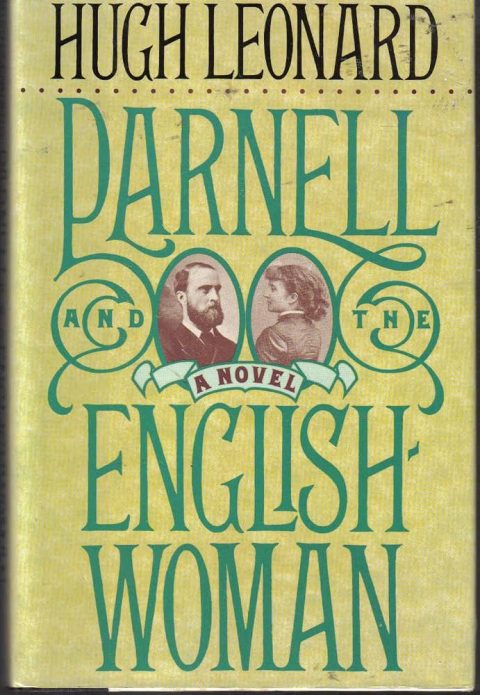
Parnell and the Englishwoman is Hugh Leonard’s first novel. It deals with events that stirred fierce passions in Ireland. The “Englishwoman” is Mrs. Katharine O’Shea, wife of Captain William O’Shea, the son of a Dublin solicitor, quondam officer of Hussars, Whig MP for Clare and later Galway, and man-about-town-with-out-means. His wife was the daughter of an English clergyman-the sister of a Field Marshal and heiress of an aunt whose money kept their marriage going. If it collapsed she’d be disinherited.
Her affair with Parnell began in 1881.
She and the Captain lived apart but stayed friendly. O’Shea had to be aware of Parnell’s liaison with his wife. There could be no scandal while “Aunt Ben” was alive.
Captain O’Shea did not sue for divorce until 1889. The suit was uncontested. A decree nisi was granted and in due course Katharine–no one ever called her “Kitty” except Tim Healy and Parnell’s hecklers–married her lover.
Hugh Leonard has written a whopping good story, based on wide research and a made-to-order plot, all of it true. Parnell is the hero, Tim Healy the villain, which raises the question, why not write a drama about the tragedy of Parnell?
Mr. Leonard, the author of “Da,” is a distinguished playwright. He creates rounded characters and writes sparkling dialogue for them. He writes with verve and economy. He has the dramatist’s ability to set scenes and the script writer’s eye of the camera. Perhaps he’ll turn it into a screen play, or a television “docudrama” about the rise and fall of the Irish party which Parnell’s genius and iron will made a political force.
As for Parnell, it is true as Yeats wrote: “He fought the might of England And saved the frish poor, Whatever good a farmer’s got He brought it all to pass….”
Parnell united constitutional and revolutionary nationalists, some though not many Ulster Protestants, priests and even a few bishops – Archbishop Croke of Cashel, who turned against him in the end, was one – as he campaigned to make the tiller of the soil the owner of the land and the Irish people self-governing. He converted Gladstone, who converted most of the Liberal Party, though not Joseph Chamberlain, to Home Rule for Ireland in 1886.
Unlike his successors, Parnell did not believe that England would give anything to Ireland, except what it was forced to give. He acted accordingly.
Chamberlain compared Parnell to Napoleon. “He allowed nothing to stand in his way,” he told Barry O’Brien. “He stopped at nothing to gain his end. If a man opposed him, he flung him aside and dashed on. He did not care. He did not harbour any enmity. He was too great a man for that. He was indifferent about the means he used to gain his object.”
Parnell and the Englishwoman, a novel, by Hugh Leonard. Published by Atheneum, New York, 1991, 265 pages, price $19.95.
Tim Harrington’s Diary is housed in the National Library in Dublin, Ireland.
Editor’s Note: This article was originally published in the October 1991 issue of Irish America. ♦
Leave a Reply