
This Business 100 issue is the largest we have published in the history of our magazine, clear evidence – if any was needed — of the strength and vitality of the Irish American business community.
We are proud to bring you this issue, and wish to give heartfelt thanks to our major sponsors, the Industrial Development Board for Northern Ireland, Waterford Crystal, the Irish Trade Board and the Bank of Ireland.
Last year when we set out to discover successful Irish Americans in business, we were embarking on an uncharted course. We all know that the drinkers of green beer identify with being Irish on St. Patrick’s Day. But would the wearing of the green mean anything in the boardrooms of corporate America? That was the question.
The answer is an unswerving “yes,” as this issue readily illustrates. Each member of the Business 100 has made clear his or her Irish sensibility by completing our eligibility form. And, indeed, many have called personally to say what an honor they consider it to be named to this list.
It is gratifying to note that following the publication of the 1990 Business 100, an informal network of Irish American business chiefs began to form. It has been noticeable that a number of business leaders, who declined inclusion in the 1990 list, responded in the affirmative on this occasion.
As was the case last year, once again we have extensive profiles of a number of the Business 100. We believe their stories reflect both the success of the Irish in business and the extraordinary strength of personality and commitment that the Irish bring to their work.
When you read through this list, remember that only a generation or two ago their forebears would have considered any white collar job a major achievement. Remember, too, that the last ‘No Irish Need Apply’ sign came down around 1925, a short lifetime ago, and that the corporate world was the last great bastion that Irish Americans had to breach.
Recall also the generations of Irish who made great sacrifices in order to provide opportunity and education for those who made it to the top. If there is a single thread running through the Business 100, it is a respect for and acknowledgement of education and family as intrinsic to their success.
“Family values” may be an outmoded concept in the modern era, but many among the Business 100 give personal testament to the link between a close family, a love of learning and their own outstanding success.
This year, there are over 50 new members in the Business 100.
As with last year’s list there may be people omitted who were worthy of nomination. Please bear with us. This is, by its very nature, a fallible list and the research involved is extensive. This year’s list has been culled from over 600 recommendations and at least 1,000 other candidates turned up by our research.
A special word of thanks here to Marianne Delaney who worked tirelessly to ensure that this list would be as complete and accurate as possible.
Our one hard and fast rule still applies: there is no-one on the list who has not filled in the eligibility form and approved their inclusion. We have also respected the wishes of those business leaders who want to remain out of the limelight.
We have highlighted several people, not because they head major corporations, but because they are businessmen and women who add greatly to the list because of their activities on behalf of worthy Irish causes, or simply because they have very interesting stories. As was true last year, there is a dearth of women on the 1991 list.
A recent Fortune magazine survey, showing that only three percent of top corporate jobs are held by women, is inevitably reflected in this list, though we are delighted to note that the female representation has increased this year.
We intend to take another obvious step with our Business 100 – in 1992 Irish America will bring a group of these dynamic people to Ireland, North and South, at the invitation of the governments of the Irish Republic and Northern Ireland.
This will be more than an exercise in roots’ replenishment, however. With unemployment at 20 percent in the Republic, and 15 percent in the North of Ireland, there is a clear case for Irish American know-how to be tapped into for the benefit of the economies of Ireland.
There is a precedent for this endeavor among Irish American politicians, who have performed admirable work for Ireland. Most recently, the International Fund for Ireland, with its $120 million aid package, has helped economically distressed areas on both sides of the border.
In a different arena, the Immigration Act of 1990 has been of immense benefit to immigrants who are living in the U.S. illegally because of economic conditions at home. That legislation could not have been achieved without the help of the powerful Irish American political lobby.
Thus, the journey to Ireland in 1992 will serve as a valuable benchmark for assessing how the business acumen of Irish America could be harnessed to help Ireland. If that is possible, then the Business 100 will have been more than worthwhile.
We are proud to bring you Irish America magazine’s 1991 Business 100.
To view the Business 100 1991 honorees, visit page 34 in our 3D FlipBook.
Who They Are….
A word to the wise: success in corporate America is not disconnected to long-term commitment. At least that is the case among our particularly loyal gathering of executives.
A full 34 percent, or just over one-third of this year’s ‘Business 100’ have spent their entire career at the same company.
Sixteen percent have founded or co-founded the companies which they now lead, and an additional five percent are running companies which were founded by their families.
If this all sounds a bit too permanent or predestined, take heart. One of our most successful CEOs is also the most eclectic. With the briefest tenure status on the list, he has, in a relatively short period, attended college on a football scholarship, earned a law degree, chaired one of the nation’s largest transportation operations and just taken the helm of a huge energy company ranking among Fortune’s top 25.
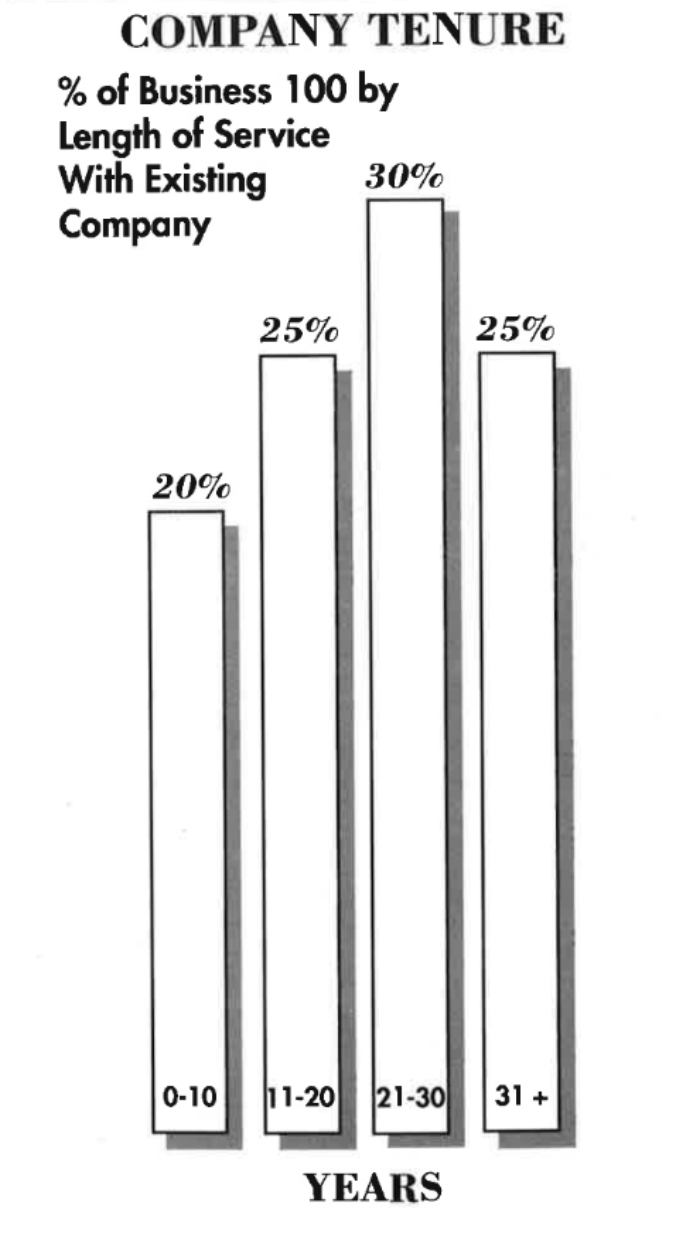
But dedicated tenure serves most of us mere mortals well, and of this year’s Business 100, 55 percent have been with their companies for longer than 20 years, while a solid one-quarter have served one company for over 30 years. Eighty percent have stayed put for more than a decade.
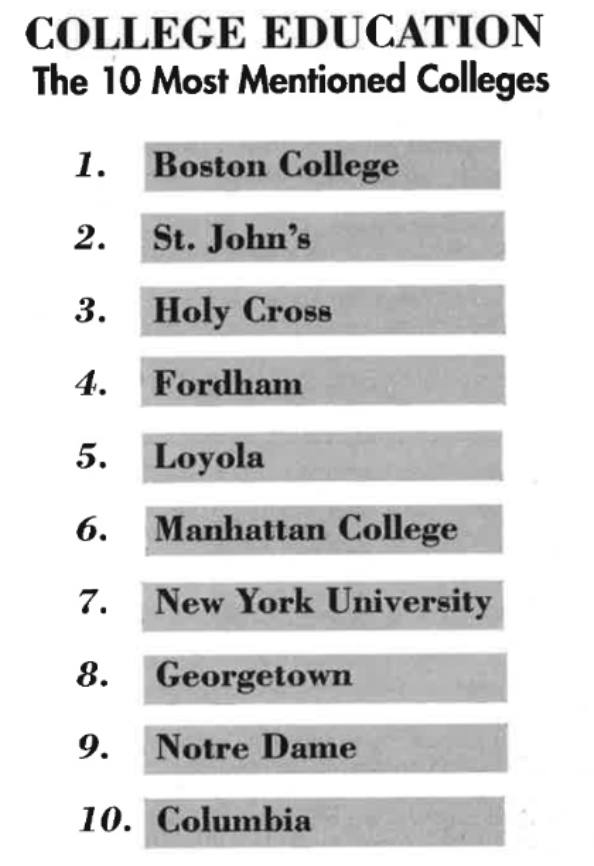
Far more of our executives have been educated at Jesuit institutions than Ivy League colleges, but 20 percent of the ‘Business 100’ attended city or state universities as undergraduates. The most mentioned alma mater is Boston College, followed closely by St. John’s, Holy Cross, Fordham and Loyola.
Manhattan College, New York University, Georgetown, Notre Dame and Columbia fall next in place, followed by Williams, Princeton, Yale, Dartmouth, Northwestern and Michigan State.
Of the 53 percent who pursued graduate studies, one-third did so at Harvard. New York University, Wharton Business School, Columbia, Loyola, Case Western and the City University of New York follow in grad school attendance rank.
Areas of graduate study consistently bear a direct relationship to present careers, excepting the 10 percent who completed law degrees, only one of whom is practicing law. Of those who mention specific undergraduate majors, one-quarter concentrated in non-career-related subjects, while another 25 percent received degrees in the technical or practical ends (e.g., engineering, telecommunications, journalism) of the industries which they now serve in executive management capacities. But business and business-related areas such as economics, finance, marketing and management dominate the overall educational paths.
Forty-three percent of the ‘Business 100’ have MBAs, and more than one-half have completed some graduate-level business studies.
On a more personal front, 80 percent of the ‘Business 100’ are parents. More than half of them have at least four children, while over one-third have five or more. One honoree prides himself as the father of eleven; luckily he’s in the sneaker business.
More than half of the men and women profiled fall into the 51 to 60-year age bracket, with a fairly even distribution of the remaining 47 percent on either end of that mean.
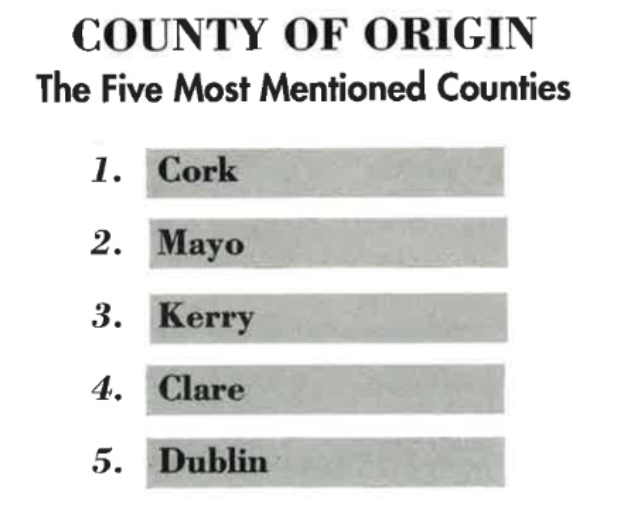
Those whose grandparents came from County Cork or Mayo form the most typical Irish ancestry picture within the ‘100.’ Cork, with more than twice the emigration of any other county from 1850 to 1920, ranks first in origins among the ‘Business 100’ for the second year in a row.
Kerry, which tied Cork last year and historically ranks second in emigration figures, takes third place as the ancestral home of this year’s honorees. County Mayo, historically ranking seventh in emigration, rises to a surprising second place from fourth on our 1990 list. Following in frequency of origin and generally coinciding with historical records, are Clare, Dublin, Tipperary, Sligo, Galway, Limerick and Roscommon. Though a county’s population base might explain a higher emigration level, Cork, Kerry, Clare, Tipperary and Limerick historically had the highest percentages of emigration per capita as well as generally high numbers.
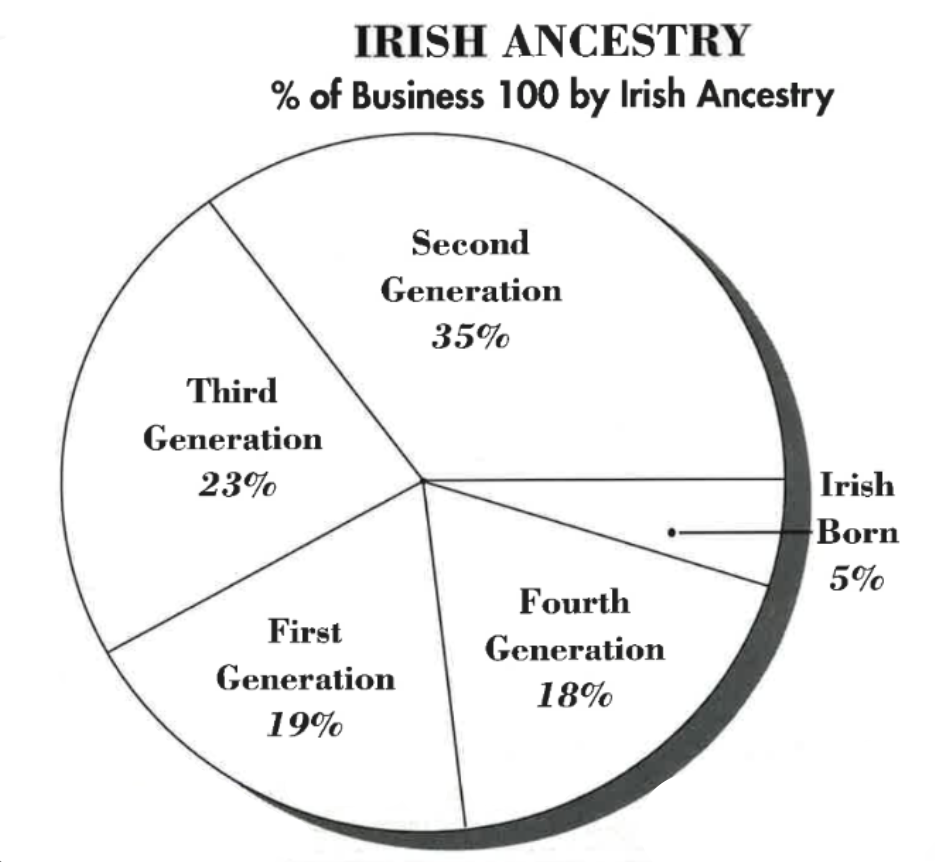
Second-generation Irish comprise the largest segment of the ‘100’ at 35 percent, while sons and daughters of immigrants, or first-generation Irish Americans, account for nearly 20 percent of the overall. Five on our list are Irish born, while 23 percent are third-generation and 18 percent are four or more generations removed from Ireland.
Of the 36 percent of the ‘Business 100’ who are affiliated with Irish organizations, most serve on the boards of the Ireland Chamber of Commerce in the USA (ICCUSA) or the American Ireland Fund. Co-operation Ireland and the all male bastion of the Friendly Sons of St. Patrick are next in popularity. Other organizations mentioned are the Irish Arts Center, the Irish Youth Fund, the American Irish Historical Society, the Irish American Cultural Institute, the Irish Fellowship of Chicago, the Ireland-U.S. Council on Commerce and Industry and the Wild Geese.
A total of seven females in the ‘Business 100’ reflects the unflinching confinement of women to the middle and lower ranks of management within the corporate arena. Although women comprise 40 percent of all executive, management and administrative positions in the business sector; senior levels of management are still almost exclusively male domains. The Feminist Majority Foundation’s 1991 report on top executive officers at Fortune 500 companies reveals the staggering reality of the corporate gender gap: 97.4 percent male/ 2.6 percent female.
Editor’s Note: This article was originally published in the October 1991 issue of Irish America. ♦
Leave a Reply