
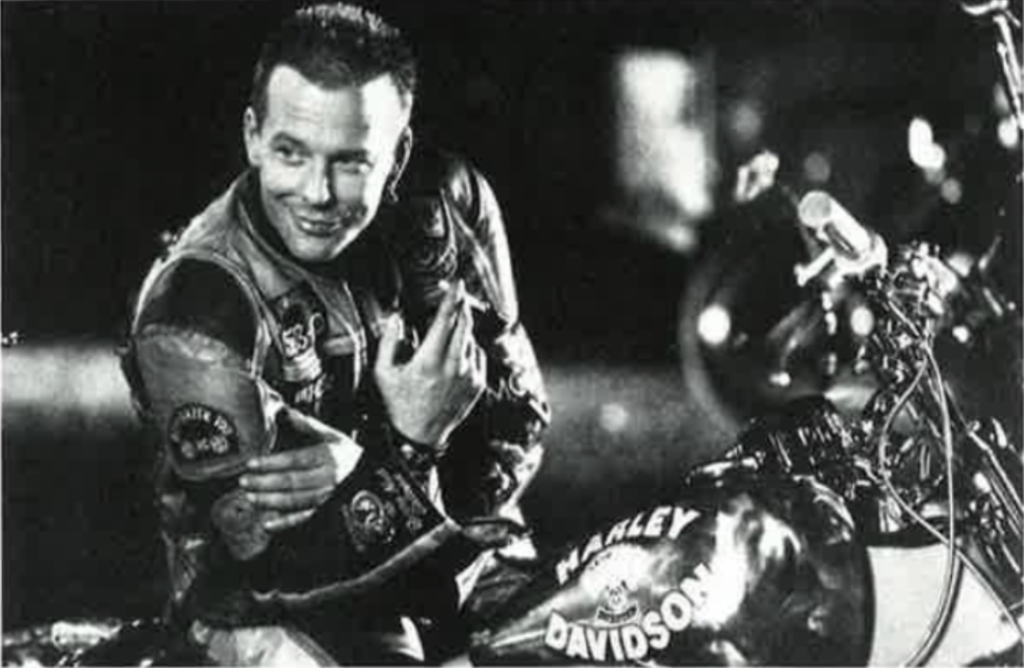
Mickey Rourke’s latest movie, Harley Davidson and the Marlboro Man, seems like yet another low point in his faltering career.
We first see Mickey Rourke in a darkened bedroom pulling a tight tee-shirt down over his muscular chest. Then the leather biker jacket. As he opens the door of the room to leave, he turns to look back and we see a naked woman turning in the bed to look wistfully after him.
We cut to Mickey on his motor bike — erect like John Wayne on a horse – heading on down the highway. Then Mickey – all spiky hair and earring — walking into a convenience store. Right into a bunch of young punks in the middle of a stick-up. Mickey ignores them until one of them puts a gun to his head.
Now Mickey is really pissed. So pissed that Mickey becomes Clint Eastwood. “If I had a nickel for every asshole who stuck a gun etc., etc.,” he says, before dispatching the villains. The girl behind the counter is mightily impressed. As Mickey exits, she is positively drooling. “Hey, mister, you got a name?” she asks. Mickey turns,
“Harley,” he says, “Harley Davidson.” We backtrack a little. There was a time when Mickey Rourke was being spoken of as a young man with the potential to be a new Brando. It was not idle talk. There were his first memorable parts in Body Heat, Diner, Rumble Fish and Pope of Greenwich Village. Rourke had an understated presence, a power that placed him apart.
Apart from a couple of notable performances since (Barfly and Angel Heart) that potential has never been realized. In recent times the Rourke opus includes: Johnny Handsome, Homeboy, Francesco, Wild Orchid and Desperate Hours – neither Homeboy nor Francesco made it into commercial release in the United States.
Mickey’s latest string of movies should be an embarrassment to any self-respecting actor – and particularly to someone with the clout that Rourke can bring to a production.
Rourke used to complain that he was tired of being dictated to by faceless Hollywood bureaucrats who didn’t share his artistic values. Back in the summer of 1987 he talked to Irish America Magazine about his sense of rage at the way the Samuel Goldwyn Company had tampered with A Prayer for the Dying – a movie in which Rourke played an IRA man who attempts to flee the Northern Ireland Troubles only to find himself embroiled with a group of English gangsters. “I was disappointed and ashamed of it,” he said of the final product.
A Prayer for the Dying was a mess – part action flick/part melodrama. “I really thought that the movie was going to be a real opportunity to explain things. Now I think they just used my name to sell a commercial film that explains nothing,” he said. Rourke saw himself as an artistic rebel who was taking on the Hollywood system – from now on, he said, he was going to make movies that were creatively satisfying.
There was a strong indication that Rourke would do just that when Barfly was released, in which he is brilliant as a Charles Bukowski literary low life.
But the movie that would seem to define Rourke’s artistic trajectory was Homeboy, in which he gave a stupefyingly bizarre performance as a beat-up boxer fallen among seedy criminal types.
Rourke wrote the script and virtually controlled the movie. He stumbles through the movie, mumbling to himself in what appears to be some strange form of method acting. It was eventually released in video form in the United States.
In the same vein is, Johnny Handsome, in which he plays a disfigured gangster who, after receiving the benefits of plastic surgery in prison, seeks revenge from the former criminal partners who betrayed him. Like Prayer for the Dying and Home-boy, it features a vulnerable woman from whom the tough, macho Rourke seeks solace and understanding.
Around this time Rourke starred as St. Francis of Assisi in Lillian Cavani’s Francesco. This movie never saw the light of day in the U.S. either in a theatre or as a video. Suffice it to say that when it was shown at the Cannes Film Festival audiences laughed out loud. But it was not supposed to be a comedy.
Now comes the latest in a line of Mickey Rourke turkeys: a dumb biker movie in which Rourke hooks up with Don Johnson.
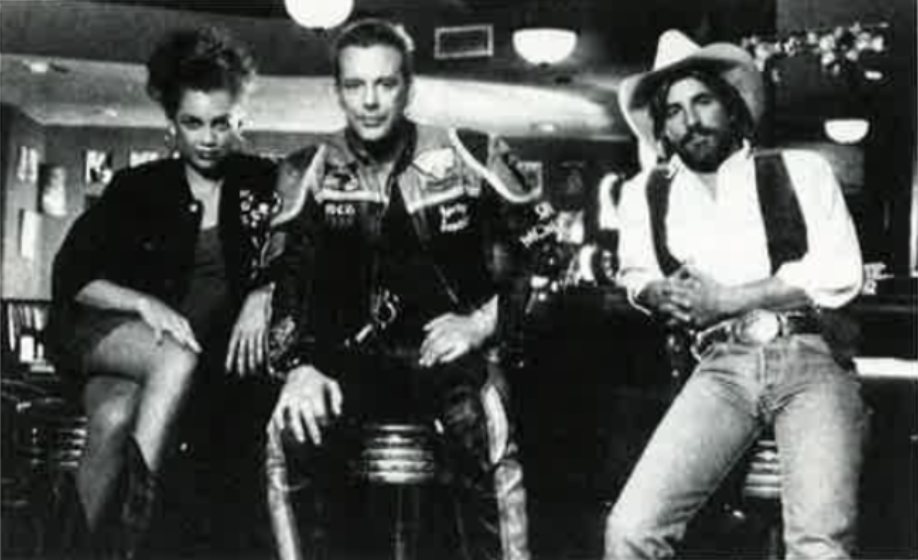
The publicity kit for Harley Davidson tells the story: “Harley Davidson (Mickey Rourke) is a philosophical drifter. His lifelong friend, the Marlboro Man (Don Johnson), is a former rodeo cowboy. They are both loyal and fearless, and they’re both dyed in the wool rebels. They never meant to rob a bank, but they did it for the right reason – to help their friend who was being strong-armed by bankers attempting to foreclose on their hangout, the Rock’n Roll Bar and Grill.”
The two buddies spend their time flying around on bikes with their guns blazing and having little discussions about the meaning of life. Mickey: “You ever think there might be something better.. like God. If there is, I’d like to meet the dude .. like, hang out with him.” Don: “It’s better to be dead and cool than alive and uncool.”
If this were a Prizzi’s Honor-like sendup of the macho/buddy movie these lines would be a must. It’s not. Mickey and Don are dead serious. The best that can be said about Harley Davidson is that it’s better than most things Rourke has been doing in the last few years.
(Except in France, where Rourke is second only to Jerry Lewis (for the Nutty Professor stuff, not King of Comedy) in American iconography, Harley Davidson and the Marlboro Man will probably be required study for film students for what it tells them about fin de siecle retro rugged individualism.)
Rourke has become a parody of himself.
In real life he has taken to his motor bike and the boxing ring. According to a recent profile in Vanity Fair (entitled ‘Fighting Irish’) Rourke’s ring performance is a bit like his recent movies. “Mickey sucks! Mickey sucks!” was the favored chant when he defeated a tired local heavyweight in Fort Lauderdale.
In Irish American republican circles Rourke attained a certain popularity ironically enough in the aftermath of the release of A Prayer for the Dying. While Rourke disassociated himself from the movie he also called for British withdrawal from Northern Ireland. During a press conference at the Cannes Film Festival, while he was promoting Francesco, he had a verbal row with some British tabloid journalists when he mentioned that he had donated money to Northern “causes.”
For the last few years Rourke has been consistently associated with attempts to put together a movie project based on the 1981 IRA Hunger Strike. Rourke says he wants to put together a deal to make such a film as well as act in it. That recent Vanity Fair profile mentioned that he was interested in playing the part of Bobby Sands.
Rourke was a guest of honor in New York last May at a commemorative event to mark the tenth anniversary of the Hunger Strike. The gathering seemed to be giving him a sort of political imprimatur to make the movie. On the basis of his work in the last few years it seems like a very risky endorsement indeed.
Perhaps Rourke is simply going through a bad phase – a sort of sowing of his wild oats before moving on to a more mature stage in his career. If this is the case he should make the transition sooner rather than later.
In the last scene of Harley Davidson Rourke is heading off on his bike (to find himself) when he spots a young woman (who could be the same one he started out with — in this movie they all look the same). “Where are you heading?” he asks her. “Nowhere special,” she says. “I’ll take you there,” Mickey intones. That’s for sure.
Editor’s Note: This article was originally published in the October 1991 issue of Irish America. ♦
Leave a Reply