
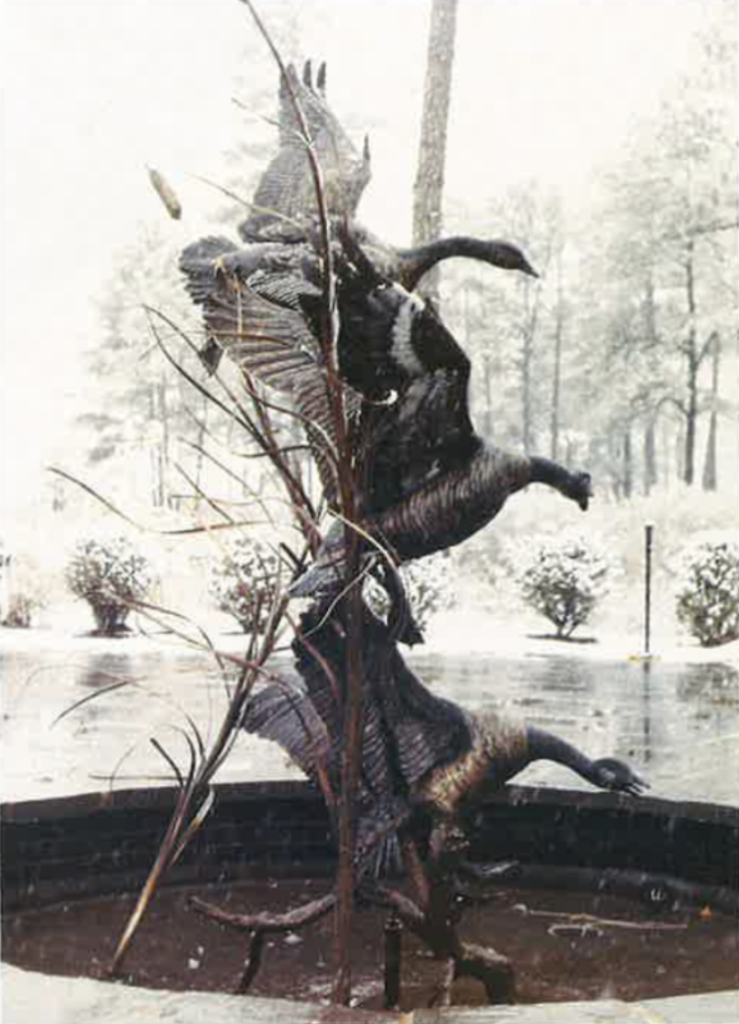
Was it for this the wild geese spread
The gray wing upon every tide?
-William Butler Yeats, September 1913
October 1991, marks the 300th anniversary of the Treaty of Limerick, which formally ended hostilities between the forces of King James II and those of King William of Orange. The exodus, which followed, of thousands of Irish soldiers and their families who would not swear an oath of loyalty to King William became known as the Flight of the Wild Geese. It was the end of an era and as Sean O’Faolain said, “It was all but the end of a race.”
The following is an extract from the recently deceased writer’s masterpiece “King of the Beggars.”
The wild geese come in their thousands with the October moon. They blacken the sky, and they cry the coming of Autumn.
Where there are low marshlands, or slob-lands, they settle down, and then the cabins are cooking them with much butter or grease in the bastables all the winter.
About the estuary of the Shannon, and all up the river into Limerick, they must have whizzed and moaned, that winter of 1691, when Ginkel offered the terms that ended the Jacobite War, and started bitter quarrels among the tired and tattered Irish. The flying Irish, down the Shannon or down the Lee with Sarsfield, looked up at the skies, and took the name, The Wild Geese.
It was the end of a period. It was all but the end of a race.
Some remained, but most went to France under their gentry, the Fitzgeralds or the Mountcashels – Ireland’s first French legionnaires. But older men remembered what had happened when thousands went to Spain after the Eleven Years’ War, and, remembering, they cursed at one another all along the battered bastions of Limerick, while the women, who had so gallantly flung down bricks and bottles at the attackers, sat and smoked, and were sullen.
When those earlier Wild Geese had fled, in 1652, the Cromwellian whores had taken the women and children and sailed them down the Shannon and the Lee to the Barbados. In their tens of thousands they had turned black under the sun-cooked in a Barbados bastable; or dead, their bodies blacker, or rebellious, their Irish bodies red from the whips. Wild Geese, indeed! Up and down they cursed, and quarrelled, and argued.
There were Diehards among them, “No surrender” men, gunmen who were to become Raparees, and rove the hills, and raid the settling conquerors, and sleep and be cold and hungry under the trees.
But whatever they did – it was the end.
They could not know that. It was, just the same, the end. For while Limerick emptied, whether to France or to the woods, Ireland was draining her jugular into the past. It might have been better for her if she had died outright. Instead she kept it up for a hundred years, the awful slow withering-away of the eighteenth century. Limb by limb she began to rot. Every single historian of that century has spoken of her in terms of some disease, and the best phrase of all says that she was like a body dragging itself about with one half already dead. That dead half was her past, alive only in the memory, and slowly rotting even there.
Editor’s Note: This article was originally published in the October 1991 issue of Irish America. ♦
Leave a Reply