
The Harvest is taken home, leaving the naked lands behind to blanch slowly in the closing fist of winter. One of the new sights in Connacht this year is the clingwrapped hay. The farmers are not making cocks and ricks any more. Many haysheds are empty. The new trend is the clingwrapped bales.
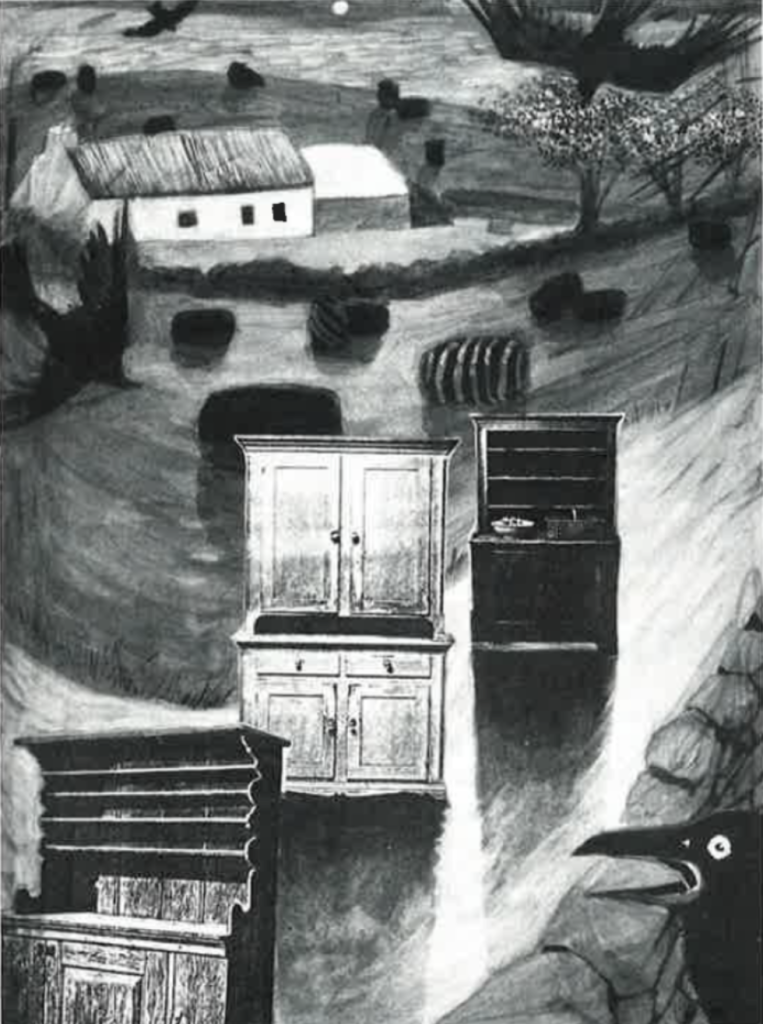
For a while, in the autumn, they were scattered through the meadows like giant black footballs. Now they have been moved down around the farmhouses. Often there are hundreds of them, squatting like shiny toadstools around dwarfed homesteads. There is as much hay in one of the big round black balls as would fill two or three of the traditional haycocks. In our climate, I’m told, they represent a Major Step Forward. That may be so but the down side of the development is that they are about as ugly a sight as you have ever seen. Somebody has described them as Mammoths’ Manure. I would agree with the description. Anything plastic is ugly. Against a pastoral backdrop like we have in the West the ugliness of the Big Bales is enhanced.
In Leitrim yesterday I saw a small farmhouse, with a thatched roof, a rare sight nowadays, and it surrounded and besieged by a battalion of Big Bales. What was even worse was that the grotesque hayballs had all been striped and daubed with white paint. Since other squattings of Big Bales around other farms are surrounded by taut strings bearing fluttering rags I take it that the painting is designed to prevent crows, rooks, and magpies from puncturing the plastic with their sharp beaks and letting in the weather at the golden hay inside. It all adds to the ugliness. There is always a price to be paid for progress, isn’t there? The West, these wintering days, looks like a scenic postcard over which somebody carelessly shook a fountain pen.
Only yesterday, it seems, the roads would be jammed in harvest time with cocks of hay being brought home to the haysheds on the backs of tractors. You cursed the bobbing cones when you got caught behind them on a narrow road.
Now that is not happening any more.
Extra manpower, extra tractors, were needed for the operation. Usually the tractor men were paid with cash money, real folding money, probably taken from mugs and bowls on the third shelf of good old-style kitchen dressers. Don’t ask me why the cash was kept on the third shelf of the dressers. Maybe it was because it was out of reach of light-fingered children. The mug the money was kept in was often lacking a handle, was chipped, was semi-retired, and had became the coffer of the house. Every bullock, sheep, calf, pig, and gallon of milk produced on the farm eventually ended up in that mug. It had letters from the Department of Agriculture and important mail like that tucked behind it as well.
And, underneath the roll of notes, there was nearly always a few safety pins for emergencies.
Those big dressers, crowded with willow pattern platters, often painted red or brown sturdily set upon their four feet, are to be seen in different settings nowadays. As you drive on past the farmhouses surrounded by Mammoths’ Manure you can find the dressers standing together on the sides of the roads, next to the encampments of travelling dealers.
They are stripped bare, down to the timber boncs, often there are two or three of them, standing together, shaking and rattling in the cold winds. They are not crowned with the big shiny platters any more, their cupboard doors hang open to show the emptiness within. The new farmers’ wives throw them out.
They replace them with allegedly fitted kitchens in which there is a high percentage of various plastic veneers. And they pay for these new kitchens, too, with plastic.
An antique dealer in the South buys a lot of the old dressers. He dips them in baths of acid to burn away all the generations of paint upon the pine. Then he exports them to Italy and Germany.
Somebody out there, looking out over a plasticated landscape, is prepared to pay well for them. I wonder why. Lord, but I wonder why.
Editor’s Note: This article was originally published in the November 1991 issue of Irish America. ♦
Leave a Reply